Ten Green Bottles – Sheila Kinsella

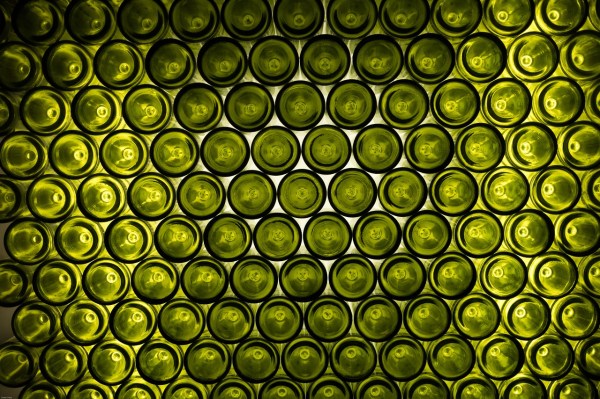
Monica picks up a wine bottle from the plastic carton and reads the label – ‘Chateau Saint Veran.’ She looks up at the house; bespoke window shutters, burglar alarm and double spiral Buxus topiaries by the front door. The beam from her mobile phone torch swathes the green glass in stark white light. Monica twists the bottle around to look for the tiny emblem of four arrows pointing anticlockwise around a circle on the bottom left side. Best to be certain that there’s a deposit, no point in carting the bottles around for nothing. The ten empty bottles of ‘Chateau Saint Veran’ chink party sounds against the others as she places them inside her box shaped ‘bag for life.’ Monica takes a pencil and her list out of the small pouch she carries around her middle and adds the house number to her notes on Rue des Tulipes: 23rd April 2020, number 22, ten bottles. For Monica, only harvests of ten and more deserve a mention.

Ten green bottles, Monica chuckles as she pads quietly up the street, opens the boot of her 1993 Ford Fiesta and places her pickings inside, taking care not to clatter the bottles. When the boot is full, she coasts the car twenty metres down the street in neutral. After all, Monica wouldn’t want to wake the neighbours.

It’s a dark but clear night, Venus and a full moon glow in the sky overhead. Monica takes an empty bag, closes the car door and scuttles across to number forty-three. When she sees the fox in the middle of the road she pauses; it freezes and stares. The fox is the size of a small dog. Their eyes lock. He loses interest and slopes off in the direction of the dustbins.

Monica pulls her silicone gloves up, tucks her mousy hair under her beanie and inspects the contents of the recycling box. ‘Macon Lugny,’ and ‘Pouilly Fumé,’ ‘Chablis Prestige 2018,’ – excellent taste and all bottled in Belgium by her favourite supermarket, meaning at least 30 cents deposit back each. She pushes the minor wine bottles aside or removes them to access the depths of the container. Eight bottles from number 44 clatter together in a chain reaction as Monica slots them inside her ‘bag for life.’ Number 52 is a beer drinker, Monica cannot abide that sort, it’s just not worth the effort, all those bottles for so little. She passes it over to rejoice at number 54’s over brimming recycling box; completes the bag and returns it to the car. She treads lightly in rubber soled sneakers. Her grey jacket and navy trousers are equally unobtrusive.

Yellow light suddenly spills out through the windowpanes. Monica blinks but the facade of the house is imprinted on her retina like a chess board. The curtain twitches. Monica scurries past.

Inside number 54, Claire hears the clinking of glass against glass. A light sleeper, her curiosity compels her to rush to the window and peek outside. Since her children left home and she retired from her teaching job, the outside world has taken on more than a passing interest. She sees a stranger pilfering from the recycling containers. The cheek of it. After observing for a few minutes, she realises that it’s a woman. There’s something strangely familiar about her gait. Poor thing, being driven to rummaging through others’ rubbish, she thinks. Wait. The woman is putting stuff into a Ford Fiesta loaded up with shopping bags. A car! Well really! Organised crime in Kraainem! Claire raps on the window.

A groaning noise breaks the silence,’ What are you doing?’ Claire’s husband mutters, ‘I’m trying to sleep.’ He turns over.

Smartphone in hand, Claire takes the stairs two at a time, grabs a coat, unbolts the front door and dashes out into the night. Thank goodness for those Zumba classes, she thinks. As the silver Ford Fiesta rolls past, Claire pushes the camera button, flash! Just in case, she takes a mental note of the registration plate: ‘SS0 203;’ and repeats the combination in her head until she grabs a pen in the hall and scribbles it on a stray car parking ticket.

Phew. So much effort, so early in the day. Claire sits at the dining table sipping filter coffee. She rubs her eyes and yawns. It’s one thing that a person in need is stealing bottles and claiming the deposits back, but in this case the act is pre-meditated and organised. That’s it, organised crime.

Meanwhile, in Rue des Roses, a block further on, Monica’s Ford Fiesta is packed to the roof with thirty-three bags each containing 12 bottles, plus the four extra loose bottles Monica picked up to round the figure up to 400. By Monica’s calculation, that makes 120 euros in deposit back. Some days she is tempted to carry on despite her lack of car space, hiding bottles in a ditch by the park to pick up later, but today she is tired and knows that the glass collection for the adjacent area is scheduled for tomorrow.

Back in the car, a flicker of headlights in the driving mirror causes Monica to sink low in her seat as a people carrier swishes past. Monica engages first gear and drives off, her face low on the steering wheel. She’s home in time for breakfast.

Inside number 54, Claire picks up the telephone and calls the local police station.

‘Hello, this is Claire Wrigley, of 54 Rue des Tulipes and I’d like to report a crime,’ she says.

‘Er… Hello Madam. What sort of crime are we talking about?’ The policeman replies.

‘At four o’clock this morning I saw a woman stealing bottles from the recycling bins on Rue des Tulipes.’

‘Bottles you say?’ comes the reply.

‘Yes. Are you taking note?’ Claire says.

‘Madame, technically speaking we’re not talking murder or aggravated violence in any form?

‘Well, no… but it’s theft, and I have the car registration number of the perpetrator,’ Claire interjects.

‘We’ll make a note and get back to you Mrs …. what did you say your name was?’ The policeman asks.

‘W-R-I-G-L-E-Y, 44 Rue des Tulipes,’ Claire’s dictation is interrupted by a dialling tone at the other end of the line.

‘Really!’ Claire slams the receiver down.

Claire lifts the calendar on the back of the kitchen door to check the recycling dates for the month of May. The next glass collection is Friday, 29th May. Five whole weeks away. Then she has an idea. On her laptop Claire consults the website of the waste disposal company. The glass pick-up day is Friday, 24th April for the neighbouring district of Wezembeek-Oppem – tomorrow.

Upon waking, Monica stretches her arms and legs out like a starfish, then sits up and shrugs her shoulders several times to loosen her joints. Out of habit she places her hand in the dent in the bed where Richard used to lie. Monica’s body aches from the constant bending down to place the bottles in the recycling machine of several supermarkets. Even now, the garage is so cluttered with bags and bottles that she leaves the car outside. One more mission this evening and then she can rest for a few weeks. Prior to leaving, she consults her notes and plans her trip, and fills the car with shopping bags.

Upon arrival in Wezembeek-Oppem, Monica parks at the top of Rue des Narcisses and starts at the odd numbers. Number 3 is prime real estate in deposit bottle terms; a strong, spicy ‘Saint Joseph 2019,’ – five times, followed by a full bodied ‘Saint Emilion,’ – tenfold. She doesn’t lock the car as she trudges up and down checking the plastic boxes and filling her bags. Monica places each bag of bottles in the car and walks from house to house checking boxes. As always, she gently lifts unwanted bottles out and places them on the pavement to be able to access any hidden treasures.

A car cruises past, its headlights shine full beam on Monica. She keeps her head down. As usual, Monica sets the car in neutral and allows it to roll further down the street. Suddenly a car cuts in front of Monica’s forcing her to slam her foot on the brake, she presses hard on the pedal, to no avail. She tries to steer away from impact, but the wheel won’t budge. It all happens in an instant. Monica’s Fiesta shunts into the Range Rover and comes to a halt. The sound of bottles rattling rings in Monica’s ears long after the car stops. She rubs her neck.

An urgent tap tapping on her window wakes Monica out of her trance. Due to the mist on the inside, she can’t see who it is and as the window is broken, she opens the door.

‘What do you think you’re doing?’ Monica steps out of the car.

‘I’m making a citizens’ arrest!’ Claire shouts.

Lights begin to flicker on and off in neighbouring houses, their glare filters out across the street illuminating both the women’s faces.

‘Claire?’ Monica says.

‘Monica?’ Claire says.

‘From Zumba?’ They both say at once.

‘Well I wouldn’t expect this from you?’ Claire says.

‘This? What is this?’ Monica looks up at Claire.

‘Stealing bottles from outside people’s homes.’ Claire prods Monica’s arm.

‘Well I wouldn’t expect you to pull in front of me like that, causing an accident!’ Monica replies.

‘We’ll see what the police have to say about it shall we?’ Claire pulls her smartphone out of her pocket.

A man’s voice cries out from a house, ‘Keep it down out there!’

‘It’s not what you think.’ Monica replies.

‘I know what it looks like.’ Claire looks down her nose at Monica.

‘Since Richard died my life has never been the same,’ Monica wipes a tear from her eye.

‘We all have our burdens to bear,’ Claire replies.

‘I collect the bottles with deposits that people can’t be bothered to return to the supermarket. Each bottle is worth 30 cents. It may not seem much but multiplied by hundreds every week…’ Monica says.

‘And bank the money no doubt!’ Claire says, starting to dial…

‘The money goes to the Belgian Cancer Foundation.’ Monica replies, ‘I can show you receipts.’

‘B-b-b-b….’ Claire stutters, ’I-I-I d-d-don’t know what to say.’ She touches Monica’s arm. ‘I’m sorry.’

‘Look, you weren’t to know.’ Monica, ‘It’s not something I shout from the rooftops.’

‘But your car,’ Claire says. Both women turn to look at the concertinaed bonnet of the Fiesta.

‘That’s why we have insurance,’ Monica reaches inside the car to retrieve the papers.

Monica suddenly finds herself enveloped in an awkward embrace, her arms stretch out by her body, the papers in her hand flutter in the breeze.

‘So sorry,’ Claire crushes Monica’s slight body to her.

One month later. Early morning on Friday 29th May, Claire parks the Range Rover at the top of rue des Tulipes, she hands a ‘bag for life’ to Monica and keeps one for herself.

‘You’ll do the odd numbers?’ Monica asks as she steps out of the car.

‘And I’ll do the evens,’ Claire laughs.

Belgium based writer Sheila Kinsella’s short stories draw inspiration from her Irish upbringing. An avid watcher of people’s behaviour, and blessed with abundant natural curiosity, Sheila lures the reader into a shrewdly observed world via imagery and comedy. Her work has appeared in The Blue Nib Literary Magazine and the Brussels Writers’ Circle anthology ‘Circle 19.’
Image via Pixabay

Cupcakes – Bill Merklee

Our neighborhood on East 59th Street was an urban backwater, a still pool off the main drag where everything and everybody swirled slow and lazy. As kids we hoped — no, we knew — one day we’d catch the current of Kennedy Boulevard and be swept away forever.

Sundays were the worst. Once noon mass let out most people got raptured away to their kitchens and living rooms or to some out-of-town relatives. Real ghost town outside. TV was dull after the Bowery Boys finished their routines. Whatever Mom cooked always involved boiling water that steamed up the windows. Made that apartment feel even smaller.

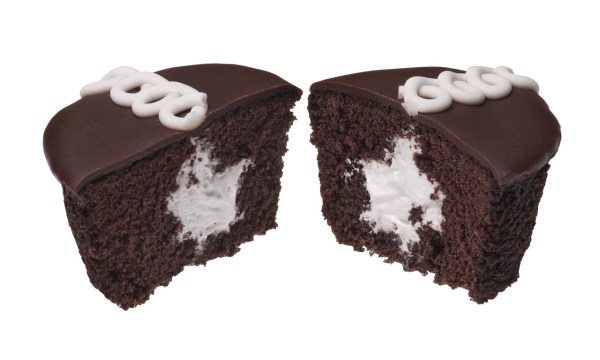
This Sunday was like every other one. The corner store was closed. Me and my friends Dwayne and Izzy stood at the glass door, coveting the Hostess cupcakes resting on wire racks just beyond the doorway. Cream-filled devil’s food delight with white swirls on top of chocolate icing, taunting us from the store’s dusty shadows. I was five, Dwayne and Izzy were six.

If we bust the window we could get some cupcakes, I said. Dwayne went round the side of the store to the gravel parking lot, came back with the corner of a cinder block and heaved it through the door. The glass shattered the day like a starting gun. Izzy was in and out and down the street before anyone else showed up. Dwayne stood there expecting thanks. I stepped back saying look what somebody did.

The dads paid for the door. I was still allowed in the place. But I never saw the other two after that. Some of us really did manage to get out of that neighborhood.

I heard Dwayne was somebody’s bag man when he got killed. Izzy’s probably in office or in jail. Me? I’ve always been an idea guy. I do all right.

Bill Merklee loves short stories, short films, and very short songs. His work has appeared in Flash Flood Journal, Ellipsis, Bending Genres, X-R-A-Y, Ghost Parachute, Gravel, Columbia, New Jersey Monthly, and the HIV Here & Now project. He lives in New Jersey. Occasional tweets @bmerklee.

Image via Pixabay
Once In A Lullaby – Chella Courington

Sarah always wanted to live in a world of color, not the ash-gray monotone of her home. But color costs. Color isn’t free. You have to earn it. Her mama died giving birth to Jacob, and Sarah had to become his mama. Her papa worked hard but lost most of what he made—trying to forget, to ease his loneliness.

Sarah had a way about her and could sense what people wanted. Nobody could barter like Sarah. She traded a white platter for a green blanket to cover Jacob, her mother’s ring for his blue jumper, even her wedding gown for Sarah’s tangerine dress that brightened her sallow world.

One Saturday Jacob was playing with the sock rabbit Sarah’d made, and she was sweeping the yard in front of their house. A stranger in a dark suit with shine on the jacket sleeves and dirt in the creases of his patent leather shoes walked up to Sarah, almost knocking her over. There was a glint of desperation in the old man’s rheumy eyes as if he’d hiked miles before stopping there. He carried two large buckets of paint and a short-handled brush. Plenty enough for the whole house.

“See this paint, it can turn your clapboard dwelling into a place where stars come out to get a view.”

Sarah smiled, imagining her walls bright as a summer orange and looked down at Jacob, pulling the rabbit’s button eyes. When she picked up Jacob, he grabbed her hair hard. She set him back down.

“Where’s your Papa?” the stranger asked.

“In town.” Most likely getting pissed, she thought.

“Your Mama?”

“Dead.”

“You tending the boy?”

‘He’s my brother.’

“I see you like tints by that dress you’re wearing,” he said. “I’m going to show you about color.”

“I’m not supposed to let strangers in,” she said.

“I don’t want an argument, but you will hate yourself if you don’t see what this paint can do.”

With his buckets and brush, he walked straight in and looked around the room, noticing the scattered pieces of green and blue. Sarah watched him search for a spot that would give him an advantage. He went to the board with the coat hooks and streaked it with his apricot paint. It looked as if the sun had settled indoors, laying its refracted glow on everything in sight—the wooden table, Jacob’s crib, her papa’s rocker, the shelves stuffed with ragged newspapers, even the pale face of Jesus staring at the ceiling.

“Want these buckets?” he asked.

“Do you see anything you want?” she replied.

“Make me an offer,” he snarled.

Sarah noticed the old man’s gnarly hands, cracked and calloused, and looked down at Jacob’s chubby arms like a baby angel she once saw in the Bible. His fingers soft and shiny. She trembled, suddenly aware that Jacob was her pot of gold.

Chella Courington is a writer and teacher whose poetry and fiction appear in numerous anthologies and journals including SmokeLong Quarterly, Potato Soup Journal, and X-R-A-Y Magazine. Her novella-in-flash, Adele and Tom: The Portrait of a Marriage (Breaking Rules Publishing), was featured recently at Vancouver Flash Fiction. Courington lives in California.

Image via Pixabay

Blown Away – Dan Brotzel

‘The judges were blown away by the quality of the submissions.’ Yeah, yeah. I have read quite a few summings-up by judges of short story competitions over the years, and invariably they go on about how they were astounded by the brilliance of the entries, how so many of the stories could have made the shortlist on a different day, how basically everyone deserved to win and coming up with the winner was an exquisite agony, darling.

Well not this time.

Your stories were all sadly very mediocre, and the only vaguely decent one basically picked itself in a matter of minutes.

The bar was embarrassingly low. Within a few minutes I’d managed to get rid of about 95% of your entries with a quick glance.

Not that I was quixotic or rash in my choices. I began, logically enough, by throwing out all the stories formatted in Ariel, Calibri or Garamond, which are all currently on my typeface shitlist (they know why). Next went stories formatted in less than 24 point. Despite the beat carnivalesque experimentalism of my own prose I’m not as young as I was, and forcing your judge to squint is just bad manners.

Stories with names in title case got whacked next because I mean, who are you, Samuel Pepys!? Then I remembered that I’d recently switched allegiance to title casing from sentence casing myself (it’s an age thing) but the story pile was going down nicely and I wasn’t going to go back and try and retrieve all those printouts from the roadside now. (I was driving overnight to a secret ayahuasca ceremony in Aldershot, so they could have gone anywhere.)

The next thing I did was to go though and identify the story by my ex-wife. It was a story about a bloke with a boil on his forehead who belched a lot, and ignored her dog, and stayed in bed half the weekend eating plain nachos, and wore the same red cardigan for weeks running till it stank. He had a birthmark on his left calf roughly the shape of Cyprus, and ended up (she claimed) in an old folks’ home taking pot shots from his balcony with an air rifle. It was called ‘Yes, Yes, This Story’s About You, You Stupid Sad Bastard’, or something like that.

So that one had to go, which was a shame in its way. I really liked that red cardigan.

Next I got rid of any story with animals in it. It is well known that the cats and their heathen brethren have already taken over the entire internet; these days, I can’t move on my timeline without coming across a video of an otter cosying up with an armadillo, or a pair of excited alpacas doing some moves that look oddly Latin. (Do. Not. Say. Llamabada.) Enough is enough, people! Animals suck. They steal our time and energy, when we could use that vital lifeforce to be out agitating for real political change – campaigning for free mouthwash, demanding an end to cordless dressing gowns, petitioning the powers-that-be for proper research into the mysteries of lucid snoring and all the rest.

I didn’t like any stories that referenced the weather either. It’s just a cliché. Ditto the sea. Ditto stories that began with the ‘The’ or ‘I’. It’s just too late in world history for that kind of shit, man. Read your Pope. Or get elected pope, I really don’t care. Your stories are still out.

I looked for a story by my other ex-wife though she’s not really much of a writer. There was one called ‘Cutting The Toxins Out Of My Life’, which did give me pause.

I also cut out all the stories with stupid or fancy language in. Words like albatross and flummox and frisson. Ditto plinth, helium and Albuquerque. Ditto ditto.

I also removed any stories that didn’t end in death because, really, what’s the point?

After all this critical winnowing and expert filtering, the only story left that was any good was one by this bloke called Donny Pretzel and it was about a man who arms himself with a 23” Sub-Automatic Pump Action Super Soaker Assault Water Pistol, which he fills with a base of tomato ketchup and garlic puree, laced after much experimentation with one part chilli spray to three parts Thai ginger paste, and he goes out and messes up every person who’s ever done him wrong. He gets to shoot them and they get to be covered in red stuff, but when he gets taken to court, the jury find him not guilty because he obviously has moral right on his side and he’s basically just such a charmer. And it was beautiful, it was like the Wild West but he didn’t kill anyone, maybe just got a bit of spice in a few eyes.

Donny, whoever you are, you’re an amazing writer and I know you’ll go far. Reading your story, I felt like I knew you already and you were writing just for me. You’re clearly a very sensitive guy whose been through so much but come out the other side with your talent and significant portions of body hair intact.

It’d be my honour to present this prize to you in person, Donny. So in the meantime I’ll hold on to the cash until you can make it over this way. Try and get here for a Thursday lunchtime if you can. It’s two for one at Pasta Lodge, and we can maybe go for a game of crazy golf afterwards and make an afternoon of it?

I think maybe we could be friends. I think maybe we could start one of those famous literary friendships that people make films about. I think I’d like that. I think maybe you could use a friend. I think I probably could.

Bring your piece if you’ve got one. I googled it in the library and feral pigeons are legal game, but it’s probably best not to try and cook one this time. Also we have to make sure the pellets don’t drop onto the petrol station forecourt next door as there have been a few complaints.

Image via Pixabay

Early Morning Finding – Ursula Troche

Nearly empty spaces
Manifest in the early morning
Reveal themselves and other things
To be found in place where you didn’t expect
To find things you might never have considered
To look for in the first place, or even the one that follows
The first place

Like urban railway stations
Which routinely echo
The fact of the city
Slightly, time-wise, before
It wakes up, as its daily introduction
And reveals itself to itself and its witnesses

Sometimes
We need silence, as well as early mornings
To notice things
And sometimes silence is used only
As a mistaken assumption
Because just as emptiness is not necessarily empty
Silence is not necessarily silent

There are spaces within silence that reveal a world
Of undercurrents, forgotten incantations, and even
Forgotten or denied spaces, beyond the ends of sentences
Behind a wish or within unconscious walls of negligence
Lingering lonely and sometimes dangerously
Lacking memory or courage to be recalled

Silence as absence of interference
Is a good starting point for thinking
But silence, as an alternative to speaking
Elongates distances and misunderstanding
Becoming a poor substitute for dialogue

Silence, when used instead of conversation
Emulates emptiness and thereby contracts
The bridging and breathing- spaces available to us
So I like to call out here, to speak these points
Where silence has not heard a word for some time.

Image by Ursula Troche

The Garden – S K Balstrup

In the sway of the valley was a paradise, a garden of pleasure not unlike the Garden of Earthly Delights. People lazed on the grass, and in coloured bathers dove into a gleaming pool. There was a thick feeling among us. The dull ache of the sublime. And we never did mind the guards who patrolled, because the grass was very green and the textures so divine.

I felt resistance sliding across the edge of my mind like a third eyelid. Secretly cleaning it of the drugs they gave, and when it was washed I would see, momentarily. I followed the cattle-line of comely, dew-skinned specimens as they trotted along in their patent shoes. By twos we approached the platform to feed. Lab-coated women watched us from all sides, peering over glasses as the queue of glazed eyed wanderers drew infinite patience from their complete lack of appetite.

For the first time I was aware of myself. I was conscious as I approached the platform and sat down to my meal. The drugs were conspicuous, and difficult to avoid. I ferreted copious amounts of powder into my pocket during the flicker of their blinks.

Dinner finishers completed their course in the brothel’s maze, and were encouraged to drink excessively so that the drugs could bloom all the wilder. I found a blonde girl in the corner in a patent leather mini, and seduced her into the back room in order to hide. Almost immediately after shutting ourselves in, a young man burst through the door to join us. It was then that I realised that he too was resisting. I showed him the drugs I had concealed and he nodded to the girl, who had started salivating at the sight of them. I hardly had a moment to think before she buried her face in my hands, consuming such a quantity of powder that her eyes turned ice blue, and she slumped down in the corner.

Occasionally, the guards came in, and the young guy and I had to pretend as if we were having a right old time with the girl on the floor. Somehow, he jimmied a panel out of the wall, and we were able to access the front corridor of the main compound. We remembered this later when we awoke on the grass, sleepy, and touching each other’s hair.

* * *

Again I found myself in the valley. It was a cornucopia of enjoyment–colourful bodies, blissful textures, and breezes honeyed by the blooming. I had never looked to the edge of the valley before, but now I could see a path. It was dirty, indistinct and had bristly shrubs along the way. No wonder our eyes had been repelled from such an unattractive section of the visual field. I crawled and shifted with great stealth! Without anyone noticing, I mounted the winding path, up and up, as it curled around.

A rattle-hiss startled me there, and under the shrubbery a strange spider was poised. Half my size he was–pink and red and yellow and black. His voice was green, and his venom was white. He told me in clicks and crackles (and psychic speech), that Mistress had founded the community below after she had forged a bargain with the Arachanarchons. They hunted once a year, injecting anaesthetising venom into their prey, so that the flesh was made softer and sweeter by the bliss they felt at death. Mistress allowed them to live in freedom in the dense bushland surrounding the valley, upon the condition that they surrender a quantity of their venom on a weekly basis, as a sort of tax.

My mind was so wide at this point, and the spider’s voice so verdant that I scarcely noticed the glint that swished past my ear. I turned, like an animal, my bloodshot eyes burning into the distance where my attackers hid. I couldn’t tell if I was visible or not, but I saw beside me what had darted close. Little tinks and thuds sounded as syringes clattered around me, shot from the guns of the guards. The great spider closed his lazy eyes, and curled into himself like a crab.

I grabbed a handful of syringes, for protection, and darted off into the scrub. It seemed that the guards were not inclined to follow, yet soon I found myself on the other extreme of the ridge, and had to climb down the rock-face in full view of two guards having a cigarette break. I acted as intoxicated as possible, telling them a wild tale about how I had chased a butterfly to the top of the mountain, only to chase it back down again!

They regarded at me strangely but then resumed their conversation, commenting that it was a fantastic day for a picnic. There was an expanse of long grass between the pool dwellers and me. I acted like something they might see–a downy rabbit perhaps. I tickled my whiskers on a dandelion and frolicked back into the flock.

In the water I was safe again, and in a dreamy state of mind I dove, gliding along the length of the pool like a smiling seal. It was under there in moments that were thick with time that I saw him again, and our eyes communicated our resistance.

* * *

I found myself next to him in the corridor with my heart beating fast. Infiltrators had entered the compound. They wore strange white helmets with ink tubes connecting their thoughts with their spine. The ingenious apparatus protected them from the dust that puffed like white flour into the darling sky. My mind kept folding itself like a gigantic map; fold and double and fold. With each crease my mind would skip, and with each spread of map, I would be aware of where I was. Their excited eyes implored us to follow, their weapons cocked in urgency. Mistress had scuttled to the rafters and they had her surrounded. Booms and squeals, clatters and tinks sounded in the distance.

We exited through a series of white tunnels, virgin to my eyes. A train carriage set on a near vertical railway awaited us, hoisting its limp and bedazzled cargo up and out of the valley. Kaleidoscopic spiders as large as unicycles fled in all directions, over hill and over dale. One came right for us! I grabbed a newspaper from an old man who had been reading it, rolled it up into a mean whacking stick, and pelted the arachnid with all my might. Down he fell like a squalling orchid, and I stumbled backward into my silent co-conspirator. Magenta fluid dripped from the paper as the headline caught my eye. “Spider Venom: the Secret Ingredient in Life Saving Vaccine.” We looked at each other and read on.

Although the words jumped backward and forward in the lines, flickering and inverting by turn, an impression of the article’s meaning reached our liquid consciousness. The world was a wasteland, and people’s souls were sinking to their ankles; their sagging life force easily discarded by a careless movement of the foot. They believed the Arachanarchons would bring about heaven on earth! Or at least a semblance of it.

I turned to the old man, who sat listlessly, staring at his empty hands. We could not really communicate. I grasped his face and held it up to my own attempting to make the shape of the spine helmets with my hands. His stare penetrated deep into my eyes, paying no heed to time. Then, he made a gruff face, formed fists and held his wrists together. I looked around me at the long legged beauties with sheening hair as they began to slump. It was an uncharacteristic posture. In horror I felt an intangible sweetness slip from my body as the grey metallic tang of the train carriage became apparent to my nostrils.

It was a coup–an eviction from paradise–to make room for others more powerful than us. To the one who had shared my desire for escape, I turned. “At least now I know my name. What is yours?”

S. K. Balstrup is the author of Spiritual Sensations: Cinematic Religious Experience and Evolving Conceptions of the Sacred (Bloomsbury: 2020) and holds a PhD in Religious Studies from The University of Sydney. After years of academic writing, creative works are slowly emerging from old boxes and drawers, the first of which have been published by The University of Sydney Press and Lunate.

Image via Pixabay

The Building – Leonie Rowland

The building with square windows is getting closer.

I have been suspicious of square windows since I measured the one in my bedroom and found the proportions to be inexact. When I told my flatmate, she said: yes, well, they are almost square. I said: we have a word for that.

I have wondered before whether the encroaching building might be a church. It has no spire or steeple, but when I look at it, I think: worship. I pass hours gazing into it and forget everything I am.

I saw someone at the window once. She was looking at me and nodding. The motion was slow and deep, like she was rocking her body back and forth. She rocked for a while, faster and faster, until she hit her head on the glass. Then, the window was empty again.

I have thought for a long time that the figure might be the one moving the building. I sensed it in the way the rocking seemed to happen outside of her. Recently, I have found myself rocking too.

The encroaching building has ivy growing up it. When my flatmate noticed, she squinted and said: that wasn’t there before. We watched the glossy leaves rustle for a time, and when she wanted to look some more, I took her to the window. We rocked together, slowly at first, then faster. The ivy was always there, blooming under the surface the way veins bloom under the skin.

After that, everything was still until New Year’s Eve. With no one to celebrate with, I stood in my bedroom and said: Happy New Year. In response, fireworks burst from the building, lighting up the windows like glistening eyes.

Get back with your rectangles, I wanted to shout. I’ve given you what you want.

Leonie Rowland has an MA in Gothic literature. Her writing has been published by Ad Hoc Fiction, Reflex Press and Horrified. She also has work forthcoming from Dreich, Emerge Literary Journal, TSS Publishing and BlueHouse Journal. You can find her on Twitter @leonie_rowland.

Image via Pixabay

I’m A Jerk And I Wear A Mask Because Screw You – Paul Ruta

I don’t wear a mask to protect you. Why not? Because screw you. I do it because me.

Don’t get me wrong. It’s great that everyone wears a mask now. Why? Smiling. I don’t have to look at all the goddamn smiling anymore. Before, I couldn’t walk down my own street without everybody smiling for no reason. Some old lady wants to get on the bus ahead of me. Fine, whatever. Then what does she do? Smiles at me. Screw you, grandma, just get on the goddamn bus and let’s go.

I’d go to a restaurant. I’d order a meal. What do they do? That’s right, they goddamn smile at me. Screw you, Trainee, just hand over my Whopper and fries then go screw off and find a mask.

Masks are good. Firemen wear masks. Awesome masks. Big goddamn masks for running into burning buildings to save puppies. I was going to be a fireman once — they begged me to join when they saw my bod — then something else came up. You’re not a fireman either, so just shut up.

One big reason I wear a mask is the ladies. They get one good look at this chiseled façade and the panties just drop to the floor. For an irresistible chunk of gent like me it’s best to cover up with a mask so I can get on with my goddamn business without getting constantly mobbed. Even a professional pussy wrangler can only take so much. It’s always been like that for me, so go screw your ugly self with a frozen broomstick.

I wear a mask because it’s badass. Badass dudes wear masks. Like those badass cowboys rustlin’ cattle and ridin’ into town with masks on and the womenfolk run off and hide in a cellar. Okay, they’re bandanas but same goddamn idea. Then they burst into a saloon and uncork whiskey bottles with their teeth and drink the whole goddamn thing. They take their masks off for that. Then they put them straight back on again and go rob a bank and shoot everybody because screw them.

Then there’s The Mask. You seen that? With Jim Carrey? It’s pretty goddamn out there. You don’t think so? Then go screw a goat.

I’d wear a mask on my Harley, if I had a Harley. And I wear a mask every time I stand near some bro’s Hog. Because I could take that Fat Boy out to Highway 50 and ride that ribbon of freedom into the wide Nevada sunset every goddamn day. No helmet, just a mask to keep the goddamn June bugs out of my teeth.

I wear a mask because I’m a man. A real man. As a real man, I smoke cigars. Big goddamn real cigars. After I spark up a stogie first thing in the morning, I put on a mask to keep that musky, real man aroma circulating all goddamn day. By 10:30 a.m. I’ve inhaled and exhaled so much oxygen-depleted personal man-stink that I start hallucinating like a technicolor lava lamp. I bet you want a slice of that heaven. But no, screw you.

Goalies wear masks. No, not soccer goalies, you goddamn Euro-pansy. I’m talking NHL.

Mostly I wear a mask all goddamn day to show my solidarity with the brave women and men who serve our great nation. Notice I said women first to prove I’m not a sexist. When you look at all the wars we won — Vietnam, Korea, that Gulf War country, and goddamn World War Two — one thing totally stands out. Masks. Our soldiers wear masks in trenches, masks on fighter jets, masks in tanks, masks jumping out of choppers, masks in the jungle and masks in the desert. Nothing says USA! USA! USA! real loud three times in a row quite like wearing a mask.

Because wearing a mask is wearing freedom. It’s goddamn America right there on your face.

Especially a mask with a stylish camouflage pattern or a patriotic Stars & Stripes motif, available in a range of convenient sizes.

And if you order now you can save 20% on a selection of combat compatible facewear to suit all your nationalistic needs. Visit http://www.goddamn-masks.com today and join the conversation on Facebook and Twitter.

Or go screw yourself, goddamn commie.

Paul Ruta is an old ad guy who lives in Hong Kong. He wrote a children’s book under the pen name Andy Spearman, published by Penguin Random House. He has talked baseball with Vidal Sassoon and has won a trophy for throwing a Frisbee very far. http://www.paulthomasruta.com

Photo by Bermix Studio on Unsplash

Weather Warning – N K Woods

Do you remember when tattoos were cool; when strangers shook hands and hook-ups happened; when women shaved their bodies and men pumped their guns; when reality stars ruled and virtual worlds beckoned; when commuting took hours and the school run was a thing; when the craving for likes trumped the need for affection; when summers were warm and hurricanes rare; when snow came in inches and the seaside existed?

No? Me neither.

But my grandmother does and she swears life wasn’t much better back then.

Wagging a finger, the one with the ring etched in ink, she tells me again. How the world is more pleasant with less people in it; how choice was a headache and the rat race a pain; how the young are so lucky, being born when we were, with dieting an ordeal we’ll never endure, ditto for jetlag, and surgery too; how fortunate we are to have missed the decade of plague, to have slept through the fighting, curled up in our cribs; how blessed we all are to have made it this far, to have lived through the storms that ended more than the war.

Then clearing her throat, she says that soon she’ll be gone. Tutting and sighing, she says not to fret, she’s told me everything so often there’s no chance I’ll forget. But she tells me again, just to be sure.

Keep your eyes on the heavens and your ear to the ground.

I nod and I knead and I mouth along with her lesson.

After fourteen years alone together, I know her spiel. There’s more to come; she’s not done yet. And on she goes. The sky and earth will guide me, she claims. Their language, I’m told for the thousandth time, only needs deciphering, like the poems we pour over when it’s too wild to go outside. But then she stops and instead of finishing in her usual way, with a rueful smile and the bit about greed, she shuffles closer to the fire and stares so intensely at the flames that I’m afraid she’ll fall in. Abandoning my ball of dough, I tug on her sleeve with my floury hand. Her lecture I can do without, but her voice I need. She hugs herself and delivers the ending in a whisper.

Stick to your own patch. Take care of it and it’ll take care of you. You’ve enough to get by. Trust me on that. And don’t get greedy.

I nod again and return to work, but then she whispers new lines that bring me back to the fire.

And pay attention to the world around you, especially to the weather. Because that’s how it starts, small changes first and then-

The rest of her sentence is lost to a fit. She coughs and she heaves and she struggles for breath. I settle her down and wait to hear more; but the pressure has dropped by the time she recovers so I listen instead to the wind.

N.K. Woods studied Creative Writing in the University of Edinburgh. Her work has appeared in Tales From the Forest, The Galway Review, Queen Mob’s Teahouse, The Honest Ulsterman, Flash Fiction Magazine and The Ogham Stone. She lives in Ireland.

Image via Pixabay

Bridling The Devil’s Coach Horse – Sinéad McClure

In the shadow of the mountains
there sleeps spectacular insects
one whip of their sharp sting
may ring your breath away

They hide in the turf
slip to the damp bottom
where they feel welcome
in the slick, wet, heat.
They creep without fear
on the wetter side of the Ox
A man from West Sligo
once told me they have been known to kill.
Beware the black wasp.

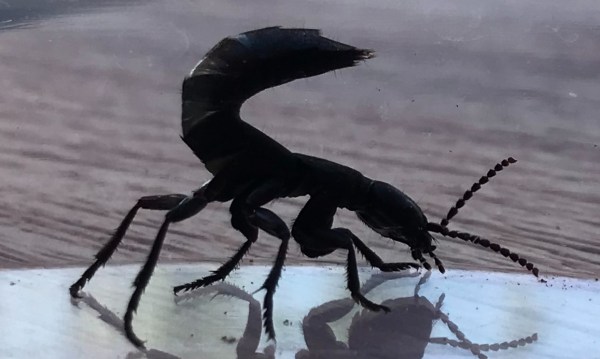
A long beetle with a switch of
scorpion tail that twitches upwards
towards disturbance.

Don’t step on it, one sting could finish you off!

The cry of a man whose child has the frog’s lick
and knows about these things;
That same man showed us how to cut Lee ridges for potatoes.
Taught us how to keep ducks safe.
Took us fishing for salmon after
storm had swelled the river
the catch weak from the spawn
bouncing into his watery path.

Brought us to the Fairy Fort
that circled the bottom of his land
raised his hand
quietly shushing,
so we could hear them.

So I moved to the drier side of the Ox
started burning coal instead of turf.

Sinéad McClure is a writer, radio producer, and illustrator. She has written and co-produced 15 dramas that have aired on RTEjr Radio. Her poetry and prose have appeared in Crossways Literary Magazine, Meat for Tea—The Valley Review, Live Encounters—Poetry & Writing, Poethead, and The Ekphrastic Review. She often revisits the theme of the natural environment in her work and has a particular interest in wildlife conservation.

Image By H.-P. Widmer – Own work, CC BY-SA 4.0

On The Year’s First Compost – Jacob Riyeff

the children open eyes wide
as grey winds billow thru the alley
finally they believe me that our food
becomes deep rich earth—
a transformation they would not accept
on faith.
the centipedes and earthworms rejoice
in my work
as I bucket up their troping of rebirth.
mulberries fall round about:
dark corpuscular rain. and I trowel
in the compost, feeding the mouths of corn,
tobacco, high balancing begonias
that dance like pink chandeliers in the draft.
A mama thrush sneaks in the maple
leaves above, kids scuttling
aswirl as I dig. one lone
squash blossom flashes out
in sudden relief, life from death—
shock of yellow on black of earth.

Image via Pixabay

First, Do No Harm… – Shannon Frost Greenstein

When I think back to my childhood – the earliest part of it, the part I once refused to think about – I still don’t quite understand how I could have gotten here. But at the same time, I recognize things could not possibly have transpired any differently.

It must be because something stops being trauma when it starts being motivation; and because the best way to avoid martyrdom is to stay alive.

*

It’s Match Day.

It’s the day medical students find out where their residencies will be, where their careers will begin, where they will make breakthroughs and witness medical miracles and accidentally kill patients and everything in between.

It is the culmination of 16 years of schooling, and it happens at every medical school in the country, all at the same time; thousands of doctors-to-be, opening a sacred envelope, discovering their futures and lamenting their failures.

I stand with my envelope, alone. All around me are my fellow students, surrounded by family, surrounded by friends, surrounded by the whole world, it seems. I am the calm eye amidst a hurricane of excitement in the room, the center of an orbit, my gravity warping space-time so everyone else is repelled around me into a vast radius.

It has been this way since the first foster home.

It was this way through all of public school, to be honest, and private university, and my top-tier medical school as well. I am a perpetual outcast; I am a pariah. I’ve been alone most of my life, but I have not been lonely. I have, instead, been working towards this, towards this exact moment, towards my destiny.

I know exactly when I decided to be a doctor. It happened in a split-second, in one of those life-changing moments that stick with you and subconsciously guide your every action, evolution disguised as instinct disguised as survival.

I will never forget it. I was a little girl, and I was watching my mother overdose.

*

I know how dramatic that sounds, but it’s not hyperbole. It’s also not what you think. Watching someone overdose isn’t like Pulp Fiction, and it’s not like 8th grade health class would have you believe, either. It’s quiet; deceptively sweet, like the poppies in The Wizard of Oz beckoning Dorothy to lie down and rest.

I was little, like I said, and I shouldn’t remember this, but I do.

I watched her for a bit, lying there, not moving. I think my prepubescent brain expected something to happen, the next link in a logical chain of events, but what I didn’t realize was that her chain was ending. I didn’t realize that the only thing standing between me and that inevitability was a Savior.

I sat there as precious moments ticked away, waiting for her to get up, or die, or seize or vomit or scream or anything. Instead, she just…slept.

The rest of that day is a flurry of motion in my memory: the landlord’s frantic steps when I finally called to say she wouldn’t wake up; police cars pulling up in front of our apartment; the EMTs bustling around our tiny living room, administering Narcan, doing CPR, loading my still-inexplicably-alive-mother into the maw of an ambulance.

There was a social worker, kind but aloof, desensitized to the trauma she glimpsed every day. She was the first in a long line of state-sponsored adults who would decide my life away as the years passed. There were more police officers, asking questions, demanding answers, pumping me full of soda and nervous energy.

Surprisingly, my mother didn’t lose custody; not that day, anyway. The above scenario would repeat more than once before the government decided to take me from the only home I had ever known. It was dysfunctional and depraved, sure, but it was also still my home. Leaving it for an endless string of foster placements was nothing short of life-shattering.

*

What really sticks with me about that day was the belief I had, the certainty which only a child can hold, that life would get better. I remember my conviction that my mother would wake up, that she would recover, that someone would fix everything and give me a future.

Of course, that didn’t – and doesn’t – happen.

Things got steadily worse, and no one came along to give me a future. The next decade-and-a-half was as terrible as you would expect a childhood spent in the foster system to be; but that isn’t what led to my current Hippocratic quest. My calling to medicine did not come from the horror of my youth – except maybe as a grain of sand irritates the oyster until a pearl is finally formed. What my journey did accomplish was to birth my need to rise above the hidden curse in my DNA, the genetic component of addiction that I knew – even in adolescence – would be a risk for me. You see, I could never abide being just another orphan of the opioid epidemic. I have refused, my entire life, to be an academic statistic or a cautionary tale.

I have, instead, always been determined to matter.

*

What I mean to say is, the day my mother overdosed, the day I decided to become a doctor, I witnessed a miracle. While it may only have prolonged what I now understand was never meant to be, Western Medicine managed, in front of my eyes, to bring my mother back to life.

Through a tiny window in an ER hallway, I watched the attending physician administer volts of electricity to her temporarily-stopped heart, and I made a decision: I was going to be a doctor, too. Someday, I was going to provide that hope for a little girl in the future, one who also might believe things would improve, if she just wished hard enough.

That stuck with me through the system, through all my schooling. I learned that the only person who was going to give me a future was me; I learned that no one can fix an addict but themselves. And I learned the art of healing, the art of saving a life. I learned how to keep a child’s mother breathing long enough for things, just maybe, to finally turn around.

Because that’s all I ever wanted, the whole time.

Things never did turn around for me – so I turned them around myself. And I am becoming, if you’ll forgive my hubris, one hell of a doctor.

*

Around me, the noise level is nearly unbearable, excitement wafting through the air like smoke, and now the whole room is counting down; counting down to the moment when it has either all been worth it or all been in vain, when that for which you’ve worked so hard will either come to fruition or leave you desperately wanting.

I stare at the envelope, trying to will its contents directly into my brain by osmosis. Even as I watch the large digital clock mounted on the wall, red seconds ticking away the last moments of my youth, I am terrified for the countdown to reach zero. If it WAS all in vain – if all of my work, all of my dedication, all of my soul I’ve poured into this endeavor was for naught – then I haven’t just let myself down. I have let down all the little girls I could have helped down the road, all the parents I could have saved. My years of training would be a meaningless sacrifice, the martyrdom of my childhood without any of the perks of sainthood or fame.

A few seconds left, and I can see all the students around me poised to rip open their envelopes; shoulders raised, fingers tense, looks ranging from exhilaration to apprehension to abject fear. I allow myself, for the briefest of moments, to think about the very slim possibility that the envelope in my hand contains precisely the news for which I’ve been hoping.

The countdown reaches the end, and there is a pause, a second of inaction, like the entire room is not convinced of the validity of the number zero. Then, as if choreographed, there is a frantic burst of energy as hundreds of burgeoning doctors rip away paper to reveal their paths.

Shouts, exaltations, swear words and wails echo from the walls, but I swear I can even hear the silence from individuals whose envelopes contain disappointment. I feel a flash of sympathy; as someone who has been let down so many times, I’m well acquainted with that particular emotion.

Still, I haven’t opened mine, because it’s not like there’s anyone waiting to see what’s inside. A murmur in my head, the voice of my inner monologue, whispers a prayer to a deity in whom I stopped believing long ago.

Please, it begs, let it be U Penn. Please, so it wasn’t all a waste, let it be U Penn.

I take one more moment to wish, with all of my being, and tear into the envelope. I discard it and unfold the paper inside, neat business creases dividing the document into perfect thirds as if it’s normal correspondence, as if it isn’t the most important piece of paper I’ll ever read in my life.

My eyes anxiously dance over the letterhead, the date, the addresses, the electronic signature, searching out the words I’m so hoping to see.

2021 MATCH RESULTS

School Code: 2310089

Applicant Name: Hannah Reynolds

CONGRATULATIONS, YOU HAVE MATCHED!

Program Code: 170354

Program Name: Cardiac & Thoracic Surgery

Institution Name: Hospital of the University of Pennsylvania

I blink unbelievingly, in awe at what I am seeing. I hear my inner monologue again, a resonant soprano that chatters constantly in my brain, that I always try to ignore, that holds the cumulative power of a lifetime of trauma.

You know what this means, right?

I do.

Revenge.

*

You didn’t think it was altruism, did you?

Oh, you did. That’s so cute.

My calling has been to medicine, yes. My goal is to sanctify life, to save it, to keep mothers and fathers and sister and teachers among the land of the living, sure. That’s what I’ve always wanted.

But, at the end of the day, we are all human. And what is more human than an innate need for justice?

We live in a meritocracy, you see, and I realized at a very young age that nothing commands more respect than a physician. People will see the letters after my name – people will see my alma mater on my curriculum vitae – and they will listen to me. They will trust me. They will believe what I say, and believe I have the purest of intentions in saying it.

No one will remember, however, that Philadelphia’s Department of Human Services ruined my life. No one will remember how they took me away before things could get better, how the social workers and police and judges and foster mothers were a collective force to endure, a Sisyphean boulder on my back as I struggled to grow, to live.

But I remember.

I remember bureaucracy, taking everything from me; I remember impotence, feeling dehumanized by the system. Most of all, I remember helplessness, my omnipresent childhood companion. Now, however – as a U Penn-trained doctor, as a pillar of the community, as the American Dream made incarnate – I will finally have what I never had before.

I will finally have power.

I will have power because knowledge is power. But power corrupts like opioids corrupt like the foster system corrupts, so is it really any wonder that I plan to wield my M.D. like a weapon – my education a switchblade in the scabbard of my mind – for payback, first and foremost?

Growing up in this city of Brotherly Love, I was screwed by both nature and nurture. But now – I will finally be taking my vengeance for both.

Shannon Frost Greenstein is the author of “More.”, a forthcoming poetry collection from Wild Pressed Books. She is a Pushcart Prize nominee, a Contributing Editor for Barren Magazine, and a former Ph.D. candidate in Continental Philosophy. Follow her at shannonfrostgreenstein.com or on Twitter at @mrsgreenstein.

Image via Pixabay

A Portrait of the Artist as a Young Mango – Tim Warren

It was a brief spell in his life, one of which most people are none the wiser, one that passed largely without incident. That is if any period of time in which one lives as a mango can be described as passing largely without incident. In truth, it can’t. Not that Kermit Lansbury can be persuaded:

“No, it passed largely without incident,” he told me once, quite firmly. It was September 1977, the first time I’d heard about it — this Mango Period. I tried to argue, but each time my mouth opened so did his: “Nuh-uh,” he would say, raising an eyebrow and a forbidding finger, that mischievous gleam in his eye. But on this occasion, as has so often proved the way, argument would get me nowhere.

Kermit Lansbury, even back in ’77, was already a highly regarded artist — in fact, perhaps you recognised the name? At the very least you’d probably know some of his more famous works: Untitled #111; Untitled #40; and perhaps his best work yet Untitled #86. Or perhaps you would if he’d given them proper titles. Or even created them; at least in the conventional sense. You see, Kermit’s reputation has been founded on taking abstract conceptual art to audacious and previously unimagined new levels (new depths, say his critics): his works exist only in his imagination; only as concepts. As he puts it:

“To make the concept concrete is merely to make concrete. And what fun is concrete?”

It goes almost without saying, then, that his works are quite unusually brilliant. Indeed, Kermit himself has assured me of their brilliance on many an occasion.

“Oh, they’re brilliant!” he always tells me, rolling his eyes in apparent rapture. I wish I could somehow walk around that internal, mental gallery of yours, I tell him — that everyone could. “But that’s just it,” he enthuses, all expansive hand gestures and wide animated eyes. “There is no need. Of course my works could not possibly be more personal, yet what could be more universal than subjectivity? We all have that in common. The simultaneously personal and universal — a beautiful paradox! Already they are somewhere inside of you. Inside of everyone. People need only look!”

Nonetheless, I did once ask him: if your works are just lying around inside of everyone, waiting to be found, then what makes you so special? “Me? I just found them first!” he laughed. Perhaps, that is something that all great artists can say of their works?

But to anyone unfamiliar with the world of Kermit Lansbury no doubt this all sounds much like the Emperor and his new clothes, and his claims to have lived as a mango perhaps no more than a cultivated eccentricity. Let me describe, then, one of the pieces he once described to me; it is not something he is in the habit of doing, and took much persuasion on my part, but I’m sure he will forgive me — after all, it has already been exhibited all around the world. The piece in question is very simple, and like all Kermit’s work unnamed: it consists only of a huge black expanse and in the bottom right-hand corner a tiny white dot. It is in the interpretation that complexity arises:

“To you, a pessimist,” he told me, “it will mean optimism, perhaps, this dot. And from moment to moment you will see a different dot: smaller, larger, in a different position, maybe even sometimes no dot, according to your mood. Everyone will see it differently. Me, I see a negative of the image — I call the dot Pessimism. But, of course, I am blessed with innate optimism. Someone else may call the image Solitude; another, Hope. How to name it, then? It is much that way with all my work.”

How to name it, indeed? But even more so, as we have already touched on, how to render it? How to render any of his works? Ever changing, endlessly interpretable, so personal as to be universal: the only possible medium, the only possible gallery space for Kermit’s works, indeed the only place that would not rob them of their essential subjectivity is certainly in his head; and at the same time, perhaps, in all our heads. To commit such works to canvas would not only compromise them, it would be impossible.

Exhibiting Kermit Lansbury, needless to say, is not without its challenges.

The stunned face of the girl who first opened a gallery to Kermit’s works was itself a picture. After many weeks of assuring her not to worry, that everything would arrive in time, just go ahead with the invites, he had turned up just an hour before the opening entirely empty-handed. “But where are they?” she had asked. “Your works? We can’t open to an empty gallery!”

“Why not? It’s a perfectly lovely gallery. All the more so for the lack of clutter,” he had deadpanned. The poor woman was frantic. It was her first exhibition. A young heiress, at this stage merely dabbling in the arts, Portia Teversham had never owned a gallery before. Which is not to say that she wasn’t taking the whole thing entirely seriously.

“We have press coming! We can’t— “

“For an unknown? You have done me a great service.”

“But— “

“Don’t worry. I’m here. That’s all you need. Every one of my pieces, even some I have yet to create — they are all here,” he had smiled, tapping his temple. I remember her just staring at the madman, open-mouthed. “I was once a mango, you know,” he had then whispered in her ear, as she would tell me many years later. I don’t think he could resist.

It is to her eternal credit, then, that she finally went ahead with the event. Kermit had, of course, talked her round:

“If beauty is in the eye of the beholder, then let them come and behold beauty. What need have they of artworks? Interpretation too. Is that not the critical thing? If that is of their own making — the public, the critics — then my work need not be involved.

“Don’t misunderstand me, there are, of course, artworks in my mind, many of them — I have spent countless hours over each — but how can I render them as I see them? Only in my mind are they as I see them. The instant they leave my mind they have failed. Were I instead to describe them it would be just the same.

“Nevertheless, they are undoubtedly worthy of exhibition. And so, here we are. I have my twenty works and each of the audience will be asked to leave with their twenty interpretations. Would that not also be the case if my works had simply been placed on the walls? When you think about it, where is the problem?” The poor girl hadn’t been sure, although she’d been quite sure that there was one.

But it was too late, by now — and not just to cancel the show — she had fallen for him…

More or less the same speech Kermit later gave to the assembled press and public. Some critics enthused wildly, if inaccurately, about the event as “a profound and unique comment on the impossibility of Art.” Others decried Kermit as a “charlatan” pulling a “cheap stunt.” While others were merely curious to see what he might do next. The reviews of that first show, it’s safe to say, were decidedly mixed. But there was one in particular that pleased him enormously:

“The images I saw ranged from the oddly comforting and vaguely pastoral, to ones so perverted and disturbing I can’t even begin to relate them. Whether these in fact corresponded in any way whatsoever to those that Lansbury had brought to the gallery, I have no idea. But, why not? Kermit Lansbury’s images are subjective, as were mine. And what do we all have in common? Our subjectivity. Thus, as subjective images are they not somehow universal? Frankly, I don’t know, and it’s making my head hurt. But that’s no reason to suppose that tonight I didn’t meet a genius.” It was nice, Kermit told me, that at least one person had understood.

It might seem odd to think nowadays, when Lansburys quite regularly change hands for hundreds of thousands, but Kermit was unable to sell a single piece at that first show. But bear in mind, back then his particular brand of conceptual art was unheard of; much less, widely understood. Collectors were baffled. Not that it’s ever been unusual for an audience not to be able to touch great works of art — museum guards are generally quite insistent on it — but in 1969, not even to be able to see what you were buying, it was unprecedented.

How times have changed!

We have Kermit to thank, of course. For it was he who first pointed out the obvious: many art collections already go unseen, gracing only the bank vaults of the rich. To these people, that they will never see what they have purchased is — aptly enough where Kermit’s work is concerned — entirely immaterial: all that matters is ownership; investment. To Kermit, then, his works may as well remain in his head.

Of course, widespread acceptance that a Lansbury might be no more than a deed of ownership was, as you’ll imagine, far from instantaneous. So it was perhaps a great fortune that a certain young heiress fell for my dear friend when she did (but in the career of which successful artist has luck not played a hand).

Within months of meeting, the pair had announced their engagement, unveiling to some of the richest people in Britain what may still be Kermit’s most stunning creation, even surpassing Untitled #86: Portia’s engagement ring. Quite unique, and near impossible to copy, its transparent magnificence — as you’ll doubtless imagine — left all in attendance breathless. Soon, a Lansbury was near impossible to obtain. Yes, it was a very happy union, in so many ways.

Granted, not a marriage without its difficulties — Kermit’s frequent alcoholic excesses down the years are well documented, and thus not recounted here; ditto the incident with the sturgeon and the dentist — but neither he nor Portia have regrets, and even as Kermit’s life sadly now nears its end, their devotion to each other remains as simple and tender a portrait of love as you could ever hope to see.

Yet, even in death — and may its scythe turn rusty — old Kermit will blaze a unique and distinctive trail: as perhaps the only artist who has ever taken his each and every work to the grave (how this will affect the collectors market, goodness only knows). But I say ‘perhaps’, for here a contradiction lies: are Kermit’s works not, as he has so often suggested, just waiting to be found in all our heads?

To Kermit there is no problem here, of course, nor with any contradiction: “So both things are true,” he will always shrug. “What can I say? I didn’t create the world!”

True — but he did make it that bit more interesting.

But let us return to the beginning now, and that little documented period before his great artistic success. I recently asked him again — had it informed his work?

“How could it?” he replied. “I was a mango! I was not conscious. My work has thus been informed entirely by not being a mango.” As he was of course aware, that wasn’t really what I wanted to know. He sighed. “People buy things that exist only in my head, yet that they have problems with? OK, I will tell you what happened when I was a mango.” What? I asked, thinking finally I might get to the bottom of it. “Nothing,” he laughed, “I was a mango, of course!”

Like I said, sometimes there’s just no arguing.

Tim Warren is a writer of mostly very short things. His microfictions and flash can be found most recently in Serious Flash Fiction Anthology: Vols. 5 & 6, Paragraph Planet, Overheard, Pendemic and the VSS365 Anthology. The rest you can find on Twitter. He lives in Cornwall, UK.

Image via Pixabay

The Day After Independence Day – Thomas Elson

In the days before air conditioning when oscillating fans provided fleeting relief, and winter chills were waylaid by Franklin stoves placed in the kitchen near the stairway to warm upstairs bedrooms, Aunt Josephine, a large, smiling, accommodating woman, the first born of a family of five, stood in the town’s only grocery story with her younger sister and nephew staring at a cold, blue tube almost six inches long.

Their husbands remained in the 1953 Plymouth. “Hell, one grocery store is just like any other.”

*

They had risen at four thirty, and, while the men milked, the two women stoked the stove, visited the outhouse, prepped the Windsor oven, gathered eggs, pulled a slab of ham, sliced it, returned the remainder to the aging room, hauled milk from the milk barn, worked the small hand pump attached to a pipe that ran from the windmill into the kitchen, started the Coleman coffee percolator, laid out the men’s breakfast of ham, sausage, scrambled eggs, homemade biscuits, bread baked the day before, newly-churned butter, milk as fresh as that morning’s sun, remembered to bring the butter and jelly to the table, ate while standing, washed and dried the dishes, placed a towel over the glasses in the rack, swept the floor, rushed to the outhouse one more time, then changed into hand-sewn flour sack dresses, nylons, and the same type of shoes their grandmother wore, came downstairs, and loaded the car with the necessities for a pre-McDonald’s day trip. As long as they returned by six that evening they’d be okay. “Cows don’t milk themselves.”

*

In the refrigerated grocery store aisle. Aunt Josephine, holding the six-inch blue tube, said to her younger sister, “Pauline, look at this. What do you think?”

“It’s only ten cents.”

“For a dime I could buy-“

“Look.” She handed the cold blue tube to her younger sister.

“Just put em in the oven and in less than twenty minutes- Jeez.”

“Come over here.” Her younger sister motioned toward the frozen food section.

“What are those?”

“T.V. dinners.”

Aunt Josephine touched the rectangular package of frozen chicken, peas, a dollop of mashed potatoes, and four apple slices.

“Why?” She placed the package back in the freezer and returned to reexamine the blue tube.

*

Back home that evening, they served supper with the blue tube biscuits, said nothing, but planned to return to that grocery store. After all, cake mixes were a dime too.

Thomas Elson’s short stories, poetry, and flash fiction have been published in numerous venues such as Calliope, Pinyon, Lunaris, New Ulster, Lampeter, Selkie, Pennsylvania Literary Journal, and Adelaide Literary Magazine. He divides his time between Northern California and Western Kansas.

Image via Pixabay

Walking with Stanislavski – Mike Hickman

On the first day of the course, the tutor told us to do a Stanislavski.

This was after he’d given his movie credits. A couple of bawdy British “Confessions” movies and the film that finally killed off the British horror industry. And he seemed proud of it and I was fucking awed by him with his jumper tied round his shoulders and his indoor sunglasses and his perfect teeth. I was fucking awed by his Certainty in Himself.

And then, ten minutes into the ‘lecture’, he told us to do a Stanislavski.

Which is how I found myself out on the town with the shoppers and the baby buggies and the druggies and the meths heads and the oldies, and I thought this was going to be It. This was how we were going to Learn. This was going to change my life.

I listened to a bald bloke talking to his mate on the blower about needing a “hundred Thatchers” for something and I fell into step behind him. I imitated his walk a bit – the strut and the constricted swing of the balls in the too-tight jeans – and I wondered if I could dare try to drum up conversation with him. Just ask him the time, perhaps, but in the lingo, with the old dog and pears and whatever else I could remember from the TV. ‘cos how would he know? He wouldn’t know I’d just started at the not-quite-a-University. He wouldn’t know I was an acting student.

Apart from the long coat and the scarf and the badges, that is, but I’d turned the lapels up and out and I’d adopted the walk and I could do it, I could do it, I could do it.

The bald bloke disappeared into Ladbrokes and I was left loitering around the bus station with the dirty macs and the blue rinses and the drivers with their ghee-greased DAs. That was still good, though. That was what Peter director man had suggested we do. So I sat there on a bench for half an hour, maybe an hour, and I turned my collar up further and I adopted the posture of the ardent fag smoker, although I put the biro away after attracting more than a few funny looks. Which should have been fine. Because there were plenty like that where I’d come from. Before today. Before I’d been packed off on the train to the digs and the Uni with a six pack of crisps and the single saucepan that my mother had been able to spare.

There were plenty of the lost and alone to be seen in the town centre back home. They were in their own worlds, too. How difficult could it be? Even without the White Lightning cider and the dog on a string.

The hour passed. It might well have started to rain.

When we got back to the lecture theatre, and after Peter had got off the phone to his agent to check that, once again, the film industry had no use for him, I got to hear of some of the others’ exploits. The big girl from Stoke had gone into a gay bar at 10 in the morning and had a right old time of it playing pontoon with a couple of geezers who she swore blind were wearing chaps. The self-conscious skateboarder had found himself down by the river and fed the swans whilst reciting Keats at passers-by. And a goodly quantity of the rest of the cohort had been down to HMV for the sales.

What had we learned from this, Peter wanted to know? Putting ourselves into the shoes of others. Being out there and Taking On A Part. What had we learned about the craft of being an Actor?

And this might have been the first inkling of the first hint of the first chink in the armour of this course and its pseudo-intellectual, anti-intellectual bunch of tutor poseurs who would rather have been propping up the bar in the Ivy than speaking to unwashed poxy students like us.

Because he’d thought it was a learning experience.

I’d sat there for an hour. Maybe two.

He’d thought we’d have “got something” from Being Other People.

Which meant he’d thought we knew who the hell we were.

But what really hit me, as he let us talk and he looked at his watch and he waited to scoot us out of the seats so he could get back to exercising his own seat, was the thought that should have occurred to me from the first.

Maybe the ones who’d been to HMV had known. Or had known that it wasn’t worth the knowing.

It was Day 1 of the course. And maybe some of us knew who we were well enough to have a punt at being someone else of a drizzly Monday morning, but he sure as hell hadn’t told us who the fuck Stanivlaski was.

Mike Hickman (@MikeHic13940507) is a writer from York, England. He has written for Off the Rock Productions, the Blake-Jones Review, Bitchin’ Kitsch, Bandit Fiction, Brown Bag and the Trouvaille Review.

Image via Pixabay

Someone Else’s Cat – Caitlin Buxbaum

You came to the door
like it was the last one on earth,
huddled on the welcome mat
in the single-digit snow
like your life depended on it.

When we opened our home to you,
you hurried in and
made yourself comfortable,
like you belonged.

We let you out, but you came
right back, and we couldn’t say no
in the face of your enthusiasm,
only closed the bedroom door
by sheer force of will, waking
to your laundry room cries
like new parents.

In the morning, nothing worse for wear,
we fed you and pondered our next move.
As you cozied up to us, we became
familiar, our bond fragile in the face
of some premonition of entropy
spurred by a shadowy betrayal.

To put ourselves at ease, I say,
it’s just someone else’s cat.

Image via Pixabay

Anáil na Beatha (Breath of Life) – Sheila Scott

Rashmi leaned into the thick perspex of the tunnel, her body bending to its curve. Outside the wind tugged at the grass and tore it horizontally. She longed to be that grass.

Everyone else she knew had moved on. They had learned to live with this new life, like hamsters in plastic tube houses or rats in a laboratory maze, but she couldn’t let go.

A loose slate on the building opposite shook free and clattered off the top of the enclosed walkway. No-one batted an eyelid. Finally, a voice broke her reverie.

‘There you are!’

Rashmi turned towards her sister. Eloise was standing, hands on hips and head tilted to one side, a pose familiar to Rashmi from earliest memory.

‘I’ve been waiting an absolute age. Eventually gave up our table and came looking for you.’ She tugged at Rashmi’s arm. ‘I should’ve known you’d be wind watching again. Come on, I’m starving.’

Rashmi trailed after her sister down the long winding tunnel towards the mall. Outside, a bird was careening towards the left wall, its wings scattered and useless and its beak open in impotent protest. Eloise glanced over as Rashmi’s eyes followed its final path. A smear of feather dust decorated the exterior for a matter of seconds before the currents lifted and carried the particles clear. No trace remained.

‘Dunno how those beggars still get out there.’ Eloise rapped her knuckles on the perspex. ‘Just as well it’s made of sturdy stuff.’

Rashmi had stopped again.

‘Jesus wummin!’ Eloise pulled again at her sister’s sleeve and hauled her towards the colourful noise of the food court.

‘Don’t you ever miss it?’ They had placed their order and Rashmi was circling her glass of soda and lime round its damp outline on the paper tablecloth.

‘Hmm?’

‘The wind. Don’t you ever miss standing at the seaside, the salt air blowing your head clear of thoughts. Or breezes cooling the sun on your bare skin in summer?’

Eloise lifted one of the laminated menus from its holder and used it to fan herself.

‘You live in the past Rashmi. Do I miss spending an hour getting ready then within seconds of stepping outside having the style ripped out my hair and my make-up smeared by streaming eyes? Do I miss dodging airborne litter and flying debris? Do I miss projectile bird-shit on good outfits?’ She set the menu on the table and looked her sister in the eye. ‘What do you think?

‘Trouble is, your memories are rose-tinted.’

‘At least we were…connected.’

Eloise’s waved hand took in the perspex warren beyond the food court. ‘How much more connected could we be?’

‘Not that kind of…’

‘Chicken pesto panini?’ The waiter dropped the plate on the table without waiting for a response.

‘That’ll be m…’

‘And brie and cranberry on wholemeal.’ He deposited the second dish and left. The sisters swapped plates.

‘So, Mum rang last night…’ Eloise barely broke for breath, a mouthful of food pouched in her cheek. Rashmi took a sip of her soda and resigned herself to another lunch with her sister.

The foreman looked pointedly at his watch as Rashmi returned to her station at the depot.

‘I’ll make it up at the end of the day.’ She made a face at his retreating back.

In the changing room, she opened her locker and retrieved her uniform. As she pulled the overalls up over her boots and slid her arms into the sleeves, she stared at the photo taped to the inside of the door: two sisters in matching bathing costumes, knee deep in waves that stretched all the way back to the sky. They were grinning as the breeze tangled their salt-straggled bobs.

‘Rose tinted.’ She shoved the locker shut and pocketed her key-card.

Pete was standing by the truck, stabbing a finger at one of the hand-held devices as she approached.

‘Thought you were a no-show.’

‘Sister. Lunch. Phone call from Mum.’ She stuck out a hand for the device.

‘Lucky we got you back at all then.’ He patted the cab. ‘Loaders are done. It’s all yours.’

‘Cheers Pete.’ She clambered up the three metal bars on the side of the wagon and settled into the driver’s seat. One of the depot floor runners heaved the door closed behind her, its hefty locking mechanism slamming into place with a resounding clunk. She set the device into its port on the dashboard and considered today’s route.

‘Ya beauty. Coast here I come.’ Rashmi slid the key-card into the ignition slot and mock saluted Pete through the cabin window as the truck roared into life and began gliding along the iron track towards the exit. The siren howled throughout the depot and the floor runners retreated to their kiosks before the great doors slid open to the howling winds.

She had been ecstatic when she finally secured a transit post; this was as close as you could get to being outside on your own since the great winds began. Once on the open rail, she clipped her music box in place and voice-selected a favourite indie band. The cabin filled with the sound of twanging guitars and a decent gruff melody, and she smiled as Eloise’s accusation of her living in the past resurfaced.

‘Stuff it.’ She rattled the gear stick to the beat and sang along with gusto. The journey ahead would take her through the beautiful rolling hills of Kenville County and terminate at the pristine coastline of West Brand, previously a popular seaside resort.

The immense bulk of the truck thrummed along the monorail network requiring only the occasional input on the gear stick or brake from its driver. Cities and towns came and went. In the gaps between lay open landscapes, the blasted scrub narrating the prevailing wind direction. Occasionally, she caught glimpses of the coast: sand bulked in the far end of its curves and rocks undercut by waves thrown out by forceful currents.

Rashmi remembered the freedom of childhood summers. Wind breaks and parasols were secured with the simple heft of her father’s hand. You could build sandcastles that lasted until the careless step of a stranger caved the ramparts. You could sit on a towel with the breeze lifting your hair from shoulders sticky with sunblock. When you got bored, you could run with abandon into the rippling cool of a welcoming sea. The level surface would take your weight gladly and, as it gently lifted you up and down, you could raise a sleepy smile towards the heat of the sun.

The last family holiday to the seaside – in fact, outdoors – had been the year before the ban. The wind break had been torn from her father’s hands and vanished up and away like an overgrown kite. Grit had filled their eyes, noses, mouths, making the picnic inedible. The sea had hurled forbidding waves onto the damp sand, forcing the family high into the shelter of the dunes’ stinging grasses.

The following year, they joined the other families in the domed enclosures of Midpoint Parks.

Beach trips had been outlawed for nigh on ten years now, but she had never forgotten the feeling of those now distant outings.

The grey blocks and tube network of West Brand rose quickly on the horizon and the rail drew the truck closer to the crystal shimmer of the sea. Rashmi dropped through the gears until the truck glided to a halt within the concrete confines of the depot. Doors clanged shut behind her and floor runners emerged from their kiosks like cockroaches into a night-time kitchen. The forklifts buzzed round the back doors of the truck, carrying away the treasure to be hoarded in bays before onward distribution to the enclosed malls.

She clambered out the cabin and passed the device to the waiting clerk.

‘Lovely day out there.’ She pointed beyond the steel grey wall towards the beach.

‘Is it?’ The clerk didn’t look up, just clicked the device from the truck into a second one hanging from his belt and uploaded the data.

‘Anything to take back?’

‘Yeah. You’ve time for a coffee if you want.’ The clerk nodded to the staff canteen on the mezzanine.

‘Cool.’

Rashmi took the elevator to the upper deck and swiped her card in the door lock. She collected a coffee, wandered over to the viewing pane, and watched as the floor runners emptied and reloaded her truck. Grey overalls, grey walls, grey base, grey vehicle. She glanced up at the light tubes overhead and caught the slightest glimmer of blue sky.

When they had finished, the foreman waved up at her and Rashmi returned to the truck. He handed her the updated device and she recorded its receipt with a squiggly signature on the screen held out by the foreman.

‘Cheers, Paul.’

‘No bother. Probably see you tomorrow.’

‘Aye, no doubt.’ Rashmi once again scaled the steps to her cab. Once again, she slotted the reconfigured device into its slot on the dashboard. Once again, she waved goodbye to the foreman and listened to the siren wail as the cockroaches ran for shelter.

But this time she unclipped her seatbelt, manually overrode the sealed door of her cabin and descended the three silver rungs to the depot floor. This time, as the doors slid open at the end of the warehouse, she ran towards the daylight, beyond the prison of the compound and into the elements.

Paul hammered on the reinforced glass of his kiosk, his warning shouts trapped within the protective shell. In panic, he hit the emergency button, but she was too far ahead, the doors juddering together too slowly to prevent her escape. For a second, Paul watched as the winds devoured the solitary figure standing beyond the gap. He heard a primal howl break from Rashmi as the blast of the wind struck her face, ripped at her hair, clothes, skin.

By the time the doors clamped shut, she had gone.

Hybrid writer-scientist, Sheila most enjoys turning idle thoughts into short narratives and illustrative doodles. Her work has been published in Postbox, Edwin Morgan 100 Anthology, Cabinet of Heed, Causeway, Ellipsis Zine, Flashback Fiction, Bangor Literary Journal, Poetic Republic, and 2019 Morton Writing Competition. Her intermittently hyperactive Twitter account is @MAHenry20.

Image via Pixabay

Siberia – Varsha Venkatesh

Cut off your ear, you tell me. You don’t need your mouth to paint, your eyes to make music, or your ears to write. All you need is suffering. Everybody famous has committed at least one act of insanity. Would Van Gogh be half as interesting if he didn’t cut off his ear? No one likes stories about shiny, happy people, and when you’re interviewed on late-night, no one wants to hear about your pleasant childhood or balanced chequebook.

Failure would be easier to endure if I didn’t need to succeed. How else am I going to sell my novel and move to Siberia? Or paint a masterpiece and move to Siberia? And why are we moving to Siberia? The world is ending, that’s why. No potable water, disgruntled critters setting off contagions, nuclear apocalypse, world peace. There’s no shortage of cataclysms waiting to take us. It doesn’t matter because you and I will be safe in Siberia. The rest of them… well, we never liked them anyway.

You don’t always make sense. Doc tells me you skip a few steps. She doesn’t think we need to write a best-selling novel or paint a masterpiece to move to Siberia, but you do, and I’m on your side — always. She wants us to live in the real world, like no one’s watch-ing. But the real world is all pretending, isn’t it? Remember when we were on that Truman Show, or at least we thought we were, and we had to be on our best behaviour. Imagine living 24/7 with that aunt — we all have one — who chastises you for not behaving like a lady. Sit with your legs together, don’t pull that face, don’t touch that, don’t gesture wildly while you talk to yourself. Behave like a lady because someone’s always watching. It was exhausting, putting on an act day and night. Do people actually live like this? I don’t know because it’s just been you and I for so long.

She tells me it’s a matter of time. Success is a matter of patience and persistence. It’s a matter of focusing on one thing and mastering it. Well, what if I focus on one thing and fail at it? I’ve got to spread my risk: something no one on Wall Street thinks to do. Put my eggs in a few baskets so that no one makes omelettes out of them. It’s not something she’ll under-stand. She’s linear, but you and I, well, we’ve got to move to Siberia, so you and I are going to have to be different. Surely, something will work, and if it doesn’t, we’ll just have to pre-tend it does. No matter how poor you are at what you do, there’s always that one guy who’s capable of selling dung as elixir. We just have to find that guy. That guy can make us presi-dent.

It used to be so much easier as a kid. The expectations were clearer; the rewards were clearer. You weren’t around then, but there was a voice before your voice. Daydreams where I was pretty and powerful. The lines I came up with: wise and witty, with just the right mix-ture of humour and pathos. I’ve never been able to do any better. Doc says that, eventually, it’ll all work out in our favour. She says that I should just do and not think of the thereafter, but how is that possible? I can’t stop thinking about what it’ll be like out there in the cold: you and I in the infinite emptiness. It’ll be quiet outside, and it’ll finally be quiet inside. Not you, dear friend, I’ll never get rid of you. I’ll just get rid of all the negative lil sourpusses who crush joy like bugs under their feet.

It’s not going well for us, friend. I don’t think we’ll get to Siberia this way. But you’ll help me, won’t you? Why can’t they be all like you? I can hear your voice in my ear — the one slated for destruction.

Don’t you worry, love. In six months, we’ll want to be the next Beethoven and forget all about this. Did you know he was deaf? Now, there’s a story for late-night. The world’s full of possibilities, even if the probabilities haven’t always worked in our favour. They have pianos in Siberia, don’t they?

Varsha Venkatesh is a scientist living in Bangalore, India. She loves writing, photography, and mystery novels.

Image via Pixabay

Movements – Tim Craig

Mozart died at 35 and thus never came to know the indignities of an old man’s bladder.

If he had, he would, Colm thought, have made his Symphony no.41 shorter, or — at least – perhaps made the second movement a little less ‘adagio’.

He twisted in the plush seat in an attempt to shift the excruciating pressure from one side of his abdomen to the other.

Were his wife still alive she would be hissing at him right now from the adjacent seat, admonishing him for ‘not going before it started’ and – especially – for the pre-concert beer to which he had treated himself in the foyer.

The simple truth was, he didn’t really enjoy classical music: he never had. He’d only ever come to these dirges to keep her company, and now she was gone it was an automatic habit which persisted in the way hair and fingernails are said to continue growing post mortem.

The pain now was unbearable. He knew he couldn’t hold on. The violins and the cellos were joined bv the bassoons and the brass. A stretto between the high and low strings leading inevitably to the coda’s five-part invertible counterpoint. He squeezed his thighs together. But there was no stopping the contrapuntal climax when it came: a tidal wave that crashed over the auditorium and burst out through the doors of the concert hall, gushing down the steps and into the surrounding streets, sending the French horns clanging into lampposts and the strings skittering down the gutters, whining like drowning cats.

The conductor raised his arms. There was a fleeting silence – a glitch – before the audience stood as one to acclaim the orchestra. All except Colm, who remained seated and who — in his spreading humiliation — wished himself not just miles away, but years.

Originally from Manchester, Tim Craig now lives in London. A winner of the Bridport Prize for Flash Fiction, he has also placed third — and been commended — in the Bath Flash Fiction Award. His teeny-tiny stories have appeared in the Best Microfiction Anthology 2019 (ed Dan Chaon), the New Flash Fiction Review and in the BIFFY50.

Image via Pixabay

Vaulting The Picket Fence – Gina Headden

Stefan’s half way up the oak tree, his 10-year-old limbs propelling him onwards. His brother, Luke, kneels on the ground below, shaping an arrow with his penknife, a bow slung over his broadening pre-teen back. Gregory, the youngest brother, feels in the pocket of his shorts for his secret treasure, folds small fingers around it.

‘Hey, Babyface!’ shouts Luke. ‘You wanna help with these arrows?’

Gregory shakes his head, runs quickly into the house.

Mom’s upstairs moving things about.

‘Anyone seen my pink slacks?’ she calls, as Gregory slips into his room.

He hears her open a window.

‘Has anyone seen my pink…’

‘No!’ chorus Stefan and Luke.

Gregory picks his way through Lego bricks, train-track, denims and t-shirts, being careful not to stand on his plaid hunting jacket, the one that looks like Dad’s. Mom loves that jacket, loves it so much she bought the same jacket for Luke and Stefan too. My Southern men she’d said, photographing them, posting them on Facebook.

From his bedroom window, Gregory watches his brothers.

‘Bow down before your king!’ commands Stefan from the treetop.

Luke looks up at Stefan.

‘Shoot me!’ Stefan dares him.

Luke charges his bow, sends an arrow skywards. Gregory’s breath catches as Stefan topples, falls like a cowboy in a Western, his arms outstretched, before smacking into dusty ground.

‘Get up, stupid!’ Luke says, laughing.

Stefan doesn’t move.

‘Stefan!’ Mom calls racing towards him from the back door.

She kneels beside Stefan, her ear to his mouth.

‘Fooled you!’ Stefan yells, pushing Mom away and rubbing his grazed elbow.

‘Bastard!’ says Luke. ‘You’re a dead man.’

‘Ha! You thought I was, you mean!’ says Stefan, getting up and vaulting the picket fence. Seconds later, Luke is after him and Mom is looking at them the way she did when they had their ‘men’s men’ photograph taken. She’ll tell Dad later and he’ll smile, talk of boys being boys, before looking at Gregory, challenge in his eyes.

Mor-ti-fi-ca-tion. The word his mother used when she spoke of the boy next door who’d had his ear pierced. Gregory says it now, likes how it sounds. He takes the treasure from his pocket, removes the lid. The pink is so pretty. If Gregory listens carefully, he swears he can hear it sing. This is the colour he’d seen on his father’s cuff that day he’d come home early from school when Mom was away. Dad had grabbed a tissue from Mom’s dressing table, pretended to blow his nose but really he’d been rubbing his mouth. When he’d turned to face Gregory, Gregory had seen black lines around his father’s eyes, like someone had circled them with a pen.

Tired Dad had said when Gregory stared at him. I’m just so tired.

Gregory puts the lid back on the lipstick, opens his wardrobe and slips the little tube in with the pink slacks beneath the box for his Nerf gun. A perfect match. He’s chosen well.

Gina Headden’s writing has been published on audio platforms and in fiction and non-fiction magazines, including, amongst others, Lightbox Originals, Ellipsis Zine, FlashBack Fiction, Longleaf Review, Sunday Herald Magazine, The Casket of Fictional Delights, Funny Pearls and NFFD’s Flash Flood. Gina lives in Scotland and tweets @gmdfreelance.

Image via Pixabay

Create a website or blog at WordPress.com

Up ↑