Goya’s Dog – Dirk van Nouhuys

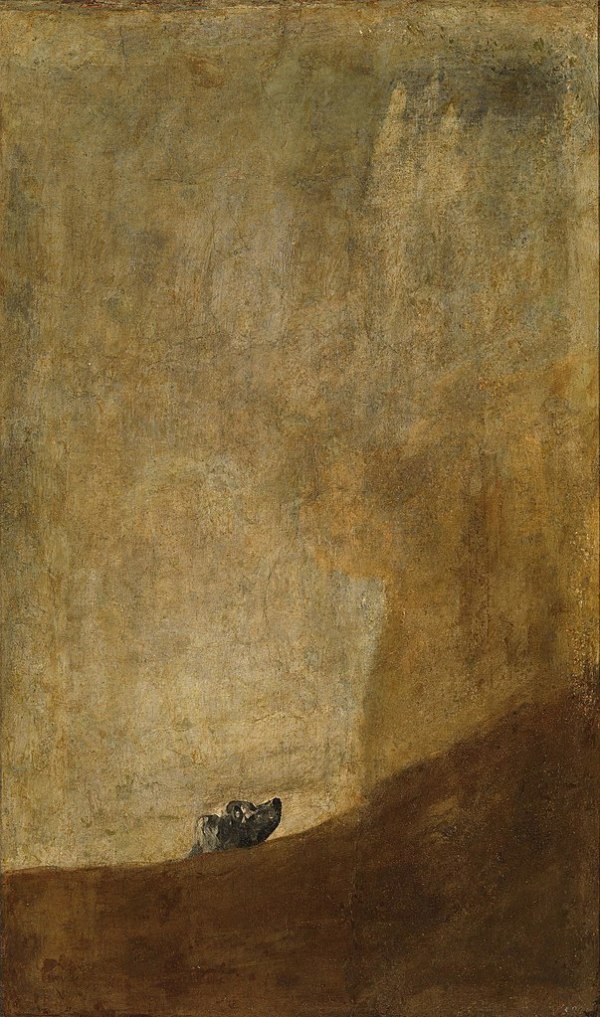
The dog is alone looking, seeing, finding no more than he presumed. Finding the past. Wanting the past to be the future, wanting not hope but satisfaction, the satisfaction of familiar smells, the satisfaction of familiar figures, the satisfaction of familiar selves, the selves around and above him now empty, now filled with sentiment but no faces. An eye, an eye for those above, those somehow himself and not himself more present in their absence than their presence. Is the future the past? – Oh such a poignant question! The poignancy is itself future! Is the future poignant absence of past love? Love of what is below the horizon line. The horizon line is bent uphill; surely that is hope? Hope does not stay. When will hope call him, offering him her red ball, the red bull of the sun setting. Let the sun not set until the future or the past has called him. Where are they? If they are lost, if they have run away or gone on to their other business, where can it be? Where is not the future or the past? Surely they love him there wherever it may be to the side of time. If he bent his head, could he sniff out where they are beside themselves to the right or left of themselves? But oh! If he lowered his nose to the ground, he could miss it if they saw him.


Image “The Dog” – Francisco Goya via Wikimedia Commons

Mindless – Timothy Tarkelly

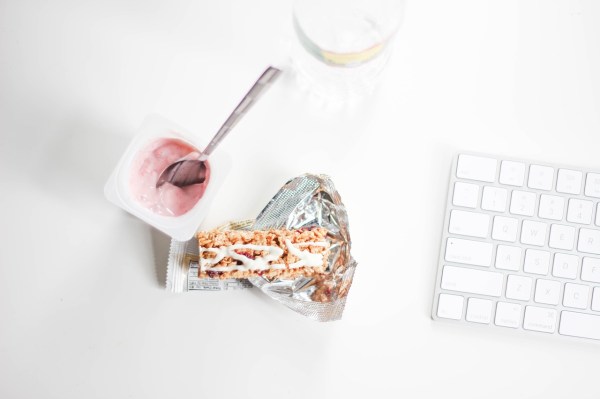
Francine peels the color-printed foil off of her yogurt and digs in, careful to get a liberal amount of berries in her first bite. This is her favorite part of the day: breakfast. It is ten after eight o’clock, which is technically ten minutes after the work day begins, but no one really cares until around nine.

She is at her desk and Karen is in one of the plush, blue chairs against the wall (where clients sit), playing on her cell phone, occasionally making silly faces into the camera.

“Maybe,” Francine begins. “I am just having a bad reaction to adulthood. Like, more than ever I just want to go back to working at the movie theater. That was the best job ever.”

Karen doesn’t say anything, which begs the question, “Who is she texting, exchanging photos with at ten after eight in the morning?”

Francine keeps talking anyway. “Yes, my job is relatively important. I can afford things, that’s good, I guess, but really I just have bills. It doesn’t seem worth it. Do you know what I mean?”

Her audience doesn’t seem captivated and her yogurt is depleting. Is this a depressive episode, or does her job suck? “Do you ever just get sick of this?”

“Nah,” Karen finally says, barely.

Outside the office, footsteps are progressing through the hallway and both parties lock it up, hiding phones and yogurt containers, just in case the footsteps open the door and say something managerly: “What are you doing?” “When will you have the [mindless obligation that in no way reflects actual work] for me?”

They pass.

“How do you keep it from getting to you?” Francine asks as she scrapes the final film of yogurt from the edges of the cup.

“I just don’t think about it, really. I just show up and do my job. Let my boss suck. At five, I go and do whatever the hell I want. I do what I want at work most of the time, too.” She lets out an unnecessary laugh. Her laugh. It’s always unnecessary.

“At the movie theater, I just did my job and left. There was never work to follow me home, real or emotional.” As if the emotional drainage is better than the extra paperwork kind. “I just made popcorn and swept the floor. I got to see free movies, got free snacks. It was the best.”

“In high school?”

“No, the summer after college.”

Karen puts her phone in her pocket, which, as Francine has observed a number of times, countless times, means that she is bored and is about to get up and leave.

“Why did you quit?” she asks.

Francine ponders as hard as she can without showing it. It is a simple question, with a simple answer, but she is baffled (more like offended) that Karen would ask the question when she knows she is about to get up and leave and forget they ever even talked about it. Now, Francine feels only interesting enough to warrant four seconds of eye contact and it is used to ask a question that does not need to be answered, will not be remembered. Francine will leave and then the boss will come and there will be more eye contact, but it will be tired and frustrated without any known reason. It will make Francine feel that she is responsible. She will work as hard as she always does (but if she’s being honest, she won’t because she has also taken to kind of doing her own thing, using the internet to keep her mind focused on staying put and not quitting to go and apply at the movie theater), but no one will ever tell her that she is doing a good job. Instead, there will be (imaginary) tasks that didn’t get accomplished and no matter how excellently she performs at mundanity, or how effortlessly she wears mundanity on her furrowed and busy brow, someone will invariably come by to make a comment about how she could have gotten her [mindless obligation that in no way reflects actual work] a little closer to perfect.

“It didn’t pay enough,” she says.

Karen stands to leave, she laughs unnecessarily. Her laugh. It’s always unnecessary. “Yep. That’s life.”


TIMOTHY TARKELLY’s work has been featured by Cauldron Anthology, GNU, Peculiars Magazine, Work to a Calm, and others. His book, Gently in Manner, Strongly in Deed: Poems on Eisenhower was published by Spartan Press in 2019. When he’s not writing, he teaches in Southeast Kansas.

Image via Pixabay

And No Bird Sang – Richard Hillesley

When morning came it was snowing and I lay on a mattress on the bare floor, shivering as the light crackled across the window panes, fingers of wind nipping the buds, numbed by the cold and unable to move, chilled to the bone and dying for a pee, and a woman on the radio was talking to a man who had walked to the North Pole in winter.

– It must have been cold,
she said.

– Colder than charity,
he said, and a shiver went down my spine.

– When I boiled a kettle for a cup of tea the water froze before it reached the cup,
he said.

The light seeped in between the curtains. The wind rattled the window, and I lay beneath the sheets, immobile and stiff, dying for a pee, and tried to picture the ice between his kettle and his cup. I wanted to get up and dress myself but my clothes were strung across a chair on the other side of the room. I wanted to wash my face and make a cup of tea. I wanted to catch the bus and get to work on time, but my arms and my legs were stiff with cold, and I was dying for a pee. I dreamt of the ice and snow beyond the window and sank beneath the sheets. Someone moved across the room above and I heard the bathroom door open and shut and the mysterious anguish of the pish in the bowl and the release of the flush of the chain, and still I couldn’t move.

– How did you wash yourself?
asked the woman on the radio, and I didn’t hear the answer.

What happened when he went for a pee? I wanted to know. Did a dagger of ice shoot from his crotch to the ground and impale him in the snow? I wanted to know, but she didn’t ask the question and I never heard the answer I wanted to hear, and rolled across the mattress in agonies of procrastination and indecision, torn between lying in bed and the ice-cold walk to the loo.

Time went by and the voices on the radio turned to other stories and faded into the ether. My alarm went off and I went for a pee, my hand on my crotch as I went, and I ran down the stairs and made a cup of tea and walked to the bus stop through the ice and snow. I was late for work again.

A day or two later I was on a bus into the city and an old man sat on the seat next to me, talking to himself. This happened to me all the time, and I didn’t usually notice, preferring to watch the world go by and listen to my own thoughts, but he had a story to tell, and no-one else was listening.

– Johnny was lonely,
he said to himself, looking out the window at the road below,
– and they sent him to the North Pole.

I drew a face in the condensation on the window and stared at my reflection in the glass.

– It was cold up there,
he said,
– and there was nobody there but Johnny.

He had a scarf about his face and mittens on his hands. The snow was still on the ground.

– They sent him to the North Pole,
he said.
– and that was why he talked to himself.

I knew he was talking about himself. He sighed and said,

– That was why he talked to himself.

The bus jerked to a stop and I got up. I tried to catch his eye, but he didn’t see me, and the other passengers didn’t care to see him. The cold and dark had wrapped themselves around his soul.

– It was colder than charity,
he said, and stared into the void.

– And no bird sang.

– That was why he talked to himself,
he said, and I pulled my coat up round my collar, jumped off the bus, and went into the city, dodging clumps of snow and listening for birds.


Image via Pixabay

Timidity – Dan Brotzel

When Tony Bell retired at 57, he told his wife Simone that at last he’d be able to focus on the things he really cared about. She thought this meant Sudoku, county cricket, trad jazz, Radio 4 and the Battle for the Atlantic. She had no idea that he meant writing fiction.

Tony had a well-paid job as the Business Development Manager for a company that provided disposable self-testing drug kits to governments, prisons and sporting bodies. But it was a long time since he’d had any enthusiasm for what he did, and for several years now his working life had been a tedious round of calls to make and meetings to be seen at. Tucked in his little office on the sixth floor, Tony had spent much of his time discreetly plotting his exit.

He was good with money, good with figures. Early in his career, Tony had been in at the start of a PR agency that specialised in controversial clients, back in the brief window of time when being in PR was vaguely sexy and new.

The agency had quickly grown because of its willingness to take on high-paying if ethically dubious corporations (and even countries, in one case). An international media network had bought it out, and Tony had been a semi-willing casualty of the transition. The sale of his shares had given him some money to play with, and ever since, his canny investment portfolio had shown steady and gratifying growth.

His wife Simone had begun by admiring Tony’s way with money. Like him she was a careful, even frugal spender; both of them made sandwiches every day for work and always looked for voucher codes before they bought anything online. But over time, she became increasingly frustrated by Tony’s reluctance to do anything with their burgeoning nest egg. He baulked at holidays that went beyond Europe, preferred to fix up the rooms they had rather than extend or remodel, and insisted that owning two cars – despite the obvious conveniences to them both – was not fair to the planet.

What then was the money for? Though he had not realised it consciously, Tony saw now that he had been saving up to buy his way out of work. Early retirement – a dream he could now make real.

*      *      *

In the weeks and months before he left work, Tony talked to several friends and acquaintances about the transition from working life to retirement.

He heard tales of men who went off the rails, driving their wives crazy by hanging round the house under their feet all day, messing up their well-established domestic systems and routines. He heard of men who’d taken the plunge early without realising they couldn’t really afford to, and now spent their time reading the papers in the library and cadging the free-coffee stickers from better-off customers in MacDonald’s.

Then there were the smug ones, the ones who said they things like I’m busier than ever! and I don’t know how I ever made time for work! These ones painted, they ran reading groups, they campaigned to save hospitals, they raved about the University of the Third Age. I only wish I’d done it years ago! they invariably said.

Then there were the lonely ones, the ones who had enough income but had lost their partner or had little family around them. They told him to get Sky Sports.

Tony took from all this the idea that retirement didn’t really change you so much as show you who you’d really been all along. If you were a busy, social, life-loving sort of person, you’d have that kind of retirement. If you’d been on the run from your own life for years, retirement wold find you out. The thought alarmed him.

*      *      *

‘Time is our element – it’s the very air we breathe – but how often do we feel we are actually in time?’ intoned the contract Christian on Thought for the Day (the one thing on Radio 4 Tony used to hate but which he now listened to religiously.)

‘We talk of making time, killing time, losing time, saving time. But these are all reflections about time made from the outside. Lord, just for today, help me to relish and revere the sacrament of the present moment. Help me to live in your time. Just now. Just for Today.’

‘And this is indeeeed Today you’re listening to right now,’ said John Humphrys with a twinkle. ‘It’s very nearly a quarter past eight.’

And so to writing. Tony had always wanted to write, he just hadn’t thought about it for years. He had spent his working life saving up money to buy time. But without any idea of what to fill that time with, the exercise was futile.

But the time to write was now. It was, ahem, write now. It had always been now. While he was working, he should have been getting up early to scribble stories like Mary Wesley and Fay Weldon had done, jotting down dialogue in between ironing shirts like JG Ballard, or sneaking down lines of verse in his corner office, like that mad American poet they’d mentioned on Poetry Please the other night. Instead of checking his portfolio and plotting his escape, he could have been plotting his novel.

But perhaps some of the other clichés about time could still save him.

Better later than never. All’s well that ends well.

No time like the present.

*      *      *

Into the planning of his retirement – or what he liked to call his rewrite-ment – Tony threw all the very considerable strategic and time management skills at his disposal. He drew up a fiction-writing calendar populated with realistic milestones and solid deliverables. He factored in time for planning and structure, background inspiration, note-taking and drafting. And he stuck it to all, he delivered. He wrote like a man whose very life depended on it.

He even gave up The Archers.

Tony had always wanted to write a novel, but his idea was to build up to that daunting challenge by spending a year writing short stories. To give him extra impetus, he chose a short story competition to write for every month. His task was to hit the competition deadline every time, and by the end of the year he’d have a bank of a good dozen stories – any one of which might prove to be the kernel of something more substantial.

Stories began to fly from Tony’s PC. There were thinly disguised tales of men who didn’t know what to do with their retirement, scathingly satirical parodies of office life (often set in a vaguely pharmaceutical sort of workplace), and a historically scrupulous account of a submarine attack on a convoy of merchant navy ships. There was even a whimsical story about a man who became so obsessed with Japanese puzzles that he…

Actually Tony had to stop there, because he really couldn’t think how to end that plot summary, let alone write it up.

After a few months, Tony took stock. His stories had received no feedback, positive or negative, from any of the competitions he entered, except for one tick-box assessment (free with the entry fee) which had given him 4/5 for punctuation and grammar.

The stories were, he knew, bland. They were formulaic, they were feeble projections of his own interests, they did not sing. They lacked balls, grit, edge, risk.

The punctuation, however, was solid.

And so he began again.

*      *      *

Tony started to write about what he really felt, about the things he wished he’d done, and the things that usually go unsaid. He wrote a story about a man he called ‘Tommy’ who had always wanted to fuck a colleague in Marketing, whom he named ‘Jan’. There had been a moment once at a drinks do when something seemed to stir between them, but both had stepped back from the edge.

Now, for this story, Tony wrote for the first time about something that hadn’t happened to him: he pushed the couple right over the edge and into a passionate affair. He imagined them wangling business trips to visit key suppliers in Amsterdam and Stuttgart and Malmo – all just so they make delirious love together in random hotel rooms.

He wrote about the sex he’d never had. The inside-outsideness of our sex, he raved. Me-in-you and you-in-me, my mouth chasing your vulva across a hectare of pure white bed.

He stopped shaving. He began to drink as he wrote – Dubonnet mostly, it was the only thing he could find in the house. (They weren’t big drinkers.) He felt stirred, raunchy, sort of juicy. He couldn’t imagine this on Book at Bedtime.

Where would this story take him? Tony wanted Tommy and Jan to win. He did not want to see them get their comeuppance in some bourgeois dénouement of reprisal and recrimination. And so in the final scene, he has Brian the boss ask to see the illicit couple. They fear the worst. But in order to keep up their business trips abroad, it turns out the pair have both been performing exceptionally, securing new contracts and smashing sales targets. The final line went to the boss:

‘Keep up the good work,’ twinkled Brian. ‘Tommy, I need you to keep it up.’

‘Fair game,’ became Tony’s mantra. Everything to the serious writer was fair game. In the heart of every true artist, there sat a sliver of ice. Tony began to write stuff down as it happened. He wrote up his fantasies of violence and revenge, he lacerated friends and neighbours with frank portrayals of their foibles and their faults, he sent up the sexual conservatism of his own marriage. He was mercilessly satirical about the aggressive parking practices of his neighbours at number 32, and the casual racism of his other neighbours at number 36.

Still no one had commented on his stories. But – to cite another of his own mantras – ‘the great must wait’. When you’re doing something new and brave, it takes a while for your audience to catch up. The silence of the criterati was surely but confirmation of the rightness of his path.

*      *      *

Tony liked to rise about 6am and get down to an early stint of typing. To avoid the infamous tyranny of the blank page – something he’d never actually experienced himself, oddly – he always left off in the middle of a para at the end of a session. Simone needed more sleep than him, and if it wasn’t one of her working days (she did shifts at the hospital) she would usually join him for half a grapefruit and a bowl of porridge around nine, by which time Tony would have the smug feeling of a couple of hundred words already tucked under his belt.

But this morning, she was already downstairs, sitting at the computer. His computer. Looking at his files. A frown monopolised her facial features, and an arm of her reading glasses dangled pointedly from the edge of her mouth.

When she saw him, she began stabbing at the screen with it. ‘This bit here – it’s Andrea, isn’t it? The woman who knocks on the door of her new neighbour with a welcome present and says, “Thank God you’re not Somalian!”’

‘Well, yes. No. It’s fiction.’

‘And this bit here, about the man who gets a bang on the head and doesn’t realise he’s become sexually inappropriate with everyone… it’s Ned, isn’t it? Jodie’s brother-in-law?’

‘Well. It’s all about extracting the underlying universal truth from the particularities of the everyday…’

‘Jodie’s my best friend! And you’ve been going to The Oval with Ned for nearly 30 years! Did you think changing the area of the cortex would cover your tracks? How could you?’

‘…’

‘And this one. This filth about a vulva in a duvet or something. This is obviously about that Janine girl at your work you were always going on about. You told me there was nothing in it.’

‘There wasn’t! I mean, there isn’t! Her name was Jane. This is a story.’

‘Oh come on! Jane, Jan, Janine, whatever. It’s obvious! Everything else is just verbatim from real life! You’ve taken all the bad or sad stuff from everyone we know, changed a few names, and you want to pass it off as art or whatever…’

‘Well, John Updike said…’

‘UpFuck John fucking Updike! John Updike did not have a sister like Naomi. When she sees you’ve painted her as a narcissistic monster who’d rather attend a client piss-up than go and see her own children when they’re ill…’

‘Well you yourself have said many times that she’s…’

‘I might have said it to you. But I haven’t typed it up for all the world to see! Do I have to watch everything I say now in case you turn it into a story for Radio 4?’

‘Actually they’ve rejected everything I’ve sent them so far.’

‘You mean you’ve sent this stuff out? People have looked at it?’

‘…’

‘Please don’t tell me you’ve sent this Middleground one.’

‘…’

He had. The Middleground was his favourite story, the one where he felt he’d come closest to saying something true and real. It was the story of a middle-aged couple who, though they had enjoyed an agreeable and prosperous companionship for years, had never quite managed to connect sexually. Neither had had the courage to really discuss the issue, and over time their couplings had become ever more stilted and infrequent, and the awkwardness had started to permeate the rest of their relationship.

‘I cannot believe you are parading our sex life to the whole fucking world.’

‘I’m a creative writer!’

‘You’re a muppet and a shit.’

*      *      *

Alternative ending 1: Tony sighed and shut down his PC. Though he had what he thought was a much better ending for The Middleground now, he would not be resending the story to the BBC or anyone else. There would be no new stories from his keyboard of dreams.

Contrary to his brief hope, his argument with Simone about his stories had not ended in erotic ecstasy but in bitter recrimination and corrosive silence. Now he had a new project for his retirement – the salvaging of his 32-year-old marriage. A work of non-fiction.

Alternative ending 2: That night, Tony added a final section to his short story, The Middleground. It described a toxic, years-in-the-making row between his middle-aged couple, which ended with up with them getting shit-faced on Tio Pepe and fucking right there on the sofa with more urgent vigour and rough experimental tenderness than they had known for years, if ever perhaps.

He couldn’t have written it better himself.


Image via Pixabay

Chink – Gail Aldwin

A navy sky extinguishes the day. Sitting on the balcony, Kate reflects upon her laziness. No excursions to the volcano for Kate, just a sunbed, a pile of paperbacks and the company of Robert. Still wearing his shorts, Robert stretches his legs then scratches a mosquito bite on his knee. Kate is cool in her strappy dress. She reaches for the tumbler, drains the contents then crunches a sliver of ice.‘One more before we go down for dinner?’ he asks.But he’s not even dressed. Hasn’t yet had a shower.‘No thank you,’ she says. ‘I’m fine.’‘Good.’ He sits back in his chair.What now? She waits. Irritation makes her skin prick.‘Are you going to have steak again tonight?’ she asks.‘Think I’ll ask for it blue this time.’Yes, mooing, even.From behind the mountains comes a rumble. Although Kate knows these steamy days can lead to storms, she hopes she’s wrong. Holding her breath, she clutches the armrests and counts. A flash comes before she’s reached number eight. She’s rigid in the chair but Robert gets up for a proper look.‘It’s coming this way.’ His voice is gleeful and he cocks his head. Doesn’t he know it’s ridiculous to swagger in flip-flops?‘I’ll get inside.’ Kate reaches for her bag but when she turns, Robert is blocking the doorway.‘Surely by now you can face it.’She hesitates. Does he know what she’s thinking? What she’s planning? Of course not! Robert means the lightening.‘Let me pass,’ she says.‘No.’ He grabs her shoulders and manoeuvres her for a better view. Kate closes her eyes, resists his pinching grip.‘There’s no point in struggling,’ he says. ‘You can’t be scared your whole life.’Kate breathes through her mouth, takes comfort from the steady pumping of her heart, listens to the gushes from her lungs. The crack and the searing light skewer her to the spot but she controls the trembling.‘See, it’s not so difficult, is it?’When the thunder comes again, she’s ready. This time with eyes wide open she waits for the crack and watches the chink of light brighten the gloom. A path to her future is illuminated. She can do it. She really can.

GAIL ALDWIN’s debut novel The String Games has been longlisted in The People’s Book Prize for fiction. To get to the next stage depends upon public support. If you like Gail’s writing, why not pop over and give her your vote?

https://peoplesbookprize.com/summer-2019/the-string-games/

(The competition ends 15 October 2019.)

Image via Pixabay

Suppose – B Lynn Goodwin

Suppose Hannah, age 9, closed her eyes and announced, “I have windowless eyelids”? Would she be creative or silly?

Suppose a storm made the lights flicker so hard that she retched. Would she have a fear or a brain disorder?

Suppose she saw a strip of a green “for sale” sign and wanted to touch the curly strip along the bottom edge? Would her parents say, “Don’t touch” or “Explore, Hannah, but keep your fingers out of your mouth”?

Suppose a row of goldfish wearing sneakers tap-danced their way into a dandy trap? Would Hannah crack up or try to rescue them?

“Why do we stitch our curls so tightly that the brain cannot breathe?” Hannah asked her teacher one day when she was tired of being told to sit still and pay attention.

Her teacher, wearing flats, a gray shift, and a loving smile said, “Soon you may be a polished artist or writer or brain surgeon, Miss Hannah.” She looked out the window at the leaves budding while Hannah sat up straighter When the bell rang three minutes later, she raced ahead of the others, got to the monkey bars first, and swung so high she could see a man in overalls and a woman whose bare tummy rubbed against them as the couple hugged.

Suppose she pushed her body into a boy’s like that. Somebody would be sure to call her Mama. She was about to scream at them to get a room, like her big brother did in the Walmart parking lot, but fear shut her down. Instead, she jumped off the monkey bars, raced to the fence, stared at them through a knothole. They must have felt her staring.

“Suppose you go back to class where you belong, Little One,” said the man in the overalls., striding towards her.

She stood still as his mouth came closer and closer to her knothole.

“Or would you rather I call the school?” his menacing voice whispered.

Part of her wanted to know what the school would do, but she not badly enough to double-dare him. Instead she turned away, rubbing her fingers along the seam inside her left pocket. Back at the swings, she shut her eyes and swung in windowless bliss.


B. LYNN GOODWIN is the owner of Writer Advice, http://www.writeradvice.com and is a manuscript coach/editor as well as an author. She won awards for her last two books, Never Too Late: From Wannabe to Wife at 62 and Talent. She loves the challenges and brevity of flash.

Image via Pixabay

#youtoo – Deirdre Fagan

Never think it can’t happen to you. You are too aware. You are too smart. Things like that don’t happen to you.

Things like this happen. They happen repeatedly, and to people who thought they were just as smart as you think you are.

Do you remember how clever you thought were when you first tied your shoes? And how clever you thought you were when you first snuck candy? How clever you were when you aced the spelling test? Or, convinced your parents you were responsible enough to be left alone? Or how clever you were, later, when you secured the perfect job only to find the person who hired you primarily wanted in your pants?

We like to think we are so clever, but we can be outsmarted, and are, more frequently than we like to acknowledge. Everyone thinks they are so clever, but the ones who take advantage are the ones not thinking they are clever, but using all of their cleverness to deceive. We are only more clever than they are if whatever we are spending our time thinking about, all of our time thinking about, is how to get what we want. Those people aren’t more clever than we are in all things, but they are more clever than we are at something primary: they are very good at making us believe we made the choice to be deceived.

We made the choice. If it’s anyone’s fault, it’s ours, and they not only convince us of that, they somehow have a way of unleashing everyone’s blame on the victim.

Why didn’t you tell anyone? Why did you let that happen? I thought I raised you better. I thought you trusted me. What did you do to make that happen? Why didn’t you stop it? You could have just told someone. You could have told me.

It’s not what you were wearing or how you looked or that you were prettier or more handsome or that you asked for it. It’s that everyone agreed to ignore the signs and everyone agreed to absolve the perpetrator because to see it means they aren’t so clever and it also means they are wrong, and they want to be right, even if it means blaming the innocent.

How high did you feel when you snuck the candy? Good? For how long? Did you then feel guilt? Did some of your joy over taking the candy make you feel badly later? Badly enough that you didn’t do it again?

When you tied your shoes, you were proud you could do something yourself, not proud that you deceived the shoes into letting you have your way with them.

Perpetrators don’t feel guilt about taking the candy. They want more. And it doesn’t have to be candy, either. They want the high of everyone thinking they are good, when they aren’t. They like hiding. Hiding is where they feel power. If they can stand right in front of you and you can’t see them, they have not only won, they are powerful, and they want power. They crave it. That’s why they pick those they can overpower. They can overpower you. They can overpower more people than you know, so much more than you know.

And you are especially easy to overpower if you need parents, or love, or money, or shelter, or someone to help with your kids. Money? Time? Help? They hear that word, help.

Do you have it all except you have never been told you are beautiful? No one has ever loved you for who you believe yourself to be? Someone has made you feel less than deserving. Maybe it wasn’t even your parents. Maybe you just look in the mirror and think you don’t deserve anything or aren’t good enough. You don’t see them, but they see you. They know exactly what you need, and they will give it to you, so you’ll give them what they want, until you are so ensconced that it’s like the carnival ride of funny mirrors and you feel the glass and see the other side and cannot find your way out.

The first (or last) person to say I love you, whether they do or not (because it won’t matter if they seem like they mean it because they don’t know what it is) will charm you, because they say they love you and they don’t have to. You won’t know the definition yet. That won’t matter. Those words will seduce you. And they may even be withheld until some damage is already done. You will already know you should have said something about what they wanted. You should have said something, you tell yourself. This is your fault. Not the thing, the not telling. You didn’t tell.

And now there’s this love out there, suggesting you should accept or forgive or even say thank you, thank you for loving me, even if it will take decades to know this is not love.

It isn’t love, right? Even after everything you will learn about love, you will wonder, was it love? It felt like love, even if it only felt that way once and briefly.

You were sleeping, or doing the dishes, or gardening, or just getting out of the shower. The first time you were surprised and didn’t know how to react. You froze. It happened. You didn’t scream. You knew it was wrong. But this person had never been presented as wrong. Only right. Only kind. Only sympathetic. Only generous. You didn’t say yes. You weren’t asked. You were taken. You didn’t say no. You didn’t say anything. And immediately afterward, or the next day, or week, or month, you were told you didn’t say no, so you liked it. You wanted it too, didn’t you? You know I love you, don’t you? We love each other. No one else would understand. They say it’s forbidden. It’s not. I am only like this because I love you and love makes a person do wild things. Remember the great love stories? Wild things.

And it will stop because the high will pass. The person who took you won’t want to anymore because you won’t be as afraid. You will succumb. The secrets will not be so fascinating to them anymore. They will need new secrets. More secrets. The power isn’t power when you don’t recede. It’s not power if you have a choice, any choice. You aren’t supposed to have a choice. And when everyone is so used to it, to what’s happening to you, they aren’t even watching anymore, they haven’t even noticed or questioned or paid any kind of attention in months, the one who taught you all about what love wasn’t will slither away leaving you to wonder what it was that happened and why you let it. You thought you were clever. But if it happened, and it did, then you let it, and you must have wanted it, and you are to blame.

You are to blame.

You believe them. You believe all of them. The perpetrator and all the people not looking at the perpetrator. All the people who turned their heads from you and are now looking directly at you. You say you don’t believe them. You were not to blame. But some part of you still believes them. They get their teeth in you.

If you don’t believe them, then you have to admit you were powerless. And you want some power too, not that kind of power, not the power over someone else, just the kind you felt that first time you tied your own shoelaces. You want to feel proud like that again. But you can’t.

The only really power you have is in convincing everyone else they were the ones who didn’t tell, not you. You shouldn’t have had to tell. It was so obvious if they were only looking.

Look at the perpetrator. The perpetrator is standing right over there. Look at that face, not through it. See it? See that face. It’s deceptive isn’t it? But you are clever too. You can see it if you don’t look away. Don’t look away because it’s easier. Don’t look away.

Look at me you say. See me. I want to be seen. Do you think you are clever? #metoo


DEIRDRE FAGAN is a widow, wife, and mother of two who publishes poetry, fiction, and nonfiction. Her poem, “Outside In,” nominated by Nine Muses, was a finalist for Best of the Net 2018. She is an associate professor and coordinator of creative writing at Ferris State University. Meet her at deirdrefagan.com

Cabinet Of Heed Contents Link 21

Image by Ankita Gkd from Pixabay

Power Outage – Ron. Lavalette

How unfortunate to be there
when the power goes out
at two separate places
at two different times
on the same day.

It was one thing, the first time,
when the supermarket overheads
and everything else
—except a few quick-witted
smartphone flashlights—
flickered twice and went black,
flashed a blinding warning signal
—a truly brilliant half-second delay—
before leaving the whole sad storefull
frozen in Aisle 7, startled into silence
and forced into terrifying immobility
for a scary seven minutes.

Everyone survived. Everyone
muddled through; made it out alive.
Praise the Lord.

But then,
again, hours later…

RON. LAVALETTE lives on Vermont’s Canadian border. He has been very widely published in both print and pixel forms. His first chapbook, Fallen Away, is now available from Finishing Line Press, and a reasonable sample of his work can be found at EGGS OVER TOKYO http://eggsovertokyo.blogspot.com

Cabinet Of Heed Contents Link 21

Image by Reimund Bertrams from Pixabay

The Man On The Train – Michael Bloor

Very occasionally, one comes across a person of natural authority, a person who impresses without effort and without design, someone who just seems more human than the rest of us. Last week, I met just such a man on the train from Aberdeen to London Kings Cross.

The journey takes seven hours, so I’m careful about being drawn into conversations with fellow-travellers: seven hours is a long time to sustain a conversation about Jehovah’s Witnesses’ aversion to blood transfusions, or the scandalous price of houses in Inverurie. So I gently rebuffed the elderly lady seated beside me when she tried to get me talking. In response to each of her conversational sallies (on the weather, the surprisingly crowded carriage, the scandalous price of tickets), I replied courteously but briefly, and returned to reading my book. Thus thwarted, she turned to the massively built, grizzled, elderly black man sitting across the table from us. More civil than myself, he answered all her inquisitive questions with grave dignity, in a rich, bass voice. The old lady quickly established that our companion was from Sierra Leone and was returning there after visiting to his son, gravely ill in Aberdeen Royal Infirmary with severe burns, sustained in a fire aboard a Peterhead fishing boat.

At Montrose, the old lady left us and the train, with a parting comment on the scandalous price of Montrose taxis. My remaining companion and I exchanged complicit smiles. He then surprised me. He leant across the table, gestured towards my book, and said:

‘I see you’re reading about Emanuel Swedenborg. A great man, I believe. And one who led a fascinating life. May I ask what your interest is in Swedenborg?’

I struggled to answer. I explained that, since I’d retired a couple of years ago, I’d enrolled in a literature course at the Open University and I was planning to submit a student project on Swedenborg’s influence on the work of the poet, William Blake. What I really wanted to do was ask what interest an elderly man from Sierra Leone could have in an eighteenth-century Swedish mystic. I might have found a courteous way to frame that rather insulting question, had I not already been witness to the relentless grilling my companion had already received on the Montrose leg of our journey. As it happened, John (that was his name) volunteered an answer to my unspoken question:

‘In my church in Freetown, back in Sierra Leone, we have studied some of Swedenborg’s writings. I am an elder in the Freetown Christadelphian Church. We are bible Christians and, like Swedenborg, we are Unitarians.’

I wanted to avoid a theological discussion on the biblical justification, or otherwise, of a belief in the Trinity of Father, Son and Holy Ghost. So I asked John about his son: I’d seen the story of the fishing boat fire in the Aberdeen Press and Journal.

‘The hospital is wonderful. I am very grateful for his care. But Andrew is very ill. Very ill. That’s why my fellow elders in the Church found the money for me to visit.’ He paused and then continued in the same slow, deep voice: ‘It has been a particular grief to me. Because I too have lived the nightmare of a fire at sea. Indeed, a fire ON the sea too. Some twenty years ago, I jumped from the fiery deck of a tanker full of gasoline into a fiery sea full of gasoline.’

I gasped. ‘You were on that tanker, the Derwent, off the Belgian coast back in 1993. You survived the collision and the fire.’

It was now John’s turn to be surprised. Mysteriously, over the last thirty years or so, Britain has somehow ceased to be a maritime nation and tragedies like that of the Derwent are no longer well known or remembered. But I used to work as a ships agent and I remembered it very well. In thick fog, the Eastern Supreme, a bulk carrier steaming far too fast, with no look-out, and with no-one manning the radar, smashed into the Derwent, newly laden with a cargo of gasoline, which spilled out of the ruptured tanks and ignited. The Derwent was swept with flames before the lifeboat could be launched, and so the crew had to leap into the burning sea. Nine men died, two of them from Sierra Leone. I explained about my old job as a ships agent and asked John whether there had been any legal proceedings afterwards.

He shook his head: ‘A Belgian court did eventually summon the Korean master of the Eastern Supreme on charges of manslaughter, but he failed to appear.’

He spoke without emotion, and such miscarriages of natural justice are unfortunately commonplace in the shipping industry, but I felt this was too painful a topic for a conversation between strangers. I asked John if he’d gone back to sea after the Derwent fire.

He shook his head again: ‘No, though I had a family to feed. And besides, I am one of the Krumen. For two hundred years, my tribe has supplied the crews for British ships. That is how we got our name. My great-great-grandfather and my great-grandfather crewed the anti-slavery patrols of the British navy. We have always gone to sea. And we have always crewed for the British. It was more than a job: it was my birth-right. But after the Derwent, I found a job at the docks.’

Smiling at old memories, he told me how, as a boy, he started out as a messman: serving in the merchant officers’ mess, with the starched white table cloths and the picture of the Queen and Prince Philip. How, on shore-leave, he used to go to Anfield to watch Liverpool FC in the days of their pomp: he recalled in particular Big Ron Yeats, Liverpool’s mountainous, Scottish centre-half. He recalled how, when he switched to working on tankers, they used to play deck-cricket on the helicopter landing deck. Grinning now, he explained the elaborate rules of the game: ‘You British, you always have plenty of rules.’

‘Did you enjoy the cricket, John?’

‘Not really. We used to play on Sundays – a rest day, except for the watch-keepers and emergencies. We Sierra Leonians would have preferred to rest. But the British officers – they wanted us to play. You could say that a bargain had been struck. The British needed us and we needed them. The work was hard; the hours were long; the pay was poor. But we needed the jobs and the families needed our pay. So we played cricket. The British made the rules and we abided by them – for the food in our mouths.’

‘After independence, things deteriorated at home in Freetown. And there were fewer British ships: we would wait at home longer and longer between contracts. But once we were back on board, things were just the same – the starched white tablecloths and the deck-cricket. There was a strange comfort in that.’

‘You know, crew changes for the tankers often took place in Singapore. That used to be a British colony too, of course. We used to stare at the skyscrapers, the shops and the clean streets. We could see that Singapore had prospered after independence. But independence hadn’t worked for us. We used to talk among ourselves about how it would be better if the British would come back to run Sierra Leone.’

‘You used to talk about that, John, about the British coming back. But not anymore?’

‘Sometimes, I still hear old men talking that way. But not me. After the bulk carrier smashed into the Derwent, after those nine men died in the burning sea, I realised that the British weren’t making the rules anymore.’


MICHAEL BLOOR is a retired sociologist living in Dunblane, Scotland, who has discovered the exhilarations of short fiction. Recent publications include The Fiction Pool, The Cabinet of Heed, Fictive Dream, Idle Ink, Litro Online, Spelk, Scribble, Ink Sweat & Tears, The Copperfield Review, Dodging the Rain, Everyday Fiction, Firewords, and The Drabble.

Cabinet Of Heed Contents Link 21

Image by walkerud97 from Pixabay

The Outcast (Winter is Coming) – David Cook

Outside, snow began to fall. Inside, a group huddled around a window table, watching the flurry as it descended.

‘Winter is coming,’ remarked one. Everyone laughed. Well, everyone except Charlie, who said, ‘And it’s only September.’

‘Game of Thrones, pal,’ said Fred from accounts.

‘Oh,’ said Charlie. ‘I don’t watch that.’

Everyone fell silent and looked at Charlie. He began to go red. He stared at his drink and pretended to see something very interesting in the bottom of his glass.

People began to talk about someone or something called ‘Stark’. Charlie slipped away from the table.

No-one noticed.

*      *      *

Two evenings later, Charlie had a date. This was rare. He’d summoned up the courage to ask Kirsty from the fish counter at the supermarket out for dinner and had nearly fallen over when she’d said yes.

He’d taken her to a fish restaurant which, he reflected as they arrived and he saw her face, was probably a bad move. Still, things were going okay until Kirsty said: ‘So did you watch the season finale last night?’

He blinked. ‘Sorry? Of what?’

‘Game of Thrones, of course.’

‘Oh,’ said Charlie again. ‘I don’t watch that.’

Kirsty’s face fell. She dropped her head and paid very close attention to her halibut. Charlie opened his mouth to speak, then shut it.

The date limped to an end. Charlie would never go back to that supermarket..

*      *      *

The following day, Charlie took the bus into town and came home with a box set of Game of Thrones DVDs and a huge bag of popcorn. He would watch the first few episodes now and see what the fuss was about.

He spent the next three hours of his life feeling somehow nauseated and bored simultaneously. He didn’t like gore. He didn’t care about dragons. And he couldn’t remember anyone’s name. What did everyone see in the damn show?

He turned the television off and bit down on popcorn, chipping a tooth in the process.

*      *      *

On Twitter the next evening, Charlie wrote, ‘Am I the only one who doesn’t like Game of Thrones? #GoT’

His follower count immediately dropped from the low hundreds to single figures to zero, while anonymous people with avatars of lizards began to send him abuse.

He deactivated his account.

*      *      *

His Mum called. ‘I’ve just been watching this Game of Thrones show. My friend Winnie told me about it at the hairdresser, everyone’s talking about it. Have you seen it?’

Charlie said that he had.

‘Isn’t it just awful—‘

‘Yes!’ almost shouted Charlie with relief. ‘It’s long and tedious and unpleasant. I’ll stick to my nature documentaries, thank you very much.’

He smiled. At least he wasn’t totally alone. Then he noticed the silence from the other end of the phone.

‘Mum?’

‘I was going to say “awfully good”, actually.’

‘Oh.’

‘I think it’s brilliant.’

‘Oh.’

There was a click as she ended the call.

*      *      *

Isolated and friendless, Charlie jacked in his job and went travelling. Surely he could escape the Game Of Thrones obsession in another country.

‘Ert þú að horfa á Game Of Thrones?’ asked a girl in a bar in Reykjavik.

‘Mae Game Of Thrones mor dda!’ said a hotelier on the coast of West Wales.

‘Ang Cersei Lannister ang modelo ng aking papel,’ commented a waitress in a restaurant in the Philippines.

‘If you don’t watch Game Of Thrones, you’re a flamin’ Galah,’ said a man on a beach in Sydney, fiddling with his boomerang in a way Charlie found unnerving.

He tore up his travel plans.

*      *      *

So Charlie came home again, far more multilingual than when he left but equally as depressed. He dumped his bag, then fell over the pile of Game of Thrones DVDs he’d left on the floor. Losing his temper, he sat where he landed and hurled the offending plastic boxes around the room. As the final one arced into the wall with a satisfying thud, there was a knock at the door.

Cursing under his breath, he hauled himself to his feet and hurled the door open. On the other side was a woman he’d never seen before.

‘Hello?’ he said.

‘Oh, hi. I just moved into the flat next door. My name’s Yasmin and…’ she stopped, and looked over his shoulder at the mess of DVDs. ‘Is this a bad time?’

‘No…’ Charlie took a deep breath. ‘No, it’s fine.’

‘You’re a Game of Thrones fan, I see.’

‘Definitely not.’.

‘Hey, me neither.’

‘What, really?’

‘No.’

His mouth fell open. He realised this wasn’t a good look and shut it again. Yasmin carried on without seeming to notice.

‘I just don’t get what’s so good about it,’ she said. ‘All this mythical stuff leaves me cold. And it goes on forever. But everyone loves it.

‘Not me.’

‘Nor me. You’re the first person I’ve met that doesn’t like it.’

Their eyes locked. Yasmin smiled. Charlie smiled. He felt his heart rise in his chest. Time seemed to stop.

‘I’m Charlie, by the way,’ he said, eventually. ‘Would you like to come in? I’ll just clean up this mess.’

They beamed at each other as Yasmin stepped inside and Charlie closed the door behind her.

‘No, I much prefer Stranger Things,’ Yasmin continued as she sat down. ‘It’s just so cool. Best show ever. Do you watch it?’

Charlie had seen Stranger Things. Charlie had hated Stranger Things. His heart seemed to notice how high it had climbed. It panicked, wobbled momentarily, then plummeted back down, landing with a squelch in the basement of his ribcage. He tried to force a smile, but didn’t manage it. ‘Do you like nature documentaries?’ he asked.

Yasmin shrugged. ‘Not really,’ she replied.

Cersei Lannister looked on from a discarded DVD box, the glimmer of a grin on the edges of her lips. Charlie glanced out of the window and noticed it was snowing once more.


DAVID COOK’s stories have been published in print and online in a few different places. He lives in Bridgend, Wales, with his wife and daughter. Say hello on Twitter @davidcook100. If that Icelandic, Welsh and/or Filipino is incorrect, please direct your complaints to Google Translate.

Cabinet Of Heed Contents Link 21

Image by Thorsten Frenzel from Pixabay

Practicing Non-Attachment – Ceinwen E Cariad Haydon

drift was in his blood
satisfaction out of reach
his search was on
for antidotes to boredom

domestic duties
didn’t hold a candle to
Chenrezig
and a hundred thousand
full length prostrations

practice
folded into mantras and mudras
on retreat
his meditations dreamt him free
of all the daily crap

meanwhile I waited
tended to his children
our youngest only three months old

fatigued
I lived in hope
of happiness in his return

he presented
in his own much-resented time
talked endlessly
of tantric experiences
bliss
sat at his blesséd Teacher’s feet

he unpacked dirty laundry
handed it across to me
and remembered

he had a gift
two cheap and ugly rings
afterthoughts bought as thanks
for my chapped fingers

far from cheerful
I saw fractured writing
on my life’s climbing wall


Chenrezig, also known as Avalokitesvara, ‘One who looks with unwavering eye’ (Tibetan Buddhism)

CEINWEN E CARIAD HAYDON lives in Newcastle upon Tyne, UK, and writes short stories and poetry. She has been widely published in web magazines and in print anthologies. She graduated with an MA in Creative Writing from Newcastle University in 2017. She believes everyone’s voice counts.

Cabinet Of Heed Contents Link 21

Image by Marc Benedetti from Pixabay

Columbogey On My Tail – Lucy Goldring

Sally, who had only meant to rest her eyes, woke to the captain’s smooth-voiced warning. Revised shipping forecasts had been received too late to return to port. Passengers should now prepare for ‘extremely rough conditions’.

Within ten minutes the ferry was sloshing about like a bath toy. Bottles of spirits skidded slantwise behind the bar, clinking like drunken dinner guests. Sally was pleased to note she didn’t feel queasy but asked a passing crewmember for a baggy ‘just in case’. Despite her protestations, she was swiftly ushered to the designated vomiting zone.

The pong suggested car-warmed bananas and microwaved train food. Sally took one of two remaining seats at the edge of the alcove, angled her body into the aisle and mouth-breathed carefully. Every pitch of the boat elicited a chorus of groaning and heaving, whilst a bronzed attendant minced back and forth with sick-bags pinched in latexed fingers.

When Columbogey was deposited in the opposite chair, she laughed out loud in astonishment. But Columbogey – riding a tsunami of nausea and dimly aware of keeping his cover – stared hard at the floor, his pasty brow beading with sweat.

Sally had first clocked the private detective two weeks’ earlier on her way home. He’d stalled at the lights on Alpine Road, then over-revved his engine in panic. Even from her rear-view mirror, she’d noticed his twitchy movements and intense stare. When Sally had picked out a meandering route – creatively interpreting the city’s variable speed limits as she did – Columbogey had followed at a uniform distance. That night she’d padded down the landing of the house she’d shared with her husband for over two decades and read his emails. The agency promised ‘unparalleled expertise in clandestine surveillance’.

Sally hadn’t expected to be tailed to her sister’s in Guernsey though. Clearly Pat was more invested in their marriage than she’d thought. (When she’d confessed last year’s office flirtation, she may as well have been talking to the understairs cupboard.)

Sally experienced a pleasant liquidy sensation spreading out from her chest, as if a secret reservoir of affection had been unstoppered. She smiled at Columbogey so long and so meaningfully that he had to meet her gaze.

‘I know who you are,’ she stage-whispered. Columbogey raised his eyebrows whilst continuing to spit drool from his lips. ‘What’s your name?’

‘Danny,’ he managed, before puking up his marmite on toast. He couldn’t be much older than the girls.

‘I won’t say anything,’ said Sally, after a respectful amount of time. Columbogey nodded gratefully. ‘But, just so you know, I’m far too knackered for an affair. Pat can be a pain in the backside at times but… we’re a team – of sorts.’

As the ferry came into Saint Peter Port, they enjoyed the cool of Sally’s mint imperials in their mouths; the comforting clack against the backs of their teeth. Columbogey – abruptly attractive having regained his olivey complexion – was the most stimulating thing to happen to Sally in years. She thought of Pat, installed on the sofa for a weekend of golf-watching and ‘fine ale’, and hoped to God he felt the same.


LUCY GOLDRING is based in Bristol and writes short and shorter fiction (along with developing her comedy writing). She has been shortlisted for Flash 500 and for the National Flash Fiction Day micro competition (2018 and 2019). Lucy has a story forthcoming in this year’s National Flash Fiction Day anthology and online publications with Ellipsis Zine, Reflex Fiction and 100 Word Story. You can follow her on Twitter at http://www.twitter.com/livingallover

Cabinet Of Heed Contents Link 21

Image by Helmut Jungclaus from Pixabay

The next train to arrive on Platform Two will be the 1300 to Manchester Piccadilly – Hannah Storm

‘I’ve left my mate with the masking tape’,
Your parting shot, and you’re off to stop
His sellotape shadow unravelling,
Not me.
‘Goodbye darling.’

A starling throws itself from the platform to the track,
I try to shout ‘stop’ but you both disappear.
Breath held instead, until the bird returns,
Beak bearing gifts for its young.
Not you.

You’re gone before I can say, ‘Listen, it’s me that has to leave.’
Listen.
‘The next train to arrive on platform two will be the 1300 to Manchester Piccadilly,
Calling at…’
It’s still too far away to see the new arrival, blurred by sun light high.

I squint, shadows split the station’s eaves,
Me beneath.
Platformed between light and shade,
An Atlas holding up the sky.

Cabinet Of Heed Contents Link 21

Image by Michael Gaida from Pixabay

27 Takes – Jim Snowden

Ginny knew her harness was way too thick. Maybe if she were wearing a winter sweater it wouldn’t show, but she was in a paisley linen blouse whose top two buttons were open because Howard wanted cleavage for this scene. The camera couldn’t help but pick up the edges of the harness that was now chafing the underside of her breasts. “Howard, I think we need a different harness.”

Howard, chatting with Gus, the DP, paid Ginny no mind.

“Howard?”

Still nothing.

“Howard!”

“Ginny, I’ve told you before I’m not used to being shouted at,” Howard said. “What do you need, honey?”

Honey? God, you’re an ass, Howard. The only reason I’ll let you get away with it is that it’s 7:30 in the morning and it’s already 7,000 degrees Fahrenheit out here and the sooner we start the sooner we’re done. “This harness isn’t going to work.”

“Why?”

“It’ll show.”

Howard turned to Gus, “What do you think, Gus?”

“Now that she mentions it…”

“I think it’ll be fine.” Howard said.

In Ginny’s imagination, Gus’s handlebar mustache straightened at both ends. “Howard, I was about to say…”

“No. It looks fine. It’ll work. Let’s get onto something important. We’ll call places in about half an hour, okay?”

“Fine, Howard.” Ginny said. “Whatever you say.” Ginny returned to the folding chair her purse was hanging on and sat. Normally, at moments like this, she’d bury herself in the script, but there was no reason to that. She had one line, and they’d be dubbing that in post. All she had to do was scream and mouth her line when she saw HighMar holding the ray gun on her. The stagehand would yank her backward, she’d fall into a pit, and that was it. Just the sort of thing she had to spend two years training at the The Actor’s Studio to learn how to do. She picked up her Thermos, detached the cup, and poured some coffee. She had stronger stuff in her bag, but coffee would do for starters.

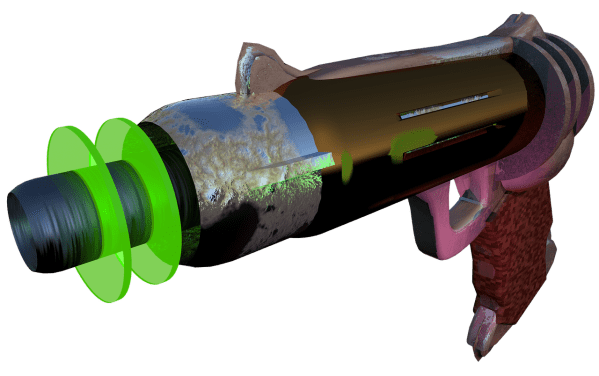
After leaping from his makeup chair in a single bound, Frankie jaunted over, wearing that stupid red and silver v-neck Martian uniform costume that made him look like he sang falsetto with The Lettermen From Outer Space. “Get a load of my ray gun.” He held up this bright red plastic toy.

“I’ve seen those at JJ Newberry’s.” Ginny said.

“Yeah. They sanded the label off.”

“So that’s the instrument of my death, is it?”

“That it be.”

“I’ve been shot 19 times in my career. That’s the silliest looking thing I’ve ever been shot with.”

“Any tips on making it look less dumb?”

“Hold it as if it weighs something. If it looks like you believe it’s solid and lethal, the audience might go with it.”

“Hold it like it weighs something. Got it. Cool. Thanks. I’ve never really acted before, you know.”

“Don’t start. It’s a very disreputable occupation. That’s what my mother says, anyway. What do you do normally?”

“I’ve got a band. It’s called ‘Head’.”

“Like the Monkees movie?”

“The Monkees made a movie?”

“Yeah.”

“Oh. Anyway, that’s not the name of our band for this movie. We’re called Frankie DeWolf and the Sensations.”

“Why the change?”

“We’re a psychedelic band, and the message of this movie doesn’t fit our image, so we made something else up when Howard’s check cleared.”

“Smart. Listen, you’re in a psychedelic band. You have some experience with LSD, right?”

“I dropped acid a couple of times, but I’m not that into it. Too unpredictable. Why?”

Ginny reached into her purse and, keeping her body between it any prying eyes, pulled out a small bag of mushrooms. “These are a gift from my daughter Judy.”

“Your daughter gave you peyote?”

Ginny whispered, “I don’t have enough for the crew. Cool it.”

Frank whispered, “Your daughter gave you peyote? Seriously?”

“We have an unusual relationship.”

“Yeah. I guess you do. I have a daughter. She’s seven. I can’t imagine…”

“Yeah. well.”

“How old’s your daughter? Fourteen? Fifteen?”

“Judy’s twenty-three.”

“Wow. I’m not trying to be fresh or anything, but you don’t seem old enough…”

“Math is not the subject I need your advice on, Frank. I’m experienced with grass, but peyote is new for me. And I figured since one of the few advantages of being in this stupid movie is coming up here where the view is nice, maybe I could drop some after we finish killing me. Since I need someone to keep an eye on me through the trip, I was wondering if you would, you know, keep an eye on me.”

Frankie scratched his ear with the barrel of his ray gun. Ginny caught a whiff of Howard’s rotting-funeral-wreath-soaked-in-jet-fuel scented cologne, which meant he was coming over to tell them to come to places. Frankie said, “On two conditions.”

“Which are?”

“First, share.”

“That’s a given. And second?”

“Don’t do it until we’ve played the joke on Howard.”

“What joke on Howard?”

“I’ll tell you later. If it works it’s going to be really funny.”

“Okay. I’ll hold off until after.”

Ginny stashed her baggie and sipped the last of her cup of coffee. She reminded herself that she’d been in good movies and TV shows—well, pretty good movies and TV shows—and set out in search of her mark. She figured it was on the south edge of the pit they’d dug on the top of this mesa, but when she got there she didn’t see anything except dust at the pit’s lip. As a stagehand pulled the back of her blouse up to attach the cable to her harness, Ginny yelled at Gus, “Where’s my mark?”

“It’s not there?”

“If it were there, I’d be looking at it right now.”

Bounding out from behind the camera, Gus looked down at the lip of the pit, frowning in a professional-looking manner before saying, “I guess we didn’t leave one. Could you stand there? We’ve got to do the lighting test over again.”

“Sure, why not. It’s just another hour of my life I won’t get back.” Ginny said.

“There’s no need to say unkind things.”

A flurry of comebacks flashed through Ginny’s head, but she lent none of them voice, mainly because a fight would just mean a longer delay. So she stood there for an hour and a half while they fiddled around with reflectors and camera angles until they finally had the look they thought they wanted. By the time they’d finished, Ginny had sweated out her makeup, so it was time for a new cleanse and coat. Another half hour gone. Then another re-harnessing and another stand at the lip of the pit. The coffee buzz was wearing off, and the time was creeping toward noon and the lunch break, not that Howard ever paid attention to lunch breaks. Ginny would make him pay attention. Little did Howard know that, last year, shortly after she wrapped her role as Carol the Pornographer in Howard’s The Baleful Yen, she’d been elected a SAG shop steward.

Finally, at little after 11am, Take One. Frankie took his position. Ginny summoned the emotional recall of begging her mother not to set her stuffed animals on fire for flunking 7th grade math, the same punishment dear old Mom would visit on Judy sixteen years later. Goddamn it, now Ginny was pissed instead of scared.

Dope Dealers From Outer Space, Scene 46, Take One.”

“Action.”

Ginny bent her knees in supplication and screamed, “Please, no. HighMar! Please no!”

“Die, Earth whore!”

With a mighty yank, the stagehand pulled Ginny backwards and off her feet. Into the pit she fell. On impact with the mat, pain rocketed through her back. “Motherfucker!” In seconds, concerned faces were looking down on her from the surface world. Ginny groaned and rolled over. Lifting up the mat, she found a pointy rock underneath. “Look at this! Nobody saw this? What the fuck is this?”

Frankie jumped in, “Are you all right?”

Ginny got up, rubbing her lower back. “I guess so. I’ll have a bruise the size of Texas, but I think I’m okay. This stupid harness is probably why I still have a kidney. Fuck!”

Howard looked accusingly at the crew, “Which one of you screwed this up? Which one of you useless assholes screwed this up?”

No one replied.

“You pieces of shit,” Howard went on, face the color of the Krypton sun, “You could have killed her. I could have been sued. I—“

“Blow it out your ass, Howard!” Ginny said. “You could’ve checked, but you didn’t. You never check on anything. You just make sure that someone else has to clean it up when you blow it. Now somebody help me out of this pit.”

One of the stagehands, with one pull of his beefy arm, raised Ginny back to the Earth’s surface. “Now,” Ginny said, “Pull up the mats, remove the stones. rake the area down, maybe pour some of the sand back in that you took out to dig this pit, then lay the mats back down and let’s start again. Okay?”

“You’re not the director of this film, Ginny.” Howard snapped. “You back off.”

“I’m taking lunch now. Back in an hour. Frankie, want to come with?”

“Right with you.” Frankie clambered up and started following Ginny back to the craft services cooler, where Howard kept the bologna sandwiches. As they walked away, Ginny heard Howard shout, “Pull up the mats and get those stones out of there, and someone bring in some of that sand to pad the floor of this pit. Right now!”

Putz.

Ginny and Frankie choked down their bologna sandwiches and RC colas. As they waited for the lunch meat and sugar burps to subside, Frankie asked how Ginny ended up in Howard’s films.

“Howard got a crush on me in ’57. I was the love interest in this western, Death Rides To Laredo or something, for Universal, which Howard saw 34 times, or so he claims. And when he sold his half of his family’s heavy harvester business to his brother and got into making movies, someone told him that he could get good actors for bit parts if he found ones who had a only few days left on their contracts at the end of the year. A lot of actors do. Three days, four days, sometimes a week or two left over from the year’s allotment. So anyway, he checked through the player’s directory until he found out I’d moved from Universal to Paramount, and whenever he was making a picture he made sure to do it before the fiscal year was up so he could claim my days. He buys up my scrap days, Paramount makes its money, and I kill myself falling into pits.”

“Bummer.”

“Yeah.”

“How do you know he has a crush on you?”

“Because the first time he cast me, in The Caveman Watusi, he tried to make the leap from crush to couch. I brushed him off and told him to go back to his wife. I don’t know why I said that last bit. I don’t hate his wife. So, to change the subject, tell me about this joke you guys are—”

When Frank opened his mouth to reply, Howard called them back to work. As Ginny passed near Howard, Howard grabbed her arm, “You and me are going to talk.”

Pulling Ginny back toward the coolers, Howard leaned in close and said, “You don’t make me look bad in front of the crew.”

“Get your damned hand off me, Howard.”

It took a moment, but Howard gave Ginny her arm back.

Ginny rubbed her bicep. “You look bad on the set without me, Howard. Besides, what are you going to do? Fire me?”

“Paramount would be upset.”

“Oh, do not try to pull the ‘you’ll never work in this town again’ shit. When Paramount tells me I have to go work for you, they’re always apologetic. If you tried to mess me up with them, it’d backfire. They like me. They think you’re a zero. Now I’m here to act for you because my contract says I have to. So let’s punch in and do our jobs, shall we?”

“Paramount Pictures Incorporated, A Gulf and Western Company thinks I’m a zero? Are you sick in the head or something? I make huge films. My films make huge money. Just the other day a major paper compared me to Orson Welles. What do you think of that?”

Ginny wasn’t sure what to make of it. Sarcasm? The reporter fell down and hit his head on something hard? The stringer for the Redlands High School Picayune was hard up for a metaphor? Howard made it up just now? The list of possible interpretations was endless. “I don’t make anything out of it.”

Howard sniffed a couple of times and puffed his chest out. “Well, you should. Because I don’t do anything better than I do this, believe me.”

“I believe you.”

“I mean, you’re not bad looking, but you’re dumb, Ginny. Really dumb.”

Ginny’s shoulders bunched up. Hatred set her veins and arteries on fire, and she shuddered as if she were primed to unleash great forces upon Howard. But she counted to ten and let it abate. “Let’s go to work, Howard.”

“Mr. Zez.”

“Howard.”

Ginny found the grip and had him help her don her harness. “Am I going to break my back next take?”

“No. We saw to it. You’ll be okay. We swear.”

“All right. I’m not puncturing a lung for this picture.”

“You won’t, honest injun.”

That’s great, Hopalong Cassidy. What are you? Twelve? “Fine.” Ginny took her mark. She felt the line tense behind her. Frankie took his mark. Howard farted around for a minute or two, then called for places. Take 2. “Action.” The cord yanked Ginny into the pit. She hit the mat, let out a little puff. But it was all right. Ginny rolled forward, got to her feet, and peeked over the edge of the pit. “Did we get it?”

“No.” Howard said. “There was a problem with the camera. It didn’t start off right. Let’s go again.”

The stagehands helped Ginny out. Back on her mark. “Places everyone”. Speed. Take 3. “Action.” Yank. Oof. Up.

“Aw, shit. What now?” Howard said. “Sorry. We need to go again. These cheap cameras. Why doesn’t the studio send us better equipment?”

Because you don’t pay for it, you putz. Ginny clambers out again. The costumer comes over with a brush and starts dusting her off. “Howard, this isn’t a tracking shot with a thousand extras. Can we get this done?”

“I’m doing the best I can.” Howard said. “Please be patient.”

Oh, Good. You’re doing the best you can. Why can’t you aspire instead to do the worst that a competent person can do? It’d be better by a factor of ten. Okay, Ginny, hold on. How many more of these can there possibly be?

Take four. Oof. Take five. Oof. Take six. Oof. Take seven. Cable broke. No spares, so the stagehand had to run into town to get a new one. On the stagehand’s way down, Frankie gave the him a dime and phone number to call to tell the bass player of Frankie DeWolf and the Sensations that he won’t be able to rehearse tonight. Short break. Coffee. Stares into the middle distance alternate with long looks at the bag of mushrooms. Oh, great. He’s back. Take eight. Howard: “Maybe this is the wrong angle. Let’s move over this way.” More lighting tests. Fresh makeup. More brushing of clothes. Getting hungry. Take nine. Oof. Take ten. Oof. Take eleven. Tarantula! Right by Ginny’s face, looking right at her! Jesus Fucking Christ!

Ginny scrambled out of the pit. The skin over her ribs felt like frying hamburger. Her back ached. Her costume was now wearing a mask of sand. “Get the fucking spider out of there. As long as it’s in. I’m fucking out.”

Howard bounded over, smiling, “You should know things are going great.”

Ginny got up on one knee, looked up at Howard, and saw in his smug expression all the evidence she needed that none of these takes had been necessary. He was just fucking with her now, showing her just how far he could push her contractual obligation. A day meant a day. 24 little hours of as many takes as he wanted. By the time he got the angle and lighting and take, Howard would turn Ginny into a bruise with legs. “Howard, how many more?”

“I need to make sure we have what we need, Ginny. It’s what professional filmmakers do. You want to work with a professional, don’t you, Ginny?”

Excuse me, Howard. I’m going to the State Legislature to lobby for the repeal of the laws against murdering your boss because I think those laws are wrong. “That spider needs to be out of there.”

“Sure. Get some water and get brushed off. We’ll handle it.”

Limping slightly because in the scramble she must have pulled something, Ginny grabbed a glass of water from the catering table, sat in her chair, and put the glass to what were now chapped lips. She didn’t like to think of herself as suffering. Surely, there were victims of floods and famines and brutal tyrants who would gladly trade places with her, for at least six takes. Were any of them available? She’d split her per diem.

Some man by the pit screamed, “Get it off me! Get it off!” Ginny guessed they got the spider. Though it could have been something else. Maybe a roc was dragging him off to its nest to feed its children. Why couldn’t that be me?

Ginny stretched her neck, got a few satisfying pops for her trouble, then looked down at her bag.

She’d known actors who’d gone on drunk or high. They’d always say they’d done great, but that was mostly because their fellow cast members had done a great job of covering their fuck-ups. Still, what was there to fuck up on this job? Look scared, beg a little, cable gets pulled, the end. It doesn’t take extraordinary powers of memory to handle that. Besides, if Howard could mess with her, she could mess with him. Fair was fair. Was Ginny right, or was Ginny right? Ginny reached into her bag, pulled out the baggie of shrooms, and chewed as many as her daughter’d recommended.

Ginny passed by Frankie on her way back to her mark, “Keep an eye on me.” She said. “I may get a little weird.” She found her spot and watched the sand at her feet. These little swirls started, well, swirling, in shapes that made the desert floor look like the carpet her friend Susan had put in, so many little squares, but with rounded corners, turning and turning like parts of some great machine. A warm wave washed over Ginny just as the stagehand attached the cable to her back. A cool, prickly feeling danced across her goose pimpled skin as the world poured the words “Take Twelve” into her ear. And she laughed and said, “Take twelve what?”

“Action.”

And Ginny looked up at Frankie. She saw he was aiming a gun at her, but out of it were coming these blue and white swirls, like See’s peppermint sticks. So she kept laughing, pointing at Frankie until finally the stagehand yanked her. Ground streaked into sky which streaked into Earth, from which they make loam which would eventually stop up a beer barrel. When she hit the mats, the sound of her breath forced from her body seemed to echo from someplace deeper than the center of the Earth. All this was one, wasn’t it? Sky, sand, cable, Ginny, Frankie, even Howard. Well, that last one was a pity, but still…

Frankie came. Reluctantly, Ginny took his hand and let him launch her from the pit.

Howard was standing there, also looking like he was made out of Susan’s swirling carpet. Judy you are the best. You get that from me. Howard said, “That was an interesting choice, laughing like that.”

“I thought so.” Ginny said.

“Let’s stick with that. It makes you look extra-crazy. I think it might be good.”

“I think it is.” Ginny said.

“Let’s go again.”

“Let’s.”

By the time the next take was set up, Ginny saw little wizards dancing around Frankie, which made laughing really easy. They were all dressed like Mickey in Fantasia, all grinning and pirouetting and briséing all over the place. Ginny’s ribs hurt from the tickling this gave her, and when she got yanked back, she cackled all the way down. More takes followed. Ginny lost count of how many there were. But when they stopped, and she was lying on her back in the pit, she looked up and saw this great, pulsating light. The Great Atom, come to visit, hovered in the sky over her, blue and red, with tendrils of parti-colored light radiating from it in all directions. It seemed like the key to everything in the universe, the thing that really ruled over all she saw and heard and touched. And yet it didn’t judge. It didn’t tell her she should feel guilty, or bad, or ashamed of her life or career. It just was. Above her, as she was below.

It.

She closed her eyes, then opened them. It was there.

She closed and opened her eyes again. It was still there.

She closed and opened her eyes yet again. And it was gone. Above her were stars. So many millions of stars. Ginny never saw these in the city. From not too far away, she heard a familiar voice shouting, “What the what? WHAT?”

Ginny sat up. She couldn’t see the walls of the pit she was in, but she felt dirt and dust and smelled grass pollen. She got out of the pit and saw they’d struck all the equipment, except the mat she’d been lying on, which she now supposed she’d have to strike. The voice was coming from below somewhere. It was Howard’s voice. Ginny ran to the edge of the bluff and looked down, but she couldn’t see anything except a few lanterns. One of the lanterns looked like it was bouncing fast along the desert floor. “IT’S THE GHOST!” Howard shouted “IT’S THE GHOST!”

Goddamn it. I missed the joke. They’re making Howard look like the idiot he is, and I’m missing it. Now somebody will have to explain the gag, and I’ll think it’s a little funny, but I’m missing the best part, the “if you could’ve seen the look on your face” part. And what other joys can I have on this worthless job?

The Great Atom whispered in Ginny’s ear, “Am I nothing?”

Ginny got a good laugh out of that. No, she thought as she walked back to the pit to retrieve the pad, you’re not nothing.


JIM SNOWDEN has placed fiction in Pulphouse, Mind In Motion, The Seattle Review, The King’s English, and MAKE. Dismantle the Sun and Summer of Long Knives, his first two novels, were published by Booktrope in 2012 and 2014, respectively. Jim’s novella, Escape Velocities, was named a notable story by the editors of StorySouth. His one-act play, Dr. Kritzinger’s 12 O’Clock won the Bill and Peggy Hunt Playwright’s Festival in 2015.

Cabinet Of Heed Contents Link 21

Image via Pixabay

The Star Collector – Damon Garn

Mama told me we came from the stars, and I believed her. She probably meant it in a more symbolic way than I had understood it at the time, but I believed her nonetheless. I don’t think this dismal ball of rock and ice could have spawned something so glorious as Mama on its own. We were from another world, another time perhaps.

The viruses, the radiation, the contaminated water made us sick all the time. You could taste the sickness in your mouth like the residue of vomit. You could smell it oozing out of yourself. It was part of life. I didn’t realize when she became ill again that it would be for the last time. That first night she was sick, she’d tossed and turned, fevered but not really burning up, then cold but without body wrenching shivers. She’d eaten the small dinner I’d fixed her – gritty bread and chunky milk – so I didn’t worry.

The second day was much worse. She’d moaned and talked, describing sunsets she’d seen as a little girl and oceans she’d swum in on her honeymoon. She didn’t recognize me at all that day. She’d whispered to herself, sometimes giggling gleefully. Her body took her through emotions and sensations, breaking her mind slowly. It scared me, making me feel small and vulnerable. Mama was my whole world.

The third day she was much better. Her eyes lost their fevered light and her sweaty body seemed to regain some strength. She ate all I fed her, including my own meager meal for the day. She looked ashamed when she realized that, but I was so relieved that I hardly noticed the hunger pangs.

“You are my star, child, do you know that?” It was something she said to me all the time. Like I was some magical thing for her. She sighed. “You are my star. They are all stars out there now – your Daddy, grandma and grandpa, Boxer…” her voice trailed off and she stared through the ceiling into a galaxy only she could see.

Boxer had been my dog. He’d died protecting me from rabirs – fierce predators that roamed this part of the world. I’d snuck away from the house, just as I’d been told not to do, and he’d faithfully followed me. When the rabir pack came after me, he held them back as I fled through the icy ravines toward home. We found what was left of his mutilated body in the snow the next day.

Now he was dead. And apparently he was a star.

When Mama slept that night, I stepped out of the front door and looked up through the darkness toward the sky. So many little lights out there. Were those dead people? Children and dogs and parents and grandparents? Is that what Mama meant when she said they were all stars now? It was kind of creepy and I shivered with more than just the bitter cold. I didn’t understand her spirituality any more than I understood the science she tried to teach me.

“No no no!” she’d say in exasperation as we peered at an old astronomy textbook. “The stars are huge. They are on fire.”

“But they’re not huge, Mama. Look at them at night – they are tiny. They don’t look like fire.”

She would sigh and continue trying to teach me. She sketched starships and cities and medicines and something called a restaurant where you could ask for as much food as you wanted. She called all this “civilization” and tried to help me imagine it. Mostly it made me feel angry and very lonely.

But at night, as she tucked me into my small bed, she would say “Goodnight. You are my star, child, do you know that?” and kiss me gently.

I was so confused.

When she died the next morning, I understood perfectly. I felt her, far above me in the empty sky. A beautiful twinkle of light that assured me she was still there, still part of me, still part of my future. She was a star now.

And I didn’t want her to be.

She was Mama, strong and smart and beautiful. I was skinny and little, the illness should have taken me instead. I could have been a real star for Mama. Didn’t she always tell me I was her star anyway?

I refused to accept her death. There had to be something I could do. Some way I could make it better. Those stars up there – weren’t they always giving us their light? If Mama was up there, couldn’t her light come back to me? I thought about this in my bed that first night I was alone.

I found our toolbox and I took our old dented flashlight and I worked all day. I used tape and gum and science and religion and I built the Star Collector. It was a wonderful device, made of love and fear and hope and tears. I didn’t have any blueprints, just my own grief-ignited imagination.

That night I dragged Mama’s light empty body on our sled to an open space between the cliffs and laid her in the snow. Boxer was buried there, so I had always associated this place with him, and with how much I’d loved him.

I placed the Star Collector on Mama’s chest and turned it on.

And it worked.

A cone of star light seeped from the sky into my Star Collector. The bright light was kindled into a single point at the center of the lens. It pulsed like a struggling heart a few times before the Collector became full and turned off.

Mama opened her eyes to the stars.


DAMON GARN lives in Colorado Springs, CO with his wife and two children. He enjoys hiking, writing and annoying his neighbors with mediocre guitar playing. He writes in the fantasy/sci-fi realm experimenting in flash fiction, short stories and a novel. Follow on Twitter: dmgwrites or at http://dmgwrites.wordpress.com

Cabinet Of Heed Contents Link 21

Image by Jonatan Pie on Unsplash

Her Other Passion – James Woolf

The first time she saw me, she jumped up and down so much the bedside light flickered and went out. I later discovered that the wiring in her apartment was in need of upgrading.

“You didn’t.” she cried. “You didn’t need to do that!”

They set to work immediately and soon had me wearing the chocolate brown leather jacket I had arrived with. Her face crinkled as she inspected me.

“I do love the feel of real paper. But, I think.…” She stopped.

He smiled. “For me, I sometimes make deeper connections with machines – or in my case, bicycles – than with other humans. Does that sound too crazy?”

Unexpectedly, I was tossed onto the duvet.

“Not this human, I hope,” she reprimanded, pushing her puckered lips hard onto his and forming a tight cordon around his neck with her arms. Then they collapsed, by degrees, like the flat corrugated cartons I had seen knocked over in the factory.

So this was it. I had arrived. But what happened next, immediately to my right, I was unprepared for. I understood it only in terms of him uncovering his USB cord in an effort to establish a connection with her power port. Yet, despite vigorous attempts, no stable connection could be made.

Instead of showing frustration, they lay back on the bed, screeching with laughter. I now know from my education in literature that the activity that had occurred falls within the category of “fornication”, a word I’d been aware of from my two dictionaries. What it entailed, I had never understood. They followed it up with something I later recognised in Fifty Shades of Gray, where it masquerades as “my inner goddess doing the merengue with some salsa moves.”

Afterwards, they concentrated on making me operational. During the registration process I discovered that her name was Judy. She decided that I was to be Algernon, after the character in The Importance of Being Earnest. I loved my new name – it was so me. And within minutes she was referring to me as Algie!

What a period of joy it was that followed! What edification. The delights of discovering with Judy the elegance of Jane Austen and the passion of Charlotte Bronte. The rapture of being held by her as she raced through Great Expectations. Her fingers pulsing nervously on my reverse as she lived and breathed The Tell Tale Heart. Judy carried me everywhere, pride of place in her emerald green Spanish leather handbag.

My early diet of Jane Austen had hardly suggested that people work for a living. But Judy was the diary secretary to a Chief Executive, and on her very first day back at the office I was passed amongst her colleagues and admired. How clever of Dieter to so finely judge his first present. What a catch he must be! I admit to experiencing some regret that my early moment of glory was shared with him. I now also know that their reaction was chiefly because I was a novelty, being an early incarnation (complete with tiny keyboard).

Quaint as it may sound, I was consumed by my sense of duty. I was now Judy’s. It was my job to store her books and facilitate her choices (displaying the text in her preferred font), define the trickier words and to respond to her natural reading rhythms.

Sometimes, as light and shadows from his lava lamp played on the sloping wall of his bedroom in the attic, she would read aloud to him the stories of Guy de Maupassant, her fingers squeezing me ever more tightly with each turn of the page. How well I understood from that pressure on my buttons, her desire for him to love all that she loved. But Dieter, whilst attentive and complimentary, never quite reached the requisite levels of enthusiasm. And so these occasions were always punctuated with questions from Judy as to what he really thought.

Over time (and this was preferable to me), reading once again became something that she did without him. The classics were now supplemented by a newspaper, The Independent, and also with Dieter’s letters which he sent direct to me (wirelessly) when he was away. I had been pleased to learn that he divided his time equally between the UK and his native Germany.

The letters were long and packed with details about his father’s bicycle company, their new superlight frames and plans to make headway in the American market. Having covered business matters, he would allow himself more informally to focus on Judy and their relationship.

Judy would approach the reading of these letters in a different way to the classics. She was as keen to go back and re-read passages as she was to progress forwards towards completion. Sometimes she would stop reading, a puzzled frown lingering upon her brow. What was she searching for beneath the words? Did they alone not provide her with nourishment enough? Having gleaned a thing or two about communication between lovers, I debated whether her love for Dieter was more like the foliage in the woods – something that would change with each winter – or closer resembled the eternal rocks beneath. Having finished a letter, Judy would usually make a hot drink and return to their living room. I should have mentioned that they had taken the – in my view – unfortunate decision to live together. She was occasionally tearful when alone in the evenings, but it was then that I was most full of hope. I would will her to pick me up so that we could share in the activity that was dearest to our hearts. Sometimes she would run a bath and, holding me carefully above her breasts, would read in steamy silence. I adored it when it was just Judy and me time!

The most dismal days for me were those when I was inexplicably left alone in the apartment. I preferred to believe that Judy had picked up the wrong bag, or had simply forgotten to take me to work. I could not have lived with myself if I had done anything to cause my abandonment; I summarily dismissed such thoughts from my mind. During those days, I hated the silence. I hated the afternoon presenting its passport and, with me still suffering alone, crossing the treacherous border into night. And most of all I hated being apart from Judy.

It was on just such an afternoon when I was alone that a bald man in a cream T-shirt entered the apartment. I had become aware of noises (I had hoped that Judy was back from work early). But then he slapped the bedroom light on, belched, and began carelessly dragging anything he liked the look of into a large hold-all bag. I was on the bedside table, where Judy had left me the previous evening. She had read for thirty five minutes after Dieter had fallen asleep. I had luxuriated in her attention, made all the more pleasurable by being in front of his sleeping frame. But now, in that very same spot, I was faced with an altogether different situation.

I had sufficient knowledge of petty crimes committed by the orphans and pick-pockets of London to know what was going on. I’ll admit that it was my own safety which initially concerned me. What if the man dropped me into that sack along with the designer clothes, jewellery and electronic goods? Worse still was the realisation that he was mad as well as bad. Raising his right leg in front of me and using the base of his foot, he smashed the full length mirror on the wardrobe and kicked the dresser stool, sending it clattering into the door of the en-suite. Then, approaching me, he made as if to grab me, but instead swiped at the bedside table with his bare arm, tipping it over and causing me to perform a neat forward roll on the floor. A torrent of CDs and framed photographs from the shelf above rained down on top of me. I could hear him above me, crunching on the piled up possessions, and I was in fear that he would step directly on me and crush me. But the noise subsided. I heard one or two thuds and he was gone. Oh, the agony of waiting for Judy’s return. The guilt that I hadn’t done more to stop him.

That day, Judy and Dieter came home together. Judy was utterly dismayed by the chaos she encountered; she ran from room to room, spraying expletives wherever she went. Dieter called for her to remain calm, stressing that she must not touch anything: “It is all evidence, Judy!”

But Judy was already in the bedroom, and, in the confusion of the moment did not hear him. She was on her hands and knees sifting the debris, wailing for her Algernon. And then, as she scooped me up and held me aloft, she planted a beautiful, lipsticky, kiss on my screen. I knew in that moment how much she loved me and how much I loved her.

Her delight was cut short. Dieter stormed in behind her, screaming about an open window that he’d discovered – that she, Judy, must have left open – and that would certainly scupper their chances of recovering on their insurance. I’d never seen him subject poor Judy to such a vicious verbal attack. But she was not standing for it. Thank goodness for her strength of character. “Since all you care for is the insurance money,” she told him, “you had better phone the frigging company immediately.”

And with that, she marched past him and out of the flat. In the nearest café, she re-read Salmon Fishing in the Yemen, drinking soya lattes and stroking my leather cover repeatedly.

She was my own heroine that evening and I reflected on our special relationship. We e-readers are created equal and innocent, and we mediate our understanding of the world through the personal choices of our owners. Our personalities are therefore truly shaped by (and become markedly similar to) theirs. The relationship between owner and e-reader might be said to be the very purest form of parenting.

I had plenty of opportunity to develop this thesis, as soon afterwards Judy began devouring a plethora of books on the subject. What to Expect when you’re Expecting and Bringing up Bébé were two of the many titles. It was a worrying development, providing a stark warning that my life would soon be changing forever.

My feelings of insecurity were not helped by a conversation on the subject of names that I overheard from a new fuchsia handbag.

“Dietz,” she began. “I know it’s slightly strange, but if it’s a boy – how about Algernon?”

“But – but, what about…?” I imagined him casting his arm in my general direction.

“I know, but I like that name. PLEASE. Algernon?”

How was I to feel then? How could I not wish that I’d been stolen after all and sold on to a new home where I might be truly appreciated?

Since the burglary the atmosphere in the flat had changed. Security had become a charged topic of conversation. There was less fornication and this led to a confrontation in which I was centre stage. One afternoon, Dieter, alone and restless, picked me up and looked through Judy’s varied collection. He began browsing in the online store. He downloaded a sample of Fifty Shades of Gray. And then purchased the whole thing. I did not enjoy the feel of him reading me. I noticed that he did not do so with sustained attention. He flicked from page to page, then settled on a passage which he read slowly and meticulously. I was then dropped (open and face down) on to the sofa as he hurriedly left the room.

I felt degraded. I knew that it was not a book that Judy would ever have chosen and this was confirmed when she said: “It contaminates Algie – just being on him!”

Dieter’s face darkened to scarlet.

“You clearly need to broaden your horizons, Judy.” And in a voice choked with anger, “Now that you’re pregnant, I would suggest our relationship might actually benefit from your reading it.”

I understood by now that I saw only a small part of Judy and Dieter’s relationship. But I had little doubt that this episode was linked to the thorny subject of fornication.

Perhaps it was no coincidence that when Judy forced herself to read this controversial book, my functions first started to fail me. I forgot where she’d reached in the story and soon afterwards opened up on a book about forgiveness that Judy had finished months earlier. She rolled her eyes and called me a “stupid thing”.

And then came the darkest period. Dieter was away. His letters had told of the family business struggling, so he was spending more time in Germany. That morning, Judy returned to the bedroom looking as grey as a battleship. She stayed there for the rest of the day. And then for several more days: sleeping a lot; hardly eating; frequently crying; and never reading. I was a helpless spectator on the bedside table. I had no idea what had happened. No inkling of what was wrong.

That is until a week later, when she received Dieter’s final letter. Delivered wirelessly as usual, he must have also texted her as she opened it immediately. It read as follows.

Dear Judy

From now on I have decided to make my life in Germany once again. My father cannot cope without me. I have realised in any case that I will be happiest with Heike. I may not have mentioned her before. She is our new marketing manager and we have been spending much time together. It is probably for the best that there will be no Algernon the Second. Like me, he would have struggled to find a place close to your heart bearing in mind your other passion.

Naturally I will arrange a collection of my belongings.

Yours

Dieter

It was then that Judy did a strange thing. She found my text to speech function and made me read the letter aloud. It was the first time I’d done this. Despite the discomfort of voicing those words, I was filled with hope that it would now just be the two of us – that I would remain Judy’s forever. Perhaps the letter was hinting that she’d always loved me more than Dieter?

As soon as I’d completed the letter, she made me read it again. And then again! And as I did so, her expression changed. No longer my beautiful Judy, she was now a wild woman whose face was filled with loathing and anger! I wanted to cry out loud that I was not responsible, that I wished only to make her happy. After the fourth reading she looked at me with piercing intensity and screamed a long wordless scream, her mouth hideous and contorted. And then she snapped me shut. Putting me to one side, she left the room. I did not see her for two months after that.

In fact, it may have been less. Or perhaps more. How could I tell, being without hope? I had certainly been abandoned. I could feel the dust gathering on top of me, as if I were a bad memory that needed burying. I lay alone in my sarcophagus of depression.

I was brought to by the voices of Dieter and Judy. I wondered if it had all been a fantasy. Maybe they were still together. And yes, here they both were, in the bedroom, talking about who would keep the clock radio. And a fancy speaker that tuned into mobile devices. Then Dieter picked me up.

“Our old friend Algernon,” he said with a tense smile.

“Yes, your very first present to me.”

“How could I have forgotten? It seems so long ago.”

“Have it. I never use it now. Besides, I’d rather not be reminded of you.”

There was a pause. Dieter put me down again.

“It’s an outdated model,” he said. “If I get one, it’ll be the whizz-bang latest.”

“It was on its last legs anyway,” she agreed. “Let’s recycle it.”

“Yes. Or they can be reconditioned. Better for the environment.”

It was a shock, let me tell you, to hear of myself referred to in this way; a mere object, well past its shelf-life, ripe for recycling or reconditioning. Both the dreaded R words sent shockwaves through my system. They meant me being slated – a whitewash of everything that made me, me. My preference, by a small margin, was for reconditioning. That at least promised a rebirth of sorts, with the possibility of a new owner who might show me loyalty and not cast me so brutally aside.

“I’m not bothered either way,” Judy said. “Leave it with me. I’ll sort it.”

They then moved into the kitchen where they argued heatedly about the silver cutlery set they’d been given as an engagement present. They both wanted that!

The flat went quiet again and another few hours went by before Judy returned to the bedroom, this time alone. She sat down on the stool in front of the dressing table, where I had so often seen her applying her make up before work. She reached across, picked me up and placed me carefully on the dressing table. And then she opened me. She began browsing in the online shop and quickly settled on Cold Comfort Farm. It was about Flora Poste, making a new life following the death of her parents in the Spanish plague. As she read, Judy started laughing – that high pitched cackle of a laugh I’d first heard those many long months ago. Judy suddenly looked at her watch, and, swearing quietly to herself, rose from her chair. She put on her gloves, dropped me into a new burgundy handbag and left the flat.

Image by Gerd Altmann from Pixabay

Round 107 Goes To The Monster – Traci Mullins

I used to fear her dying. Now I fear her living.

The paramedics find her on the kitchen floor this time, unresponsive and chilled like a popsicle.

“A couple more hours and she wouldn’t have made it,” they tell me.

I’m still the emergency contact, but no matter how powerful my love remains, I’ve never won a round with The Monster. For years, the denizen of addiction held us both captive. I’d had to save myself.

When I get to the hospital, the nurse glares at me suspiciously. Pulling back the warming blanket intended to unthaw Molly, the nurse points to multiple bruises on every extremity.

“What’s going on here?” she demands.

I’d seen this before, knew about the drunken falls and collisions with sharp-edged furniture. “This is the fourth time this year she’s been hospitalized. She does this to herself.”

Two days later Molly wakes up, the same haunted defeat in her eyes I’ve seen a hundred times before. I hold her hand as we silently mourn our lost dreams.

The Monster cackles as I look away. Molly lets go of my hand.


TRACI MULLINS writes short fiction and has been published in Flash Fiction Magazine, Dime Show Review, Spelk, Ellipsis Zine, Palm-Sized Press, Fantasia Divinity, CafeLit, CommuterLit, and others. She was named a Highly Recommended Writer in the London Independent Story Prize competition.

Image by StockSnap from Pixabay

Always Meet in a Public Space – F C Malby

Mark Jackson
47 years old
Electrician
Likes football and climbing
Seeks 30-40 year old female for adventure.

After three months of chatting online, this will be all you know about Mark. You will arrange to meet at Waterloo station on Saturday morning for coffee. It is half way between Stevenage and Horsham, and in a public place. Always meet in a public space, you never know, Stacey will tell you. Stacey will tell you lots of things, wade in on a lot of your internet dating with opinions and advice, some of it will be unwarranted. There will not be anything in particular that might give you cause for concern from your ‘chats’ with Mark, nothing that will ring any alarm bells. He will be polite and interested, will ask questions about your life.

But, you will know little about him, except that he will have a teenage daughter, Kate, who wants to be a nurse, and he will go climbing in Scotland and sleep out in the wild without a tent. He will tell you a story about putting up some tarpaulin between his motorbike and a friend’s bike on a recent trip to France, hoping neither of the bikes will collapse on either of them, crushing them in their sleep. He will be funny, charming and less invasive than Tom, a thirty year old chef, who will ask you about your underwear and ex boyfriends, or Henry, a thirty-six year old plumber who will ask for your number in the first message and ask to chat ‘offline.’ You will not be sure whether to decline or ignore, eventually choosing the latter.

Your mother will ask why you can’t meet people the ‘old fashioned’ way, you know, face to face. You will fob her off with the excuse that no one meets like that these days and that no one actually has time to meet face to face — long work hours and modern living. Your mother will roll her eyes and tell you about how she met your father at school, and how he was the only man for her. You will hear the story more times than you will ride your bike to the office, and listen to your mother complaining about plummeting marriage rates and sky rocketing divorces. She will always exaggerate. Face to face meetings will consist of blind dates with oily business men, organised by well meaning friends, and recouping with ex boyfriends at parties, or at the pub, after one too many.

The truth will be that you are afraid of men. All your friends will be married and you will not want to be alone, despite your fears, or childless, by the time you are forty. That is Mark’s dating cut-off point’ so there must be some truth in the matter. Internet dating will be easy. You will log on, late at night with a glass of Pinot Grigio, in your flannel pyjamas, and chat to men without leaving the house. The idea of meeting up will be less appealing, but you will want to see what Mark looks like in the flesh, find out if there is any chemistry between you. He looks warm and friendly in his profile picture. The light makes you think it is summer. He is crouched down in a garden with a brown and white collie — intense, brown eyes, tongue hanging loose.

Can’t wait to meet you, he will say in his last message. Looking forward to seeing that pretty face. It will be Wednesday and your stomach will flutter.

Saturday morning will bring with it a cool, fresh start. You will pull on a polo necked sweater and jeans — not wanting to look too smart — followed by your white Nike trainers. Waterloo will take an hour and nineteen minutes from Horsham via Clapham Junction. You will leave the flat at nine twenty, allowing for a ten minute walk to the station and time to buy a ticket. You will take a book for the journey, Girl on the Train, and understand the irony. It will be an intense read and there will be an absence of commuters. The carriage will be empty, apart from a man at the other end, reading a paper. You will remember to text Stacey to tell her where you are meeting, will have fed the cat and told your mother you are going for a job interview. Two of these things will be true.

An announcement will crackle across the tannoy: something about not leaving belongs on the train and Vauxhall being the end of the line. You will slide the book into your bag and glance across at the man at the other end of the carriage. He will already be waiting by the door. The cafe will be located in the atrium of the station and you will wonder whether Mark might already have arrived. As you reach the door, you will realise you arrived first and will take a place at a table near the door, just in case. He will arrive five minutes later, dressed in smart trousers and a pressed shirt. It might as well be starched at the collar. He will smell of cologne as he leans in to kiss you on the cheek. Your stomach will lurch as he touches your skin.

“Excuse me, could we have two coffees?” he will ask the waitress.

“Certainly, Sir. What would you both like?” She will look at you.

“I’ll have a cappuccino, thank you,” you will say with a smile, but it will be forced.

“And I’ll have an espresso.” The waitress will watch Mark intently. You imagine most women linger; he is good looking and toned, dark hair, blue eyes, long lashes. He will take your hand. “I’ve been wanting to meet you since we started messaging, but I didn’t want to seem too keen.”

“It’s good to take things slowly.” He will not respond.

“So how was your journey?” he will ask.

“Smooth, no problems. I’ve almost finished my book. How about you?” You will imagine that he might ask about the book.

“It was fine. I’ve been here for a while.” You will wonder what he did before he met you.

“Your job must keep you busy.”

“Yes, but it earns me good money.”

He will run his finger around the rim of the sugar pot. You will watch the waitress making the coffees, willing her to join you, but you will not be able to explain why the thought enters your mind. You won’t feel comfortable with him in person. There will be no real reason, but something won’t feel right. Trust your gut, one of your friends will tell you. Maybe there will be something in it. The coffees will arrive, but Mark won’t look up. You will want to grab the waitress’s arm, stop her leaving. Your reaction will make you question whether or not there is something wrong with you. Trust your gut.

“Tell me about Kate. How is she doing?”

“My daughter? She’s good, gone to see a friend today. She’s studying for her mock GCSEs. It’s a stressful time.”

“I can imagine.”

“What about you? How was your week?”

“We had a big project to deal with, lots of meetings.” You will not be able to remember any further details, and won’t feel comfortable elaborating.

He will raise his eyebrows and take another sip of coffee. He will be cooler in the flesh than the warm and interesting online version of himself. Always meet in a public space, Stacey will say. “Tell me about your relationships. Any bad stories?” he will ask.

“Nothing I can think of. Why?”

“It’s always interesting to find out who people have been out with in the past. What luck they’ve had.” He will smirk.

“It’s not something I feel comfortable talking about.”

You will get up to pay for the coffees and walk towards the counter at the back of the cafe. Always meet in a public space. The waitress will give you the bill as you will pull out a crisp ten pound note. It will have been newly printed. You’ll feel nauseous, won’t want to return to the table.

“Were the coffees okay?” the waitress will ask.

“Hmm? Yes. Lovely, thanks.”

“Are you all right, Madam? You look pale,” she will say.

“I think so. The man I’m with, what do you make of him? I know it’s an odd question, but it’s a blind date and I don’t feel comfortable.”

“I don’t think you need to worry.”

“Why?” you will ask, and you’ll lock eyes with her. The waitress will nod in the direction of the table by the door. You’ll turn to find it has been vacated. Mark will no longer be there. “Is he in the men’s toilets?” you will ask.

The waitress will shake her head. “No, he left through the front door just as you got to the counter. I did think it was a bit odd. If you don’t mind me asking, what made you get up? You’ve only just arrived.”

“I needed to get away. I feel a bit sick. Can I have a glass of water?”

“Yes, of course. Do you want me to call someone for you?”

“No, I’m fine. I’ll head home. Thank you.”

You will leave and catch the next train back. You will not be able to bring yourself to read the rest of the book. Your nerves will overtake your desire to discover the ending. The carriage will almost be empty again. You’ll watched the trees pull away into the fields as the train picks up pace, and wrestle with questions about the date, about him; and you’ll wonder. Always meet in a public space.

At Horsham, you’ll pick up a Gazette. You will walk the ten minutes to your flat, turn the key in the lock and climb the stairs. You will kick off your shoes and flick on the kettle, find a corner of the sofa and pull out the paper. Flipping through the first few pages, you’ll glance at the weather on the back page, then scan the crossword. It will be a tough one this weekend. You will hear the kettle switch flick up and you will get up to make a coffee, then settled back down and turn to the middle section. He will be there. Mark’s face will be in the paper.

Jeffrey Richards (56), wanted for the murder of Kaylee Williams (16). There will be a picture of the bloodied face of a teenage girl next to his. The words, ‘violent sexual assault,’ will begin to blur as you try to read the detail. You will want to vomit, want to scream. Always meet in a public space.

You will contemplate emailing the dating app, calling the police, calling Stacey or your mother, but you will be unable to move; instead, you will drop your coffee, watch it spill across the sofa and across your lap, watch the brown liquid bleed into the fabric. Always meet in a public space.


F C MALBY is a contributor to Unthology 8 and Hearing Voices: The Litro Anthology of New Fiction. Her debut short story collection, My Brother Was a Kangaroo includes award-winning stories, and her debut novel, Take Me to the Castle, won The People’s Book Awards. Her stories have been widely published both online.

Image by Primrose from Pixabay

Leaving Lucy – Faye Brinsmead

Lucy!

That textured patch in the gap between liquidambar leaves is the crown of her head. Coarse-weave brown, with silver wisps like glow-worms. They remind me how long we’ve been doing this. Our nightly performance has changed over time. She no longer bawls my name, she stage-whispers it. Soft, but intensely audible.

I don’t usually lower my voice. Bugger what the neighbours think. But tonight it’s a tiny sound carried on the breeze, fluttering past her ear like a dead leaf.

Don’t want any.

The glow-worms hesitate. Should she insist? She’s tried threats, cajoling. Bottom line is she can’t climb up here and get me. Or force spaghetti-bolognese-boiled-carrots-and-brussels-sprouts down my throat.

Molecules of night hang in suspension. Stars delay their rising. Gnats tread air.

Lucy, this has gone too far. I want you inside in twenty minutes. Your father and I …

I listen to her vinyl sandals scrumpf through wet grass, prepare to step down, land heavily on the concrete path. Like a conductor, I could wave in the skreek of the sliding door, waggle a finger for each heel-fall, welcome silence with a levelled baton.

Instead, I lie back in my nest, staring up at leaf-blotted stars and mouthing her name. Lucy, Lucy, Lucy.

Three years ago, when Emily, my only friend, moved interstate, I took to spending recess and lunch in the library. At the back of the main room, spiral stairs led to a loft where old magazines sprawled on dusty shelves. In the gum tree whose lemon-scented leaves pressed against the loft window, a magpie was raising her brood. As I watched them that first day, a National Geographic slid off its shelf, landed near my toe. Was Lucy a Tree-Climber, After All?

That’s how we met. I, crouching on green shagpile; she, staring at me through the polymer clay eyeballs of her reconstructed face. We were both eleven. We didn’t look alike, except for the brown eyes. But something made me feel I was gazing at my reflection in a brackish pool. After I found Lucy, I didn’t try to make any other friends.

Her skeleton, a broken necklace on black velvet cloth, didn’t have any feet, just a single ankle bone. By contrast, the toddler Australopithecus afarensis whose discovery had prompted the National Geographic article had a large, curving, wiggle-able big toe. So she could shinny up the home-tree if a leopard slunk by, crawl into her family’s nest at sunset.

Nest? Yes. After dark, our ancestors became wingless birds who folded up their bipedal bravado in the hair of trees.

That afternoon, a hail of Bunnykins cups, bowls and plates dispersed Sal, Prue and Mattie. Psycho! Sal shouted over her shoulder as they fled inside to tell on me. The tree-house was mine. I swept the rest of the girly rubbish over the edge. With my brother’s help, I moved the pine platform about 10 feet higher, covered it with earth and dead leaves. The scents of growth and rot creep down to meet me as I scale the trunk after school every day.

My nest – our nest – contains nothing but an Arnott’s biscuit tin of clippings about Lucy culled from magazines and newspapers. I’ve grown quite a bit since the day I evicted my sisters. When I’m up here now I have to crouch in a way that pulls me back three years, and three million. Side by side, we gather fruits, dig for plants, suckle our babies. Our people live in a range of habitats, but I’ve always known that our home-tree grows beside a lake, its roots slipping among strange shapes of ancient fish.

I’m not allowed to sleep up here. Come down by dinner-time is the rule. Recently, I’ve been bending it more and more, testing the give of its fibres. Tonight I don’t care if it breaks. I’m not coming down. Lucy’s fall hurts less up here, even though, squinting through the swirl of autumn leaves, I can plot every micro-second of her trajectory.

I saw it at breakfast time, on the front page of the newspaper fortress Dad hides behind.

Lucy fell from tree, new CT scan suggests

The skeleton of Lucy, the 3.2-million-year-old hominid, shows injuries best explained by a fall from a tree, a team of scientists claim. Full story page 10.

Braving Dad’s outrage, I snatched the paper, ran out of the house, scrambled up here. It wasn’t easy in my school dress, which I tore on a forked twig. Through a smear of tears I read the article over and over. Bits of it have lodged in my head like shivers of glass.

We wanted to piece together the story of her life. We had no idea we’d find the clues to her death … She landed feet-first, probably at the edge of a lake … Almost certainly, death came quickly … quickly …

Twenty minutes must have passed. Another coat of dark blue has deepened the sky. I’m ready to face them. Heels tensed, hands gripping branches, eyes trained on the outside light. If Dad brings out the ladder –.

These are the fractures we see when a modern human falls from a great height.


FAYE BRINSMEAD lives in Canberra, Australia. A lawyer by day, she writes short fictions in all the snippets of time she can find. Her work appears in Reflex Fiction, MoonPark Review, Twist in Time Literary Magazine, formercactus and Vamp Cat Magazine, among others. Say hello on Twitter @theslithytoves.

Image by Michael Gaida from Pixabay

Mare Serenitatis – Jennifer Wilson

no matter that I am no beauty,
the mirrored sea will not break
beneath me. instead I tread
as though suspended, barely
wet, the soles of my feet
silvered by the tide.

and I move against the moon
who would gravitate to storms
should I slip, make a
miscalculation of my steps
as I seek you, stoop
to pick your pale white
eyes up from their bed –
little closed cowries pressed
tight against the grit and darkness
of the ocean floor.

O the sea, my love, is nothing
to fear though it is no
friend of mine. black bands
of hagfish make no meal
of bone. do not cry,
there is salt enough
in our wounds already.


JENNIFER WILSON lives in Somerset, England, with her newborn baby and fully-grown husband. Her work has appeared in Memoir Mixtapes, Molotov Cocktail and Mojave Heart among others. ( A full list can be found at jenniferwilsonlit.wordpress.com, while she may be found on twitter @_dead_swans )

Image by Stefan Schweihofer from Pixabay

Create a website or blog at WordPress.com

Up ↑