What’s In A Name – Marissa Glover

Our name is the first secret we tell a stranger. I know from Sunday school that Father Abraham had many sons and God changed his name from Abram to Father of Many Nations as part of the promise. It was like smack talk—same as Deion Sanders, showing up to play ball. Here you call him Prime Time. Even before the pro contracts and Super Bowl rings—he is he that he says he is and woe to the Gators and Tigers who do not believe. “Danny Rand” won’t pack the punch of “Iron Fist.” Don Diego de la Vega is a cowardly fop. No one’s afraid of Bruce Banner. After the name change, Big Abe could roll up to Canaan, or wherever, with his flock and barren wife—a walking talking billboard, calling things that be not as though they be. His introductions functioned as prophecy: Hello, I’m the Father of Sand & Stars & Sons. Seems the name mattered. Even for God, the promise was not enough.

My father promised my mother they’d name all their kids with the letter “M.” My brother Michael’s babysitter was called Larissa—such a pretty name, my parents agreed. So I was born Marissa and some websites say the name’s from Mara, meaning bitter, or Mary, of the sea. It’s hard to tell, really—what secrets we keep locked in the chest. After the divorce, my dad broke his promise, naming his third and final child Joshua—the brother who watched Inspector Gadget and G.I. Joe; who played cowboy, loaded cap guns blazing through palmettos; a boy who was and is God’s way of saving us all.

MARISSA GLOVER teaches and writes in Florida, where she is co-editor of Orange Blossom Review. Marissa’s work has been published in journals such as Helen: A Literary Magazine, The Furious Gazelle, Ghost City Review, The Coil, and New Verse News. Follow her on Twitter @_MarissaGlover_.

Image via Pixabay

7p.m. Whirlpool – B F Jones

The boat is in great trouble. Its lopsided position isn’t the most ideal for survival and the fact that the captain lies face down in the water doesn’t bode well for the future.

Beautiful Sandra is also drowning; the power of the waves having propelled her off, and the water is now slowly swallowing her, the tips of her fingers and the mess of her blond hair still just caressing the surface.

The large shark, strangely blue, has spotted her long legs and is slowly edging towards her, its mouth gaping in anticipation.

Still aboard, Dora, Jasper and Mrs Fairhell clutching her ginger cat, are being swung around while the boat heads towards the large iceberg ahead. Dora stares wordlessly at the white mount, her arms outstretched in front of her in a futile attempt at pushing back the ice. Next to her, Jasper, equally silent, has raised his golden sword. Mrs Fairhell, with complete disregard for the situation, is lying down next to faithful Whiskers.

But the collision isn’t the pain of broken bones they expected, for the boat miraculously travels through the iceberg, coming out on the other side somewhat foamy.

It however transpires that Whiskers is no longer aboard and, while Jasper consoles Mrs Fairhell, Dora takes charge of the vessel.

Mustering the little strength she has left, she unfolds her rigid legs and stands up, placing her arms, still outstretched, on each side of the wheel. The boat gently steers and backs away from the ice, passing the captain’s listing body and the last tuft of Sandra’s hair. The strangely blue shark is nowhere to be seen and Dora wonders how much of Sandra’s body has remained.

“Ellie!”

No matter how much stirring Dora does, it seems the boat is dragged towards a large whirlpool.

“El-lie!”

They brutally bob up and down, causing Jasper to lose his sword and flinging Mrs Fairhell to rejoin her cat. Soon they will all be swallowed by the slurping mouth and…

“Ellie, for the last time, get out of the bath!”

Image via Pixabay

The Servants of the People – Michael Bloor

Some said that Alwyn Wyckham-Smith M.P. had suffered ‘a mid-life crisis.’ Some said it was ‘a secret sorrow.’ Some said it was Brexit. But no-one really knew what happened…

The M.P. held two constituency ‘surgeries’ in his West Barsetshire constituency every month, one in Barchester and one twenty miles away in Blister. He would have preferred to have held them all in Barchester, where his constituency office was, along with the constituency secretary. But at the selection meeting, six years ago, the officers of the constituency party had enquired closely whether Wyckham-Smith would keep on the Blister surgery, if he was selected. Naturally, he’d laid great stress, in his reply, on the importance of ensuring that the elderly and infirm of Blister should continue to have easy access to their elected representative. So, as he told himself, looking in vain for a parking space and cruising wearily round Blister market square for the third time, he’d once more succeeded in being the agent of his own suffering.

Eventually, he found a space by the device of motorised shadowing: driving slowly behind (and alarming) an old lady, tottering over to her battered Nissan Micra with her shopping. Running late, he jogged across the square to the Mason’s Arms Hotel, where the surgery was to be held in a rented back room. He handed the list of appointments to the hotel receptionist, apologised to the first appointee (a local builder), opened up the room, and got down to work.

It was dispiriting stuff. The builder was complaining about the local council turning down his planning application to build next to a famed beauty spot. A Sikh constituent was complaining about his brother-in-law’s niece being held in an immigration detention centre. The chair of the local civic society wanted to know why there was still no start-date for the anticipated Blister By-Pass. One local activist demanded to know why the government were shilly-shallying over Brexit. Another local activist demanded action to prevent the post-Brexit sale of Britain’s wonderful National Health Service to the Americans…

Two-and-a-half hours of hopeless cases and of impossible demands, and Wyckham-Smith’s polite smile was wearing thin. The last name on the appointments list was vaguely familiar, Mr A. Burton. In response to the knock on the door, Wyckham-Smith suppressed a yawn and gave out a faux-hearty ‘Come In!’ A thin, pale, hesitant person entered, smoothing down what little was left of his thin, pale hair.

‘Pleased to meet you, Mr Burton. Won’t you take a seat? What can I do for you?’

‘Actually, it’s Reverend Burton. Not an appellation I insist upon, but in this case it’s really rather reverend, I mean relevant…’ (spoken in a sibilant whisper).

‘Good grief, it’s “Gone” isn’t it? Old Gone-for-a-Burton?’

‘Mmm.’

‘Sorry. I’m being disrespectful: I’m afraid you took me by surprise. Er… Do you remember me perhaps?’

‘Indeed yes, you were Head of School. Although then, you were just “Alwyn Smith”.’

‘Ah, yes. Under the terms of grandfather’s will, I was required to add the “Wyckham” bit… Families, eh? So, you’re a churchman – jolly good. You know, although you took me by surprise just now, I’m not actually surprised that you joined the clergy. Haha.’

The Reverend Burton smiled and looked down at his hands. ‘Odd you should mention occupational choices Mr Wyckham-Smith. I was remembering…’

‘Call me Alwyn please, old chap. May I still call you “Gone”?’

‘If you wish, er, Alwyn. I was remembering a conversation we once had, waiting to go into the Chemistry Lab. You turned to me and said, rather out of the blue, “My father’s a Weights and Measures Inspector. He says that’s a good job. I don’t think that’s a good job, do you?’

‘Crickey. Did I really say that? And you remembered it after all these years, eh Gone? Well, well.’

‘Mmm. I suppose I remembered it because it was a rather odd conversation. And because you were confiding in me. After the incident in the school play, I’m afraid I was rather shunned by my fellow classmates.’

‘The school play?’

‘Shakespeare’s Julius Caesar. You played Caesar and I played The Soothsayer. It was when I had to repeat my warning about the Ides of March…’

‘Ah yeeesss, I remember! You were The Soothsayer… I’m sitting on my dais-thingy and Tank Thompson, the Roman Soldier, throws you at my feet. I say, “Well Soothsayer, the Ides of March are come.” And you’re supposed to answer…’

‘Yes, I was supposed to answer, ‘Aye Caesar, but not gone.’

‘Mmm. And we were all looking forward to it: to Gone saying “not gone.” Schoolboy humour eh?’

‘Yes, but I didn’t answer.’

‘That’s right, you didn’t.’

‘I didn’t answer because Tank Thompson threw me too hard. I tripped on my robe and cracked my head on the corner of your dais.’

‘Mmm. You were out cold, old chap. The English teacher kept whispering your line from the wings. But there wasn’t a cheep from you. Eventually, the English teacher and The Roman Soldier (aka Tank Thompson) carried you off into the wings. An unexpected humorous episode like that could’ve made you a school hero. What rather spoilt it for you was…’

‘What rather spoilt it for me was my mother erupting from the third row, and shouting “Let me through. That’s my son.”’

‘Well. Yes, it did rather. Schoolboys can be very cruel, eh?’

Both parties reflected for a moment or two on the terrifying mob-rule of schoolboy societies. Wyckham-Smith, weary as he was, made an effort to lift the mood. ‘Y’know Gone, it could’ve been worse. My cousin, Roderick Colin Stevens, had the initials “R.C.” So he was known throughout his schooldays as Arsie Stevens.’ The Reverend Burton merely nodded.

There was another pause and Wyckham-Smith asked what it was that had decided Gone to make an appointment for the constituency surgery.

‘It’s about my mother. She’s 92 and she’s being evicted from her flat by her new landlord.’

The story came out in dribs and drabs. His mother retired to Blister when Gone Burton was appointed the vicar of St Alkmund’s on Blister’s shambolic Summerleys Estate. She had a comfortable ground-floor flat in one of Blister’s last remaining Georgian terraces. But the whole block had been sold to a hotel chain for conversion to a boutique hotel. Planning permission had already been granted.

Wyckham-Smith knew about the hotel development. The exasperated owner of the Mason’s Arms (where they were currently seated) had been bending his ear about it for the last eighteen months. Sadly for Mrs Burton, it was a done deal.

‘Couldn’t your mother stay with you in the vicarage, Gone?’

‘On the Summerleys Estate?? I’ve had three break-ins in the last nine months. There was a stabbing in the bus queue last week. The only shop that’s not boarded up is the betting shop. My mother’s terrified of the place.’ Gone paused and muttered, ‘So am I.’

‘Well, technically, if the eviction was served, your mother would be classed as homeless and eligible for rented accommodation from the council…’

‘Yes, she’d be offered one of the hard-to-let flats on the Summerleys Estate.’

Wyckham-Smith had canvassed on the Estate during his first election campaign. He had experienced first-hand the discomfort of the genteel, forced by circumstances into proximity with the poor. How had it happened to his country, this apartheid of the poor? He wondered how the Reverend Burton coped on a daily basis – the empty church, the stares of the children, and the sniggers of the teenagers – each morning’s fragile hopes shattered in the dirt and the spittle of each evening.

His constituent seemed to intuit the M.P.s unspoken thought. ‘I have had two great consolations in my life: the power of prayer and the love of my mother. Cleaning the mess in the church porch last week, I found the local paper with your picture on the cover… So I thought, perhaps…’ His voice was cracking. ‘I fear I’m losing my soul-mate. And I fear I’m losing my soul. You’re my last hope… Alwyn?’

* * *

Trudging through the rain to his BMW, afterwards, Wyckham-Smith, reflected back on his schooldays alongside Gone Burton and the others. He remembered the morning school assemblies when he’d thought the words of the hymns they sang were meant for him. ‘Onward Christian soldiers,’ and the rest of them. What was left of the idealism he’d felt when he was elected to Parliament? He paused, squinted up at the louring sky and muttered, ‘I fear I’m losing my soul too.’

The electronic car-lock clicked.

MICHAEL BLOOR is a retired sociologist living in Dunblane, Scotland, who has discovered the exhilarations of short creative writing, with more than fifty pieces published in The Cabinet of Heed, The Drabble, Everyday Fiction, The Copperfield Review, Firewords, Litro Online and elsewhere.

Image via Pixabay

A Passing Caprice – Rekha Valliappan

‘The only difference between a caprice and a life-long passion
is that the caprice lasts a little longer.’
– Oscar Wilde

I am playing hooky on a Friday, you know F-r-i + d-a-y! 3 + 3 head to butt swing on the nose regular kind of Friday that places the cone of silence of deep sleep in juxtaposition with quaffing stinky cheese, crackers and other bite-sized breakfast-in-bed morsels so I can be off to a routine start. My only thought is to laze around and flip my handful of coins. This week’s collection, jangling in my pockets, ready to capriole. Not a disease. The camelids, a caravan system of dromedary ruminants traversed the Atacama Desert for millennia simply because man and beast played hooky.

The door bell rings. Damn! My doorbell doesn’t just ring, it hacks, like Gabby having a scarf-and-barf, when she wants to spit out a hairball, only none comes. I am meaning to fix it, only the flathead screwdriver and wrench once stored in my tool-box is laying in a puzzled assortment on my work bench in the basement below. Like everybody I open one eyelid. Salesmen I think, blinking my watering eyes first at the front door, then at my vaulting coins, all bouncing like adrenaline junkies having their trampoline moment. Let them ring!

With my belly rumbling, the same as always, several coins flip, bound, leap, some unwillingly, defying laws of nature, expelled without incident on a starving stomach and roll away into crevices and cracks here and there in the floorboards and under the bed. As I lazily watch them airborne, the singular happens. And the plural of singular?Singularity. It’s not like my life is not miserable enough for some superpower moments to happen. It’s not Gabby, although at times she flips the rest, swallows others, not today. If her innards are ever documented shining round nickel-sized objects will be spotted. She’s grown old. Age makes her anti-social. She doesn’t chase my hopping coins as much.

Truth to tell, I am not good with loose change, except for flipping. It’s not as if you have hundreds of dollars in spare change laying around that you can afford to lose, as my mother would say, but her not being around any more I can flip all I want, so here I am flipping like crazy, silver showers in plume, fifty coins or more, when lo and behold I see what any disbelieving adult will not normally see. I swear on my mother’s grave, and her more than six feet below, bless her discerning soul. Jay, you’ve done it!

The metal coin jumps in the air in a way I’m never going to see it jump and makes a three-point landfall on its edge, you know standing up, tin soldier like. And there it stands, dead stop, after wobbling a bit, without further quavers. Given my state of mind I accept the arrival of my sun and moon, sea and land, Narcissus und Goldmund epiphany moment of life’s meaning and destiny. “Gabby,” I yelp mouse-like for fear the magic will disintegrate. Gabby is having one of her own Eureka! moments looks like, hookier than mine. She opens her lazy eye, the silver-ghost one, gives a pig’s grunt and rolls over, playing dead. I stare at my hands. I recognize one but not the other. They look larger than last night, the one I recognize. My smaller hand gives me delicious shivers. How else could I have flipped?

“What do you think, Gabby?” No answer. Later the door-buzzers leave. I quickly tune to Dr. Math in my laptop to gain some algebra knowledge. I am not willing to touch my shining quarter for I cannot help thinking it will subvert the truth hitting me in the left side of my face, the side that resembles my mother’s, down to the long distance nose-line. I feel the bee sting of the moment’s life-bite. I’ve been stung before. A fresh wave of delicious trembles descend to my toes. The angle of accuracy on this day means my chances at redirected caprice are astronomical. They have improved by ninety to one. I discover from Dr. Math a coin landing on its edge is a one in a trillion stand-off. Holy Guacamole! Caprice has hit enterprising good luck. Imagine sailing to Paris, walks in the Tuileries. Ibiza. Stay away from that coin unless you want to be imprisoned in your own delusional dreams. They be fool’s gold in the empty air! The cascade of my mother’s crackles descend in a fountain from Rishikesh to ensure my eternal salvation to Nirvana. But, the fundamental facts of kinship dictates that in a matter of wills caprice is by invention.

Satisfied my hooky caper is going slam dunk ad infinitum I make wordless noises at Gabby and take off to my regular joint, a diner few blocks down the road, to replenish my vitals. First things first is an irreplaceable matter of accumulated experiences. It’s not as if you are starving that you cannot afford to stand any more hunger, as my mother would say, but her not being around and all I can eat all I want, so there I am salivating like crazy that F-r-i + d-a-y! 3 + 3 morning for falafels and black coffee, when Gina who serves me whoppers at my usual table gets a surprise at my earlier than usual arrival.

I tell her I am celebrating my coin flip. Gina, of course bursts into loud laughter. She ought to get a manicure. “Oh, that!” she says disinterested-like, studying her nails, painted bright blue. “It’s landed on the nose,” I bubble, excitement flying spittle off my mouth, I miss all distribution points. She asks to see the wonder-coin. I peel it out of my inner coat pocket, undo the gauze covered in tin foil. Concealed inside is a small pewter case afraid to lose its star-sprinkled sparkling coin. I had won the case in a raffle at a new year’s party. “Chedi,” she says dismissively, to be irritable. I glower at her. Chedi to her means mere metallic, I suspect. She has gained some views of stupas and stuff from touring the east. Her hope is to one day be the curator of the Met in New York. Once she told a group of us university delinquents a lively but likely story of an empress in brass which ended in her, the empress, being turned into a chedi. I want to know more.

I turn my magic coin this way and that, too eager to mind Gina’s haughtiness or dispute her chedi claims. I am not convinced. I would hate to know She disappears into the kitchen. The place is filling up and I lose another opportunity to chat with her, the way we are used to, over cups of steaming black coffee.

I hail a yellow cab to head downtown.

Where to, Sir? asks the friendly cab driver in turban and a beard.

I’m celebrating my coin flip, I reply.

Jolly good, he says, I know top class celebration spot for coins.

That’s the place I want to go, nowhere and everywhere, is my expansive reply.

This side is up . . . that side is down.

Down, then up, then up and down, FLIP! I yell deliriously at the cabbie, and there’s an extra for you.

The traffic flows briskly We are headed downtown. To Chinatown. .Anyone who attempts to reach downtown from uptown at the height of mid-morning rush will know it takes over a couple of hours give or take a few minutes. And never on a Friday! I have all the time in the world. Flip!

Like a kid mesmerized by Pachinko at that moment if I can fly to the moon I will. The Big Bang occurred when the right chemicals in the universe all fused together after the initial burst. It is true I tell the cabbie. While it took a few hundred billion years, in reality it lasted less than a second, for life to form. He doesn’t mind me, humming ‘Stairway to Heaven’ under his breath. I grin, eschewing all airy matter leading to unexpected weird and my cluster of cascading silver coins. Two sides of the same, fault lines and all. A passing caprice? Perhaps. Chased by my dreams. Could be. A handful. Flipping?! The very reason I like to play hooky. Especially, on a Friday.


Image via Pixabay

Crapulous – Dan Brotzel

His train was crawling in to Waterloo, but Luke was flying. He’d woken with one of those mad inspirational hangovers, and it was clear to him this morning that he was a creative genius, maddeningly fertile, insanely receptive to the faintest ripples in the pool of consciousness… and also incredibly horny.

He was in a state of grace; the universe held him in its karmic spotlight. Thoughts and images flung themselves at his mental whiteboard. He looked and he saw; and above all, he felt.

Even his movement this morning had been a triumph: thick and moist, with a pleasing tint of rich tomato red. A bolognaise movement.

From his window, Luke watched as one bus driver waved to another with easy, understated familiarity, and he wanted to weep for their quiet, brave humanity. He smiled to himself at the unspoken agreement between morning commuters that the carriage is an extension of the bathroom, where we are technically all still alone; this made possible all sorts of plucking and powdering and shaving and applying of makeup in a way that was so charmingly unselfconscious he wanted to weep all over again.

He thought of Jaynee. Though they would doubtless have killed each other had they carried on living together, the image of her metallic blue nails on his boxers that first night would haunt his fantasies for ever. ‘You always taste of alcohol,’ she had said to him once. ‘It’s such a turn-on.’ He thought of Penny on Reception. Those bangles. That tattoo.

He thought of tie-breaks in tennis matches, and how oddly often they mirror the scoring of the set they conclude. He wondered at the sensation of profound impotence that always follows the cutting of one’s fingernails, and at that disconcerting tripped-up feeling you get when you step on an escalator that’s not moving.

Behind him, a man said into his mobile: ‘How dare she say that? I’m the most spiritual person I know!’ A woman cupped her iPhone with exquisite care, eyeing the screen with the secret smug smile of a millionaire Buddhist.

Now Luke composed a brief but powerful poem about an intimidating character called Big Red, who had been found splayed all over the sidewalk. This was the devastating conclusion:

Nasty way to go
— Especially for a beef tomato

One-liners flooded his system. ‘Brenda’s idea of daring is doing a photocopy with the lid up.’ ‘It was the sort of evening that put the de into joie de vivre’. ‘One was caught and one got away… / So the question remains: Does crime pay??’

He began work on a musical, provisionally entitled Holborn Viaduct. This bold new updating of Romeo and Juliet would centre on the struggle of two families vying for control of the area’s sandwich bars. The production promised some unforgettable songs, including the heart-breaking Don’t Treat My Feelings Like No Sandwich Fillin’, and the show-stopper Do you Want Butter with That (or Are You Still on That Diet)?

More lines. ‘Obviously I was too lugubrious to take public transport.’ ‘Of course I wrestle with form, but only on a part-time basis.’ ‘Phaedra thinks the world owes her a loving.’

Ah Phaedra. Luke thought of the drama of her looks and he ached. He thought of her parchment-pale Victorian skin, offset by her bold red lipstick and black, black hair. All bold tones and stark contrasts and solid outlines, she was beautiful like a saint in a stained-glass window. Or a packet of Marlboro Red.

Leaving the platform and walking again the familiar route to the office – along the Avenue of Drunken Remorse, down the Steps of Failed Resolution and left into the Alleyway of Regret – it suddenly seemed to Luke as if he was in a room, some sort of tatty municipal hall lit only by a weak milky light source, and that the whole of the outside world was in there with him too.

A man giving out free papers pointed to a headline about a local council objecting to tenants flying the flag of St George from their balconies. ‘Our knights carried that into battle,’ he said.

At Reception, Penny’s usual spot had been taken by a temp called Rachel. (Luke knew Rachel because they’d been out drinking a few times. She had that knowing hedonistic under-smile that all druggy clubbers have.)

‘Penny won’t be in today – her Dad’s been hurt in a car crash. Her boyfriend rang in earlier.’

Shit, thought Luke. I didn’t know Penny had a boyfriend.

Every face has a default position, he thought, as he stared in the toilet mirror. Mine is: disappointed languor.

How actually had he got home? He had indeed surely been too… lugubrious to take public transport. Oh fuck: the mini cab. He remembered asking the driver where he was from – Kazakhstan, was it? Albania? Iraq? – and then, after grilling the poor man on his background and prospects, Luke had decided to turn career adviser.

For the rest of the journey, the driver sat in sainted silence as Luke bombarded him with spurious insights about evening classes, training courses and internships, and repeatedly promised him access to a network of industry contacts he didn’t really have.

‘I just feel you could be doing more with your life,’ slurred Luke earnestly, as he threw up all over the back seat.


Cabinet Of Heed Contents Link 25

Image via Pixabay

Passing Resemblance – Lucy Goldring

My morning? Total fucking nightmare, since you asked:

prehistoric alarm clock + insane leave-phone-and-tablet-downstairs-overnight rule = oversleeping before ridiculously important exam

Nice one, Mum, mad props. In my ‘best interests’, yer?

No slow-release breakfast for yours truly. Quick release a shit, neck a protein bar and Usain it out the door.

Check my phone… still nothing from Ellie. She says I’m getting weird in bed. I tell her to loosen up – everyone’s doing that stuff now. And even if they’re not, it’s waaaaaay hot and she knows it. At least Ells shaved for me though. Sasha told Del to fuck off and dumped him.

Higher maths is rock and I need to pass, so, yer, been bricking it a bit. Skimming through these questions, though, I reckon I’m covered. Been cramming craaazeee hard – head like f‘kin Hogwarts library.

There is an issue though. It’s the invigilator. I know her. Like fully recognise her. Bugging me something chronic. Saw her just after I found my mad little desk: cute face, curly bed-hair, sexy granny dress and a fine beee-hind.

She’s just started lap two. My leg’s jigging like I’m working a pump. If I place her on the next pass I can still ace this stupid paper.

Focus.

Invigilator girl’s pacing down my aisle; eyes ping-ponging all about the place. A room full of whirring brains and all I hear is me breathing innnnnn annnnnnd ouuuuuut.

As she draws level, I angle my face satellite-dish style. Our eyes meet – but her face is as blank as my answer booklet.

‘You okay?’ she mouths, stretching the words like a chewy bar. Her lips are really fleshy – salmon pink.

I nod, squeeze out a smile. Invigilator girl glides on.

Focus again.

Then it’s like I glimpse her in my rear view mirror: the girl from the messed up porn. Went round most of Year 11 that clip. Nobody admitted to liking it. Invigilator girl’s not her, but it’s more than what you’d call a passing resemblance. Seriously, they could be sisters. Reckon Del and Nathan will’ve noticed it too.

Pornography’s how boys unwind, yer? Pure. Fantasy. After two hours revising you gots to change the music, man; you shut down some tabs, you open some others. So why did Mum look like her insides were all twisted up after she hacked my tablet and found my shit. She’s had a face like cold pizza ever since. Been talking bollocks about sex addiction. Says I’m going to spoil the ‘true joy of intimacy’ for myself. What the hell, Mum? Seriously cringe.

Refocus.

Forty-eight minutes left on that stupidly massive ticking clock. I’ve got this fully covered. The mind is a machine – you just need to master the buttons and levers. Proper learning equals repetition times reinforcement, yer? There’s a shit tonne of web resources. And retrieval is just slick mnemonics plus con-cen-tra-tion. I can block out thoughts of invigilator-porno-girl, no sweat. That stuff I’m trying on Ells later? Not even going there.

Seriously though, check it out online: repetition and reinforcement. Reckon if you look at stuff ‘nuff times, you can lock that shit in forever. Anything worth learning is basically a finger-tap away. You want to pass at maths? You want to pass at sex? Fully. Covered.


LUCY GOLDRING is based in Bristol and writes short and shorter fiction (along with developing her comedy writing). She has been shortlisted for Flash 500 and the National Flash Fiction Day micro competition (twice in both cases). Lucy has a story in this year’s National Flash Fiction Day anthology and online publications with Ellipsis Zine, Reflex Fiction, 100 Word Story, The Cabinet of Heed and Funny Pearls. You can follow her on Twitter at @livingallover

Cabinet Of Heed Contents Link 25

Image via Pixabay

But The Gods Have Eternity – Ciarán Ó Gríofa

It isn’t easy, sitting by this fire, listening. Once I was a nymph bathing by a cool spring, the air fragrant with wild mint. Now they call me hag, witch, half-oracle, but never woman, wise one, kind one. Listening requires knowledge of the soul, a politic face, a few fairground tricks, and, crucially, being at ease with the void.

I keep a place at my hearth for dearest Cupid. Now and again, he appears at the sunlit jamb, withered, throws the bow in the corner, lays down his quiver – that’s the deal. Then, I reach into the cubby, open the old Chinese tea caddy, and hand him his cigarettes: twenty Carrolls and a cricket lighter. A small ashtray with a map of Majorca.

Now I know what you’re thinking. Farmer’s fag. It’s not widely known, but if Cupid could retire, hang up the wings and the ballistic equipment, he says he’d gladly lean over a gate of an evening, count cattle, curse the midges, muse on mart prices. Fewer still see that Cupid, forever seventeen, still refuses to accept it: that he’s stuck.

Where I’m from, seventeen is quite late to start smoking. “Those things will kill you,” I said, the first day he came, the pack of cigarettes in his fist, the seal unbroken. He pouted at the irony, shuffled about, made to leave. So, we made a deal, out of respect for my finite life: one cigarette per visit. And, as the cigarette burns, he can talk about anything. Loneliness is the bespoke curse of the gods.

Today, he draws long on the cigarette, sits back and spreads his knees like he has just finished the second cut of silage. The feathers of his wings extend, he exhales slowly through his nostrils, a rebel devil. Then he fixes me with those nut-brown eyes. From now on, he says, I will be called Eros.

Bless the young for their notions. We are what we are. Especially gods. At this point, he hocks and spits into the hearth, so that it sizzles, then, resting his head on his free hand, says: I’m going back to my roots. I want to start over. Love is a serious business, with heady outcomes. Now, I know they call me rogue (they call me hag, witch, half-oracle), but I want to be more responsible, and therefore, more respected. I want, he says, tapping some ash, to progress. And he raises an eyebrow. What is wrong with that?

And there it is: the void. I stand to re-arrange my shawl, flap at a fly. When a fickle god asks a suffering mortal for an opinion, it is dangerous, for both. But the god has eternity to repair.

“Be the best version of yourself,” I say, staring at his forehead, my smile a reflex.

Yes, he says, and seems sated. He stubs out the cigarette, the filter red with lipstick. He stands, picks up bow and quiver, stops at the jamb, fingers an arrow. You know, he says, with a wink of his eye, I could –

He’ll break my heart someday, I swear it. And then he is gone, in a flutter, the sun on the jamb fading to evening ochre. I make mint tea with fresh mint from the well, and honey. Its aroma mixes with the thinning smoke. What was the best version of me? Nymph, half-oracle? I can’t tell. And where did I get that from, anyway? Was it Reader’s Digest, or Ireland’s Own?


Cabinet Of Heed Contents Link 25

Image via Pixabay

The First Time – Clare O’Brien

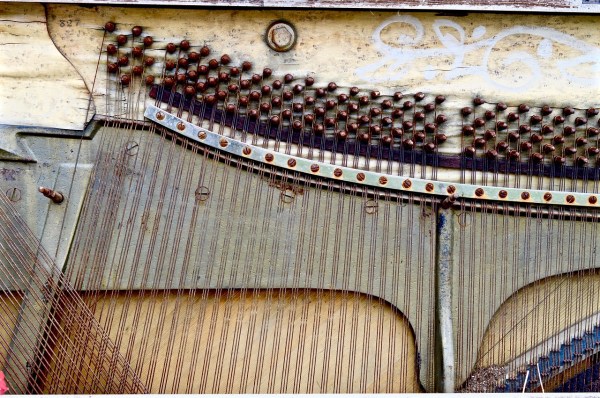
They are locked in stalemate, eyeing each other like a couple drawn together by some mysterious logic at a dance. He doesn’t trust himself to break the ice; she, the well-schooled piano, must not speak until spoken to. She stays demurely silent, burying the complex passion of which she is capable, hiding it in the stillness of ivory and wire.

He is only a boy, and she is older than she looks. He fears her, fears what she knows, what she has heard, what she has spoken under the caress of other, more skilful fingers. His hands are big and clumsy; the afternoon stretches out before him like the soft skin on a mug of hot milk. He wants to break it, break the white silence where his own reflection floats, close his eyes for ever and make her sing the black jagged music in his mind. He spreads out his fingertips, stroking the surface of her keys without depressing them, looking for a handhold, a place to start.

He dare not touch her. He is afraid he will hurt her, hurt himself. He lifts his hands, his throat constricting. He can hear it in his head, feel it like an ache, a heavy anguish in his skinny chest. He hums it under his breath but he can only make one note at a time, and there are more, many more, flocks of sound like wild birds migrating, harmonic, aerodynamic. The wings of the song beat in his brain, and the piano hears, and stays mute, waiting. The stillness thickens.

A sudden noise outside shocks them both and they come together in a dissonant clash, his hands tensing into claws on her keys. Outside beyond the window a group of children freewheel down the hill in the late afternoon sun, their bicycle bells exuberant.

Indoors, the white silence fractures into colour as the sound spins out of control, and the quiet boy forgets himself.

She vibrates inside even as the hammers fall back. He listens to the random noise as it dies slowly towards silence, feels it under his hands as his fragmented face comes back into focus. In the new stillness he smiles and spreads out his fingers.

And this time she yields to him, plays with him, croons the timid notes he tries. The slow swell begins and he moves with the current, letting the notes break over them both. The sounds roll and surge like the sea. As the sun begins to drop below the horizon his hands grow more confident, his head lifts, and something like music pulls itself together in the gathering dark.

CLARE O’BRIEN has been a schoolteacher, a journalist, PA to a professor, press officer to a politician and social media manager to a rock star. She lives in Scotland, by the sea, where she’s currently at work on her first novel, ‘Light Switch’. Her work has appeared in Mslexia, Spelk, Hedgehog Poetry, Northwords Now, Dark Marrow, Cabinet of Heed, Riggwelter, and more.

Cabinet Of Heed Contents Link 25

Image via Pixabay

Infinite Rainbows – Dan Brotzel

People sometimes asked Rick if he travelled for his work. It was a question he kept meaning to tuck away for use at the next barbecue with the neighbours, when he always struggled to come up with new small-talk prompts that he hadn’t used at the previous barbecue.

Yes, I do actually, thought Rick. Last week I was in Doncaster and Reading. The week before it was Slough and Swindon. I’m also often in Glasgow, Bromley and Hull. Rick travelled to clients and prospects, criss-crossing the country to lead workshops and support on pitches, to attend tissue meetings and wash-ups and beauty parades and blamestorms. As a result of all this, he spent a lot of time in trains, and had come to some fixed conclusions about London stations.

He was dutifully tolerant of Victoria and its eternal building works, as one might be of an elderly mother, since it was the London station of his childhood. He was as stupidly charmed as any tourist by the faux village set-up of Marylebone. He was warily amused by Liverpool Street, with its City sass and vim, like a dad with a boisterous teenage daughter who is on the verge of eluding him forever. He was bored by Waterloo, wilfully under-impressed by the new Kings Cross, but quietly amorous of bohemian St Pancras, with her pianos and her clandestine continental connections. He was intrigued by Fenchurch Street, station of mystery, since he had never been there.

But Paddington, brash and expansive and unhelpful, oppressed him. With its perverse signposting, its absence of sightlines, its long walks between connections, its barriers at the wrong end of platforms – with its refusal, in short, to act like a proper station, Paddington could fuck right off.

At the cafe where he chose to wait for his train, queue-forming protocols had become ambiguous. A pair of bridge-and-tunnel types — two middle-aged women with silk scarves and floral luggage — stood at right angles to Rick by the counter. They had clearly got there first, but to the untrained eye it might have seemed as if they had already been served, or as if Rick was trying to get in ahead of them. One of the women flashed Rick a look of such scandalised hatred that he fell in love with her at once. He flashed back a smile of exaggerated obeisance — offering a comedy medieval mime to indicate his deference to her and her friend’s advanced queue status and nobly refraining from pointing out their eccentric positioning, which to his mind had caused all the trouble in the first place – and began plotting ways to kill them with kindness.

But no. He would not go there; he was stressed enough about the day’s workshop already.

He took a deep breath. It was easy to forget that there were people who travelled by rail for the fun of it. On inter-city trains in the daytime, after all, the world of work ruled supreme. People marked their table-top territories with the full panoply of laptops and headphones, expensive travel mugs and stationery porn. As Rick walked through the carriages, he saw people casually parsing Rosetta-stone spreadsheets, constructing lengthy passive-aggressive emails with highly politicised uses of cc-ing and bcc-ing, compiling turgid slidedecks in which the projected figures for the next Q are always somehow trending up.

And above all he heard them, braying and wheedling and bossplaining on their phones, as they dressed down junior team members, sold toasters by the thousand, discussed their chances of winning seven-figure contracts, and snarked at their agencies in heated conference calls. (‘Has Carrie actually signed off on this iteration, Jay? The user experience is about as far away from elegant simplicity as it could be, it really is.’) And they did it all with unselfconscious ostentation, Rick noted, often involving the whole carriage in their drama.

He was wearing a new shirt. Out of the packet, it transpired to be so blindingly white and starched and sharply creased as to appear the very opposite of smart — like crap fancy dress in fact. (He remembered randomly that he was still someone who didn’t know what ‘diffident’ meant.)

There was a lot riding on the workshop with today’s client, a leading global provider of something something investment solutions. They reportedly had a big budget, and an appetite to do lots more if today went well – but also, at the same time, a cheerful acceptance that if nothing got done for a very long time, that didn’t really matter either. They didn’t have a clue, as far as he could see, and they were utterly unaware that Rick didn’t have a clue. They should, in short, have been the ideal client.

Except that, rather than wallow in blissful ignorance, the client had been led to believe (not least by Rick, alas) that he and his company had the knowhow to lead them out of the wilderness. They kept deferring to his judgement, terrorising him with their childlike faith in his abilities. Rick had clearly talked far too good a game at the pitch, because here he was now, trapped in a room with a load of Senior Global Something Somethings, all of whom expected to be dazzled by the strategic brilliance of a man who had never understood what strategy actually meant.

Rick wondered, and not for the first time: Do other people really approach these meetings thinking, ‘I am a powerful agent of transformation!’ and ‘Today I will be mostly smashing it!’ and ‘Time to board the Change-Train, people!’ Rather than, say: ‘Do we have to do this?’ or ‘Can’t this all please go away?’ or ‘Would you mind counting me out?’ or ‘Wish I was dead’? (Asking for a friend.)

The warm-up hadn’t gone too badly, at least. Rick got everyone to go around and share a fact about themselves that no one else in the room knew. One woman had once shared a taxi with David Beckham, another was a secret crochet fan; the Head of Something Insights revealed that he had never tried Weetabix.

They were not long into the meeting proper before an unspoken consensus emerged that the pet phrase of the gathering would be ‘To your point.’ Every workshop has a pet phrase, Rick believed, and this one was good enough to add to his elite store of meeting staples. It was right up there with ‘What does everyone else think?’ and ‘Shall we take that one off line?’ and ‘That’s not a sentence I expected to hear today!’

Beginning your remarks with ‘to your point’ flattered the addressee that you thought their comment had been worth returning to and developing. It convinced the person who said it that they were a master of logic and joined-up thinking. And it flattered everyone by making it seem that the meeting was not actually just another cosmetic rehearsal of stale platitudes, but was instead a lively and creative symposium in which the powerful thoughts of great minds could be seen to develop and progress towards important, actionable conclusions.

But on top of all that, the very greatest thing about ‘to your point’ was that different people’s contributions didn’t need to connect together in any way at all:

‘I’m not sure if we know enough yet about who our clients are, or what their true pain points are.’

‘To your point… I really wish we’d stop using that teal colour for the background on our Twitter quote cards. I know it’s in the new brand palette, but it just looks a bit lurid to me.’

After lunch Rick began again with another mini warm-up. He got everyone to say whether they preferred Breaking Bad or Game of Thrones, and to give reasons for their choice. All was going swimmingly till they got round to the Chief Something Officer, who insisted that she had never watched either and would rather talk about Mad Men Instead. Rick the mild-mannered socialist fumed. Honestly, he thought. It’s one rule for them and one for everyone else…

While Rick toiled with his meagre tools of war — his slides and his whiteboard markers and his blue-tacked flipchart sheets – he noticed that an entire aspirational lifestyle was popping up outside his client’s window. It was a Friday afternoon, and for some the weekend was beginning early. Bars spilled out onto terraces, and the balconies of loft-style apartments were suddenly full of loafing urbanites supping chilled prosecco as they gazed out over the children splashing with loud pleasure in the fountain of a bright new public square. The fountain boasted a sheer-flowing water feature whose metallic planes glinted infinite rainbows in the swoon and sheen of the afternoon’s unexpected sunburst. Paddling barefeet, a pair of young lovers kissed for the first time.

Around the square, slogans asked: ‘What are you thinking right now?’ and ‘What if you just took a moment?’ and ‘Isn’t life amazing?!’ A sign flashed up: ‘Giggle. Wonder. Breathe.’ In one corner, a police horse stood magnificently still, preening with proud muscularity as its officer brushed and stroked and sluiced it down. A small crowd of appreciative children and mums had gathered to enjoy this blessed moment.

Back in the room, the Post-It notes were wilting in the heat and dropping from the walls. Rick’s deck had got stuck on a slide which said only, ‘Strategy: Why → How’. It was a slide Rick had devised in a moment of insight many moons ago, but which now blinked back at him, blank and surly.

The sun beat into the room unpleasantly. Rick reflected that if he had set out to wear a scratchy, starchy shirt designed for the express purpose of showing up the starkest possible contrast between the non-sweaty and the now all-too-sweaty areas of his body, areas which of course spread out from under his arms but also now included a growing patch in his upper middle chest area plus, he could confidently surmise, a linear vertical stripe running down the centre of his back… well, this would have been that shirt.

No matter. One of the assembled clients – the Assistant Something Account Something – was now enjoying his sixth or seventh epiphany of the hour.

‘So I guess what you’re saying is that, essentially, in a sense, our strategy should, in a way, be, kind of, no-strategy?’ It was the young, eager one, the one who always tried too hard. He had got Rick out of several tight spots already that afternoon, because although he wouldn’t shut up and had no idea what he was saying, the rest of the group felt obliged to respect his input, even though the conversation had digressed and even regressed on several occasions thanks to him already.

‘To your point, that could be exactly what I’m saying,’ said Rick. Was he? He certainly liked the idea of the follow-up work from the workshop involving the development of a non-strategy. But just then his highly-attuned client sensors picked up a micro-grimace from a more senior stakeholder.

‘Or not?’ he added, hastily. ‘What does everyone think?’

It had turned into another classic flop-chart presentation*. But thankfully it was too late and too hot for anyone to care.

As he was making his way through the client’s security gate afterwards, Rick compiled a quick obituary of himself. He was a man who was born, assembled some garden furniture, and then — to your point – died.

In his bag, he still had the birthday card from his 45th. They were studiously low-key about birthdays in his office, and his had fallen on a weekend that year. He’d come in to find a card on his desk, and decided to see how long he could go without opening it. All day as it turned out; no one mentioned it at all. When eventually he did look, not long before home time, it was to discover that only three people had signed it. Out of spite, he deleted his comedy all-department thank-you email about how he was adjusting to hitting the big three-oh.

After a much-delayed journey home, during which he had to deal with three heated calls, a provocative text and six pointed emails from his boss, Rick arrived back in London to discover that Paddington was still there, gurning sarcastically at his crumpled suit and absurdly heavy laptop bag.

Next morning, at breakfast, he was taciturn and morose. His mind teetered helplessly on the hair-trigger of irritability. The children ignored him.

‘I don’t know why you bother to join us for these meals,’ said Lorna. ‘It’s obvious you’d rather be somewhere else.’

I can choose how to respond to this situation, thought Rick. It’s entirely within my power. I can be aggressive if I choose… Or I can be passive-aggressive.

He looked up, suddenly inspired. ‘Now that’s not a sentence I expected to hear today!’ he said. ‘What does everyone else think?’


* Flop-chart presentation: A presentation using pretty graphs and fancy animations to mask an absence of any real ideas or useful information.

Cabinet Of Heed Contents Link 24

Image via Pixabay

At The Bottom – M L Noonan

This is what it feels like:

You are falling.

You’ve been falling for a long time down an ever-darkening hole. At first, your descent was a gentle downward drift, like floating, but now your speed calls to mind the words ‘terminal velocity.’

If someone were to ask why you’re falling, how you came to be here, you would only be able to say that you deserve it. The details are complicated, and fuzzy. All that matters at this moment is what’s coming.

This is what it feels like:

You’re a rustic, hand-thrown stoneware mug with a durable glaze, stained on the inside from years of coffee and tea, a few small chips along your rim, containing the sludgy remnants of yesterday morning’s coffee.

You are falling.

As you tumble through the air, you spill the bitter liquid over your sides. It splashes across the linoleum floor, sending drops flying onto two people standing nearby, staining their pants. One watches helplessly. The other will be oblivious until you land with a sharp crash. Later, both will fret over whether the spots will wash out while asking each other how this could have happened. You were so sturdy. You weren’t even close to the edge of the counter. It doesn’t make sense.

This is what it feels like:

You have time to think, I’m falling and I’m sorry.

You feel yourself emptying out, everything draining away to leave you hollow. You focus only on what’s coming, the inevitability of it, the necessity.

As the ground rises to meet you, fear arrives. Not the piercing terror of facing a grizzly bear in the wild, but the dull anxiety of walking into a dark, unfamiliar room. You brush this away and settle into a numb calm, become an open ocean beneath a heavy blanket of dead-still air. Acceptance.

In the final fraction of a second before impact comes a flash of relief mingled with a mournful yearning as vast and deep as the universe itself.

You shatter.

This is what it feels like:

You wake to find that someone has put your pieces back together. You feel every crack, the stiffness of the glue, the weakness of your structure. You’re whole, but you will never be the same.


Cabinet Of Heed Contents Link 24

Image via Pixabay

Super Sensitive To Sound – Jim Bates

“Alan, help me,” Jeremy panicked, pleading with his eyes, beseeching. “I’m scared.”

I reached for my lover and held him before turning to Janet our hospice caregiver, “Could you please give us a moment.”

She, like me, knew the end was near. She nodded and quietly left the room, the bedroom Jeremy and I had shared for over thirty years. Even though he couldn’t hear me, I whispered in his ear, “I’ve got you, my love. You’re not alone.”

He squeezed me tightly, kissed my cheek and then closed his eyes, body relaxing. I could barely feel his faint heart beat, but it was there. He was still with me.

Jeremy used to be, in his words, “Super sensitive to sound.” When I first met him, he was wearing headphones and my immediate thought was that he was just some weirdo living in his own world, listening to baroque music or something. I was wrong.

“Here’s your package,” I said, handing him the large envelope, ready to run off to my next delivery. He removed the headphones and said, “What?”

I repeated myself, starting to get irritated. The courier service paid me to make deliveries, not waste my time trying to explain the obvious. “Your package?” I stated.

“Oh, yes, thank you. Thank you very much,” he said, politely. “I really appreciate it.” He smiled at me with bright white teeth. He had a thin build, close cropped beard and hair, piercing blue eyes. Physically, I was attracted to him right away. “I’ve been waiting for this.”

I was suddenly curious. “What is it?” It felt like a manuscript of some sort.

“It’s a rough draft of a novel.” He smiled shyly. “I’m an editor.”

I was intrigued. I loved books and reading. I was still in college, working on my PhD in literature and writing my thesis. We got to talking (courier quota be damned) and immediately hit it off. Six months later I moved in and we’ve been together ever since, nearly thirty years.

Now this.

I must have held him for an hour. Janet stopped in often to check on us. “Just stay with him, Alan. He needs you.” She didn’t have to ask twice.

The room was peaceful and quiet, far different from the world Jeremy was accustomed to living in. He heard everything exponentially; noises I took for granted drove him up the wall. He heard the refrigerator running at night even though it was in the kitchen and we were in bed upstairs. He heard normal sounds like traffic in the street or an airplane flying overhead ten times louder than normal people, and the noise gave him headaches. Bad ones. Nowadays he might have been called autistic. I don’t know about that, but I’ve always felt he was unique and quirky and I loved him all the more for it.

He wore the headphones to dampen noise and they worked well, but a few years ago we went on a picnic in the park near our home and I convinced him to take them off. “Just try it, Jeremy,” I said, “Give yourself a break. Listen to the world the way it really is.”

He cautiously removed them and listened. Birds were singing and children playing on a swing set were laughing. A boisterous pickup game of basketball was going on nearby. Even though I knew the noise was painful for him, I could tell he was entranced, mesmerized. After a few moments he grinned and spread his arms wide. “It all sounds beautiful.”

He started wearing his headphone less and less after that. Even though he still got headaches, he was determined to live life to the fullest. “To listen to the sounds of life,” was how he put it. By the time the tumor had riddled his brain he’d ditched them completely and was learning to live with his painful headaches. He never complained. He was incredibly brave. Now the tumor had robbed him of the ability to hear anything. The irony was almost too much to bear.

I felt him stir in my arms. I sat up and looked. His eyes were open so I massaged his shoulders, “How are you doing?”

He smiled. Now completely deaf, I could tell he was reading my lips. “I can’t hear you, but I’m doing all right. Hold me some more.”

I did.

Maybe we both drifted, lost in old memories, but suddenly he was gripping me tight. “Alan. Alan!” he called out. He had tears in his eyes.

I held on. Tight. “I love you,” I told him.

“What?” he asked, holding me close.

I yelled in his ear, “I. Love. You.”

“I love you, too,” he whispered.

We embraced with all the passion of our lifelong love for each other. In a little while his breathing slowed and his heart beat faded. Then, with one final exhale, he passed on.

When I felt him slip away I screamed, “No!” Then, again, “No!”

Thankfully, Janet gave me a few minutes before she came in and together we took care of what needed to be taken care of.

An hour later she left me alone one last time and I sat on the bed with Jeremy. Outside, in spite of my sorrow, I could hear the laughter of children playing and the melodic songs of birds singing, sounds in the last few years Jeremy had been listen to and learning appreciate for their own beauty.

Those sounds suddenly gave me an idea, one last joy we could share together. I went to the window, opened it wide and let the noisy world drift in, filling the room to overflowing. I went to the bed, sat down and took Jeremy’s hand, leaned in close and whispered, “How about if we listen to those sounds of life one more time? Just like we used to?”

And together we did. They sounded beautiful.


JIM BATES lives in a small town twenty miles west of Minneapolis, Minnesota. His stories have appeared in CafeLit, The Writers’ Cafe Magazine, A Million Ways, Cabinet of Heed, Paragraph Planet, Mused – The BellaOnline Literary Review, Nailpolish Stories, Ariel Chart, Potato Soup Journal, Literary Yard and The Drabble. You can also check out his blog to see more: http://www.theviewfromlonglake.wordpress.com.

Cabinet Of Heed Contents Link 24

Image via Pixabay

Just A Bead – Pauline Duchesneau

A hollow white streak pierced the lone glassy obsidian sphere. Inspiration lagged, defying
limitless options. What purpose? What message? Or concept? Another time, in another mind, the
manifestation would appear. But now, the depth of the glossy black equaled the stagnated
innovation. No epiphany rescued. Absent craving tormented. Meaninglessness reigned. The void
expanded and enveloped, created nothing from more. Apathy thwarted as distinctly as the point
of the unthreaded needle without a goal.


PAULINE DUCHESNEAU’s writings of various sorts have appeared in Dime Show Review, Pilcrow & Dagger, Adelaide, Riggwelter, and Rosette Maleficarum, among others. Her first novel of magical realism seeks its final draft. Pauline heaps loads of thanks on her supportive wife and their ever patient beagle.

Cabinet Of Heed Contents Link 24

Image via Pixabay

Ylem – Mehreen Ahmed

Her name was Andromeda. She swam on satin water. Lapped up in the silk, her mind was restive. Her thoughts were agile, but discrete and non-linear. Absorbed her musings, her dreams were clear. She swam in them, out of her depths, just as well, they kept coming back. Braided in and out, oscil-lating, and edgy, they chased her almost, inconsequentially. In a way her swim impeded, these half-formed thoughts, writ on water’s hem.

In the aftermath of the war, random bodies floated. Down by the stream which eucalyptus skin coated. Covered by stringy barks, pale faces were spotted. The enemy gloated; bodies were quite bloated. Marked with agony, of the swollen bodies, some eyes shut, peculiarly, some were still open. Her focus turned in a moment.

She sat next to her mother. They chatted in an oval room, mother and daughter. Her mother looked fresh and young, way back, a maiden. Andromeda was born much later.

She asked.”Where have you been all this time?”

“I had been out to a conference,” her mother replied.

“How did it all go?”

Her mother answered, “Very good. All was good.”

“Ah, but I missed you. I really did.”

Her mother smiled. Father entered the room. His handsome face was radiant, the atmosphere lightened. Mother rose to offer him her chair. But father took a stool, sturdy and bare. Father died nearly a decade, Andromeda thought, in retrospect. The room darkened. Over the water, bold and low, fluttered a lorikeet, a flying rainbow. It seemed it was going to gouge her eyes. But the sprightly bird frolicked, passed her elbow.

The neighbour, who like a father, died indeed. She went to his funeral with a wreath. Then he dropped by to meet her that night, this reverie, held her cheat tight. When she asked him,“Have you seen God?”

“No,” he replied. This, a silent place.Where am I? This present moment. Vast, and void, this light space, offers no air. Did I die? Am I really dead?”

“No, God then?” she asked.

“Where is He? He hasn’t come to meet me, yet,” said the respondent.

“Do you miss us?” she had asked.

Tears in her dreams, she felt surreal.

“Yes, I miss your aunty,” he answered, then he vaporised like a collapsed star.

A fusion of elements, hydrogen and helium, led to the birth of a cosmic star. The helium ran out. Star collapsed. He collapsed. She saw the neighbour, driving his car; through the suburbs of his choice, with his wife, whom he referred to, as aunty. The chemicals conferred. An accident oc-curred. He died. Of her dreams. Finite lives made of infinite gasses. Of the cosmos, of the elements, life perished. Andromeda contemplated, the stuff of life. This precious breath, did it not live outside the orbit of death? Helium, and hydrogen, oxygen, iron and zinc.

Mountain passes were rugged. She walked through the terrain. A storm picked up, she looked for a spot. She found a cave. In the dark shelter, she sat amidst litter. A lightening fell outside. That creepy light, opened her mind to shadows below. She was not alone; somebody there. In a flash, the shadow disappeared. She was out of her wits. She tried to sleep. Just when she saw some cave paintings. On the wall, they looked ancient. And they were, ancient. In a bit, she saw a little boy. A broken charcoal in his hand, he sketched stirring stories, like the fall of Troy. He lit a small fire.

Lights emanating from the fire helped, this sentient boy, to see better. He drew stick figures of many shapes and sizes: tall, short, men, women and children. It was almost dark, on the rugged wall, shape of the boy silhouetted in the moonlight. Floodlights in the dark cave, paintings of tall tales, some washed up partly in the rain. Segment of a story, like this painting of an alley, people walked through with missing hands or hair. Many even defaced, in the falling rain. Colours ran down the leaves of trees, and turned them into lighter shades of green. Pure paintings filled the dingy walls, and onto the floor, some scribbles crawled.

Gallows hung without much peruse. Kings devised a horrendous ruse. Spilled blood into the soil to infuse. Children sacrificed, for fertility of the soils, far better use. Heavy harvest at stake, people kept quiet, no one to refuse. Little boys to be taken, gods to be appeased. Telltale signs of ominous days. The King’s men marched, and dragged the boy away. Off to the gallows. Off with his head. The artist, little boy, broken into shreds. In white loincloth, wrapped around his waist, the boy’s gaping horror, clouded his face. His small hands trembled. She looked through a portal. Tears, and cries of the innocent sacrifice. No one took pity at the bloody altar. Wounds remained unaltered. Cosmic parameter, a stern factor.

Flashbacks played wistful memories, she lay on a beach a mere bystander. A silent witness to the many silken dreams, lovers entwined a beautiful beginning. Sunken sands, in waxed moonlight. Of the mandala, an ephemera, imperfect finale of the drama; done and redone until time had spoken, given up on the beach, a part of resurrection. In the hours all became sand, quintessentially minus-cule, and indestructible. In the heart of it, each wave flow, atom of H2O.

Over those swelling waves, she boarded a pirate ship. And saw a thousand vessels, a war imminent. On the horizon, a ship appeared like a phantom. A skeleton of a ship, spectacularly luminous, shone in the lantern. There was a gunshot fire. She was hit. Oh! It hurt! She was hurt. She felt the pain of the gunshot. But she lived. She saw ships pass by, while her own cruised towards the nearest beach; sea-gulls, scoured the skies. Sands, the most wondrous, where monks built palaces, and played Kings and Queens. Of a greater imagination, ruled by them, the three Moirae sisters. Monks made mandalas, painstakingly intricate, human history and destiny pleached. Giant pyramids erected with care, and the Taj-Mahal, The great Ozymandias. The King of Kings, his life sized statue pitched on the beach. Immortalised in the scroll, the statue awash, the mandala destroyed, flattened to the ground.

The hollow sand; into the sand, she buried her legs deep to the waist. A hybrid formed of part sand and part flesh. At its best, a mermaid tail; she lay half covered under the clay. High on her imagina-tion, her dreams displayed, decrepit old castles’, windows’ deep splays. Such was the beach, on the edge of which, the tireless seas creased. Where romantics rode unicorns, nomads wild horses, Homer, churned verses, now deplete.

Time’s most valued, gift offerings to gods, watched this once how their altars burnt? Stars burnt out. The sun burnt. This gleaming altar made out of gold; plush gold clouds, nestled the thrones. A toy boat marooned, on gold-plaited sheet, uncertain of directions, an aluminium plate; hot liquid gold, poured into the mould, this sea basin, replete to the brim. Gods’ own altar, never to erode, shimmering and sure, until pilgrims came home.

Andromeda swam, a big hand bagged a snake. There was a man though towards dawn. He told her this, expressed a wish that he wanted to leave, to be born again.

“Born again?” she asked.

“Yes, that is possible,” he said.

“Impossible. Because in order for you to remain what you’re, you need genes from both par-ents.”

“It is possible, though,” the man said.

“What about your wife?”

“What about her?”

“Does she have a say in any of this?” she asked.

“Probably not.”

The wife loomed. But she didn’t seem to mind. She heard his desire. So, she did not hinder.

On a fevered night, in one short month, the man left for a forest, of illuminated fireflies. The blue forest sparkled, a pathway was strewn, with sprinklings of fire ubiquitously flown. Around tall trees and slim short bushes, he walked alone through a lucid forest. A forest transformed into a conduit, this hermit of a man, roamed its bended unit. Reincarnation on his mind, soul in another body, stars in the sky, twinkled a smile.

Here she was, with this lady in white, appeared in her dream, that’s how it transpired. Some sy-ringes in her hand, wet lips in betel juices, glowing with health, she stood at her bed. Holding them out, those long syringes, she knocked into her some worldly senses.

“Your mother’s injections.”

“What?”

The lady vanished. Her mother had run out of insulin and was on the brink of a disaster. The lady had come to tell her this, to ask her if, she could get her some insulin. Andromeda’s grand-mother, this dear lady, kind and Godly, rests now sadly. The silken waters blanketed her skin. Her swimming undeterred, held her by a spell. This undying chemical, once produced within her organ, the failing pancreas, now injected for survival.

“I’ve come to say goodbye,” it seemed he taunted. She looked at her brother, then understood his intent. Upon waking, she found to be true, that this saintly priest had passed away too. This dream-land, not entirely unreal, of sense perceptions, a world parallel. Sights sounds and smell, shaped up to be real, pain compounded a curious blend.

Disjointed thoughts came to pass. Mesmerising chimera seeped. Tantalising glimpse, of enormous replica, as shaded entity. Who’s to know, what’s with the truth, this wakeful life of actuality? A dream within a dream; doll within a doll, within a doll, the picture awry, always off limit. That cave painting in the rain, defaced people walked up the streets, the greens washed off. Waters dribbled over, of a partial reality, conceived by this artist in utter antipathy.

Such fragmented cognisance, manifold layered dream, alluded to allegory of the cave theme. Half a dream, a broken thought, the unfinished story, manifested to Plato’s shadow reality. This palpable existence, transcended truth, hinged on puppeteers beyond familiar scope. Answered with certitude, flung within the stars, lay a larger image, the fate of the universe. The long and short of it, dismantle the stars, dismantle Leda, a sense of foreboding descended Andromeda. For, “It is the stars, The stars alone, that govern our condition,” Shakespeare foretold


MEHREEN AHMED is an internationally acclaimed author. Her books, The Pacifist, is “Drunken Druid The Editors’ Choice for June 2018″, andJacaranda Blues,”The Best of Novels for 2017 – Family Novels of the Year” by Novel Writing Festival. Her flash fiction, “The Portrait” chosen to be broadcast by Immortal Works, Flash Fiction Friday, 2018. Bats Downunder, one of her short stories, selected by Cafelit editors for “The Best of CafeLit 8, 2019”.

Cabinet Of Heed Contents Link 24

Image via Pixabay

What I Loved About Barmouth in the Summer of 1986 – Steve Campbell

It wasn’t being woken before the clinking of milk bottles and getting crammed in, five abreast, across the back seat of our car as the smell of manure wafting in through the open windows, or the crawl behind an endless caravan of caravans, counting sheep to pass the time, it wasn’t the plastic shopping bag my brother filled with vomit that sloshed about in the foot well or the monotonous games of ‘I Spy’ and ‘Spot the Yellow Car’ that caused us to bicker and sulk instead of entertaining us, it wasn’t the wind-ravaged tent that we wrestled to erect, handed down from relatives who’d upgraded to a deluxe eight-berth caravan or the continuous Welsh driving rain, that somehow felt colder than English rain and found every hole there was to find in that tent, it wasn’t the missing bulbs of the tired illuminations that lined the promenade, or the cackling seagulls that dive-bombed us whenever we ate in the open air, it wasn’t the siren-blaring fruit machines that devoured every last penny I’d scraped together doing chores over the previous Winter, or the five out of seven days where the weather forced us to stay in the tent and play card games over and over and over again, it wasn’t the cows grazing in the neighbouring field that kept us awake at night with drunken moos, or clumps of sand that got everywhere and made applying suncream, changing clothes, showering and eating, crunchy, it wasn’t the rough pebbles that we had to clamber over, making monkey noises to reach the only square metre of unoccupied beach, or the dog turds we discovered buried a few inches beneath the sand’s surface. What I loved about Barmouth in the Summer of 1986 was that one Saturday afternoon, before we packed up to leave, where the smell of freshly cooked doughnuts dragged us into a shop and we came out with our lips coated in sugar and clutching oil-soaked paper bags brimming with fried batter, it was the afternoon where the clouds were nothing more than a whisp and couldn’t prevent the sun from browning our shoulders and raising freckles across our noses and, enmasse, everyone on the beach squeezed into swimsuits or rolled up trouser legs to feel the sea against their skin, it was the afternoon where the water was as clear and bright as any exotic location Judith Charmers visited, so much better than Tenerife or Florida or Devon or wherever my classmates would be bragging about when we returned to school in September, it was the afternoon of skimming stones until my shoulder aches and making a dam to stop the sea from coming in with a group of children I’d never met before, and would never see again, but that didn’t matter, it was the afternoon where I swam a little way out and lay on my back, waves lapping around me, and all I could see was blue because the sky had melted into the sea and it was impossible to tell where one ended and the other began, it was the afternoon floating close enough to the beach so that I could hear the shushing of waves but also being a million miles away, giggling to myself because I didn’t have the words to articulate how I was feeling, it was the afternoon that was over all too soon but one that I knew I’d come back to, decades later, reclining in a deckchair with a book in hand, I’d steal a glimpse over the pages between chapters and see my children splashing in the same sea, a few yards from the shore and a million miles away too.


STEVE CAMPBELL has work published in places such as Spelk, Fictive Dream, MoonPark Review, Molotov Cocktail and Flashback Fiction. He’s Managing Editor of Ellipsis Zine and is trying to write a novel. You can follow him via twitter @standondog and his website, standondog.com

Cabinet Of Heed Contents Link 24

Image via Pixabay

A Girl’s Guide to Frog Gigging – Mary-Jane Holmes

Arielle dripped duckweed into the yard, a cowl of nutria round her neck strung up by their angry orange teeth. She’d pulled them from traps sunk along a stretch of marsh she had no right to be in keeping her body low in the water so old Larnaudie, spit-polishing ball bearings by the landings couldn’t get a whiff of her and set to. Every so often, a frog mistook her skirt ballooning across the bubbling algae, for a lily pad and she scooped it up, thudding its head against the alder roots that held the river bank and stuffing it into her knickers, for she knew that snaring water rat was one thing but there was no forgiveness for frog gigging these days.

‘Give me that twine’ her mother said, taking the marlin spike from her mouth, setting it down on the halved cognac barrel that her father had used as a makeshift work bench before he’d left ‘to make his fortune’. Arielle unhitched her brace of vermin, pulled the nylon cord out from under the limp bodies and handed it over. Her mother licked the ends and twisted the splice into the lengths of the skep she was working. It would be the fourth she’d made, the others swinging from the paltry coppice beside the pig huts and the bees yet to colonise any of them. Arielle flinched at the fervour of this fruitless industry when there was so much more to be done; how were they to pay next month’s rent? She was young but she sensed this was a type of craziness deeper veined than Thierry Begoux barking at the few automobiles that growled through the village, or Mathilde the seamstress sewing nightdresses for her kitty.

‘Your brother can practise on those’ her mother said to Arielle’s catch, re-arming her mouth with cow horn ready to de-pith and strop the bramble suckers for the binding. Arielle gathered the wet shag of pelt by the tails and crossed the yard for the house, kicking at the tufty mole-hills sprouting in the lean spring sun. The warmth was welcome, the winter had been raw and with her mother too dafty to oversee the planting, the brassicas and onion sets Arielle had sowed, had rooted shallow, only to curdle in the first hoarfrosts. They’d lived the latter end of the season on pickled cucumbers from the summer harvest, saving the softer conserves – the syrup blanched persimmons and duck fritons for Mother who had stopped eating but Arielle made her suck them through hollowed oat grass.

Her brother Felix was in the larder sharpening knives on the whetstone for his new job at the abattoir, his face churned pink with effort. When Arielle picked up the pretty pearled handle of a tripe knife, he snatched it from her and ran its serrated edge across the downy cut of her jaw. Arielle did not move. She knew that to do so would only flame her brother’s frustration that Mother’s old knives were past honing and that he had to work in the abattoir. She listened to the dull blade scissor at her skin, a sound like crepitating straw. Felix stopped when he saw the coypu and Arielle bolted to the attic stairs shouting back that Mother had said to flush them out good before hanging them.

In the attic, she lay on her mattress tracing the welts rising on her cheek. She closed her eyes and thought of her father who had never sent word, had never sent the money he promised and wished there was someone to help her, knowing she would have to coop the chickens and pull Mother from her canes and baskets before the dew fell. It was then something slipped warm against her abdomen. Reaching under her skirt she pulled out a frog. She held it up by its webby hands and it did not struggle, just hung there, its pale throat pumping. ‘What a wise thing you are’ she said and kissed it, and kissed it knowing for the first time that flush of hope madness brings, and the frog blinked, her eyes as glistery as shining armour.


MARY-JANE HOLMES has won amongst others: the 2018 Mslexia Flash Fiction Competition, 2017 Bridport Poetry Prize and the Dromineer Fiction Prize. She has been published in places such as Best Small Fictions 2016 and 2018, the Journal of Compressed Creative Arts, Prole, and The Lonely Crowd. She is Chief Editor of Fish Publishing, Ireland.

Cabinet Of Heed Contents Link 24

Image via Pixabay

Heterochromia in Charlie’s Living Room – Michael Bloor

On his way to the airport for his early morning flight, Charlie felt shrivelled and cowed. The previous evening, a meeting at the university had been cancelled and so he’d arrived home early, only to find Huw Pryce-White at his ease in an armchair with a whisky glass in his hand. Charlie’s wife, Felicity, had explained (a little too quickly) that Huw had popped round to borrow a book, and she’d poured him a drink while she searched for it.

There had been a pause. Pryce-White, his famous, battered, leather jacket unbuttoned, had simply stretched out in the chair, smiled, raised his glass and winked. The wink was disconcerting, since Pryce-White had one green eye and one brown eye. Closing one eye wrought a complete change in his physiognomy. A number of past female students had allegedly found themselves fascinated by those piercing, dissimilar eyes, to be released only when they were hooded.

Charlie, initially nonplussed, then worked his way through an unpleasant train of thought, carriage by carriage. ‘What was the book?’

Pryce-White had remained silent, still smiling. Felicity supplied an answer: ‘Er, Louis MacNeice’s autobiography…’

Another pause. Charlie muttered, ‘It’s in the bookcase in the spare bedroom – I’ll get it.’

As he climbed the stairs, he recalled a poignant passage from the book. MacNeice, on first arriving at boarding school as a child, had not gone to the toilet for two days, because he was too embarrassed to ask for directions. Charlie knew how that child had felt. After Pryce-White left, Charlie had failed to ask Felicity for directions.

*      *      *

Boarding the Aberdeen-Heathrow shuttle, Charlie was shrivelled once more to find the adjoining seat already taken by a very large, bearded gentleman. But in the event, he proved an entertaining companion – Gunnar, a Norwegian oilman – who had just been dispatched by his drilling company to a place in Africa called ‘Libreville.’

‘What do you know about Libreville?’ Charlie had asked.

‘Don’t know a damned thing.’ Gunnar laughed and signalled for a tonic water and a complementary packet of peanuts. He topped up the tonic water with a whisky miniature from his side pocket.

‘If I were in your shoes, I don’t think I’d like not knowing. Unknown prospects.’

Gunnar shrugged: ‘I imagine there will be someone there to meet me – there usually is.’ He fanned some boarding passes: there would be two more flights to board after he arrived at Heathrow. ‘Maybe I’ll find out something by the time I arrive.’ He laughed again.

‘Does this kind of thing happen to you a lot?’

‘Every once in a while. Before I was in Aberdeen, I was in Azerbaijan. I’d never heard of that place either.’

‘What was Azerbaijan like?’

‘Don’t really know. I was in one of those places… er, “gated community.” Everybody there was in the oil business too. Fancy a whisky?’

‘It’s a bit early for me… but, why not?’

Gunnar produced another miniature from his side pocket, poured half into his tonic water and the other half into Charlie’s plastic teacup. Charlie had never tasted whisky in tea before. He reckoned it was a good combo.

Gunnar asked what Charlie would be doing in London. He was told about the dreary academic journal and its dreary editorial board meeting. There was a pause. ‘If I may say so, Charlie, you seem a little gloomy.’

Charlie stared into the now-empty teacup. ‘Gloomy?? Gunnar, I feel like a man on a beach watching the ebb tide and knowing it will never return.’

More whisky appeared, a half-bottle this time. And Gunnar listened to the story of Huw Pryce-White sitting in Charlie’s armchair. ‘Hmm. Hoo Priss-Vite, you say? A curious name: hyphenated, perhaps? Is he Scottish?’

‘He likes to pretend he’s Welsh, likes to play the hell-raising Celtic Bard, but he’s actually from a place called Blundellsands, outside Liverpool.’

‘Heh. You would like to do him harm, I think?’

‘Dead right, pal.’

‘Heh, heh. I was born in the Lofoten Islands, in the far north of Norway – a fishing community. You know how superstitious are fishermen. My grandfather, he knew many spells, many charms. Also, secret signs – staves – that can be drawn or carved to bring luck. Or bad luck.’ Gunnar paused to top up Charlie’s cup and murmured confidentially, ‘You simply hide the stave among a person’s belongings.’

It was a tough call. Charlie took another swig, thought about it, and then asked politely about Gunnar’s granny.

The moment passed (apparently, Lofoten Island women were bad luck anywhere near a fishing boat. No spells or staves, but she cooked a mean fish soup). The conversation moved onto the disappearance of the Scottish herring fleet. But a seed had been sown.

*      *      *

Two days later Charlie, through his open office door, watched Pryce-White wander along the corridor, into the staff toilets. Charlie snuck quickly into the vacant adjoining office and stole Pryce-White’s famous, battered, leather jacket. That night, he burned the fucker in his backyard.


MICHAEL BLOOR is a retired sociologist living in Dunblane, Scotland, who has discovered the exhilarations of short fiction, with more than thirty pieces published in The Cabinet of Heed, Everyday Fiction, The Copperfield Review, Litro Online, Firewords, The Drabble and elsewhere.

Cabinet Of Heed Contents Link 24

Image via Pixabay

Disasters – Jared Pearce

When the storm kills your cat,
or the cold kills your mother,
or the heat kills your father,
and we could go on to the end,
then it’s easy to see nature

coming alive. But most of the time
we scurry around each other,
leap from another’s shadow,
keep our ears twitched for any
crunch on the pine needles

because it’s people crashing
cars, burning tires, casting bullets,
razing sunflowers. We know
the real deal when we see it.


JARED PEARCE’s collection, The Annotated Murder of One, was released from Aubade last year (www.aubadepublishing.com/annotated-murder-of-one). His poems have recently been or will soon be shared in Xavier Review, Blue Mountain Review, THAT, Adelaide, and The Aurorean. Link and upcoming events are featured here: https://jaredpearcepoetry.weebly.com.

Cabinet Of Heed Contents Link 24

Image via Pixabay

Tessa – Emily Livingstone

There she sits, a queen of death and life, on the chair next to Mom’s bed. Mom has been dead for two weeks, and I’m ready to touch Tessa. Tessa’s chestnut curls have called to me since I was five. Her face is still perfectly smooth, her eyes still shiny and piercing. I’m sweating, I realize, but I grab her anyway, feeling the stiff petticoats brush against me as I carry her.

When I was a girl, I longed to play with her, and Mom always said no. But I couldn’t resist—she would be the perfect tea party guest, the most obedient child in a game of house—I needed her. I took her once, when Mom was lying down, and brought her into the garden to smell the roses. Then, I just sat on the grass, and looked at her, holding my breath as I stroked the hem of her dress, rubbed those delicate fingers. And then, Tessa and I were yanked apart, and I spent two days in my room, listening to the click of Mom’s heels outside the door and the clomping footsteps of Sean, two years older and never in trouble. Mom took me out every few hours for the bathroom, but she didn’t speak to me. When I washed my hands in the sink, I met her eyes in the mirror. They were like dark glass, with no special recognition for me.

I am holding her in Mom’s garden now, and I hear my name. I go red from cheeks to core. I’m a grown woman, holding Tessa in the yard and looking at the neighbor woman.

“I’m Becca,” she says. She’s tanned and thin, holding a watering can and looking at me through the chain link. “I just wanted to say sorry about your Mom. Let me know if we can help with anything—my husband’s Pete.”

I nod, waving at her awkwardly while I hold the doll. Then, I flee.

Mom hated that family. There was the day it rained—one of Mom’s good days—and the kids were out playing in the mud. “Shame on their mother, letting them run around in the muck like that.”

I thought they looked like something out of a children’s book, running, shrieking, floating little boats in a puddle near the swing set. But I said, “Let’s close the curtains. Then we won’t have to see.”

I sit Tessa on the couch and start microwaving a Lean Cuisine, trying to get it all out of my head. Mom. Becca. I keep catching Tessa’s eye. Even now, even when I’m the only one left (Sean can’t be bothered to come back to deal with Mom’s death, just as he couldn’t be bothered to come back and care for her when she was alive), Tessa is distant. She looks through me and past me, past my own death to a time when she can rule over an empire of tidy solitude.

The microwave beeps and I flinch. Tessa looks smug. And then, I know what to do, and I go and take Tessa by the arm so that her body clunks against my leg, and I bring her up the driveway to the street and sit her on the trash bags I’ve put out for garbage collection.

My heart is beating wildly, and all evening, I think of her out there. I imagine tomorrow, when she is thrown in the back of the truck and coffee grounds smear her pale face, and egg yolk sticks to her dress. When she is compressed.

I fall asleep watching TV, and wake to the sound of the truck pulling away. A rush of nausea washes over me, and I go to the window, but the trash is gone. Tessa is gone.

I’m lonely. Lonelier than after the funeral. The only time I’ve felt like this was after Candy. Candy, my secret. Candy, who plucked me from the sidelines of a college party and taught my body to move. Candy, who held me in her arms for weeks and let me hold all her secrets. She left me so easily.

I sit on the couch as Mom used to do, and stare out the window at the neighbors’ yard. And then, there is the little girl. She is carrying a big blanket and a basket, and it’s so much for her, she almost looks like she could fall over. Then, she leaves again without unpacking her picnic, and returns with a teapot, which must hold real water, because she carries it against her chest, right under her chin, and walks very carefully. She unrolls the blanket, and there—green dress, black shoes, chestnut ringlets.

The girl bends Tessa into a sitting position and slowly pours two cups of water. The little girl solicitously holds a cup to Tessa’s little bow mouth, but all the while, Tessa’s eyes look over the girl’s shoulder, fixed on me.

I hold my own oily, stringy, dull hair and pull. My eyes are watering. I take a step toward the slider, then stop. I should never, never have thrown her away. She’s valuable, probably. She’s mine. The girl will ruin her.

I watch the girl speak to Tessa and lean in for her replies. When the tea is complete, the girl picks Tessa up and hugs her around the waist, bringing her inside with all the casual intimacy of a sister.

I pack more things in boxes, but then I have to unpack them in case I’ve made another mistake. It’s around two a.m. when an idea comes and hope coats my tired brain and lets me sleep.

*      *      *

The aisles are filled with cheap, plastic dolls wearing outfits in garish hues and looking blankly out into the fluorescent light with overdone expressions of wonder or joy. How can I possibly get the girl to want one of these? They are nothing like Tessa. They would be all wrong at a tea party. They would drool on the table cloth and spit up the tea. They would crawl away and get mud on their jumpers.

I settle, finally, on a doll whose name has already been chosen by some marketing team. “Mackenzie” has straight, shiny blonde hair and makeup painted over her eyes. She has a denim jacket over a tank top and a skirt that’s repulsively short. But at least she has eyes that open and close.

*      *      *

I knock on the door while I balance Mackenzie’s box on my hip. She’s wrapped in appropriately heinous paper depicting hundreds of balloons rising with snaking, curly-cue strings underneath them. There’s a pre-done, iridescent bow to top it all off.

The mother seems happy to see me, eyes flicking to the box. She invites me in. The happiness doesn’t last long when I explain the mistake—that Tessa belongs with me, that I’ve brought this other doll for her little girl.

The mother gets cold, her face losing its flexibility. “I know you must be going through a tough time,” she says, “but Lyddie’s really taken to the doll, and you did throw her away.” She takes Mackenzie and promises to try.

*      *      *

The girl goes outside later, holding Tessa. She sits on the ground hugging Tessa tight, stroking the perfect curls, and I open the slider slowly, go out there, drawn to them. She hears me, and stands—her face is red and blotchy with crying. She holds Tessa’s head under the chin and shouts, “You can’t have her! She loves me!”

The girl runs with Tessa behind an oak where I can’t see her. A moment later, the door to the house opens, and the mother makes a beeline for the girl. My breath catches. She’s going to get it now. The doll will be taken away. The little girl will be locked up.

The mother scoops up girl and doll and carries them into the house, smoothing the daughter’s hair and murmuring to her. She doesn’t look at me.

My knees feel wobbly. I go inside, to my room. I lie down on the old pink comforter, burying my nose in the mildewing cotton.

I used to lie just this way when I was bad—when Mom put me here. I would go in and out of sleep, and each time I woke up I would try the doorknob, sweaty in my hands, but it was always stuck. Sometimes, I shouted, but Mom never answered. Sometimes, when Sean was home, he would come to the keyhole and yell, “Shut up, Adah!”

Finally, Mom would open the door and say, “That’s all done now. Time to come out.” I’d be so hungry, and Mom would give me a bowl of white rice and a glass of milk. Always that meal. What did it mean?

I can leave my room whenever I like now. When I finally do, I see an envelope lying on the floor just inside the front door. I read the message and open the door.

There is Mackenzie, smiling up at me from her plastic box.

With scissors, I cut into the box, freeing Mackenzie. I hold the doll up and look into her face. Mackenzie looks friendly, open, maybe a little pathetic. Of course, the little girl had not wanted this doll. Of course, she had not been fooled. Her hair isn’t even right. Not even close to right.

My hands are trembling as I plug in the curling iron in the bathroom and use it on Mackenzie’s slick blonde hair. There’s an unpleasant smell, but I bite my lip.

“Beauty is pain,” I tell Mackenzie.

The doll is horizontal on the vanity and her eyes are closed against the heat of the iron. What else? Wipe off that makeup. There must be a way to get it off. Different clothes. I meet my own eyes in the mirror and I see my damp, red face, the wrinkles around my eyes and mouth, my wet eyes. I look back down at Mackenzie. The curling iron has melted part of her cheek and her hair is caught in the plastic wound.

“Come now,” I tell her. “Be a good girl.”

Really, her hair is better, and the curls almost hide the burn.

When I lie Mackenzie down on the welcome mat next door, I think she looks quite well.

*      *      *

The knock on the door is angry—like a movie where they will come to take people away to a secret prison. But I feel a kind of calm return to me. It will only be Tessa, coming home.

But no—it’s the father from next door, gripping Mackenzie tightly by the neck. Mackenzie’s wide-eyed, scarred face thrusts into mine, and I reach for her, only to have her yanked back again.

“You left this on our doorstep,” he says.

I’m afraid. I’ve never had a man mad at me who wasn’t my own brother, and Sean was bad enough. The father is tall and a little overweight. He’s still wearing work clothes, a suit and everything. He is like an old TV father gone wrong.

“You did this as what—a threat? Well, I’ll have you know that if this doesn’t stop—if you don’t cut this out, I will call the police. You leave my daughter alone—and my wife.”

Now, he shoves Mackenzie at my chest and my arms come up to close around her. I’m shaking and I have to pee. I don’t move until I hear the neighbors’ door slam shut.

“There now,” I say, and sit Mackenzie on the couch. I’m still shaking when I make it to the toilet and my bladder lets go.

My legs feel unsteady as I return to the living room. “Mackenzie, quiet down. You’re getting on my nerves.”

I pick her up.

“Why don’t you go and lie down,” I say. “I’ll let you know when it’s time to come out.”

I lie Mackenzie down on the faded pink bedspread, and her eyelids click closed.

I close the door and lock it.

I go over to the sofa and sit, holding my knees to my chest. I turn on the TV and let the programs play and play. Mackenzie wants to come out, but it isn’t time.

There’s a noise from next door, and I’m up, looking out the window. I hear running, stomping feet, then a boy’s low grunt, and a small sound I can’t identify. The brother is on the porch of their house. I go for the slider, and I can hear more happening—footsteps and angry yelling and a girl’s wail.

I fumble with the handle, then I’m outside, and four pairs of eyes are on me. There is the father, red-faced and frozen mid-yell. The mother, kneeling and hugging the little girl around her middle; the little girl, red-faced, too, and crying. There is the boy, staring at me and holding Tessa by one leg, her petticoats all overturned and her poor bare legs exposed, and her hair hanging down, but even worse, her face. Her face is in pieces on the porch—I can just see it from here, through the chain link that separates the yards. The boy glares at me. The mother ushers all of them into the house. Tessa goes, too. Only her face remains.

I moan, backing into the house. I crawl into bed with Mackenzie and clutch her tightly.

*      *      *

Mackenzie and I spend the next few days together. We don’t go out or answer the phone. When the real estate agent Sean arranged for comes, we are quiet and don’t move a muscle.

The night before trash pickup, I’m anxious. Mackenzie tries to comfort me, but she doesn’t understand.

We watch out the window. Finally, the father brings his trash in a black bag up to the curb and leaves it there. When it’s dark, I tell Mackenzie to wait, and open the front door and creep up to the road. I tear open the trash bag and reach through the coffee grounds and liquids and soggy tissues until I feel her.

I take her by the waist and hug her, carrying her home.

Tessa is quiet during the bath, which is a blessing, since the water could get inside her head if she makes too much of a fuss. Much of her face is gone now. The eyes, nose, and most of the mouth are broken away. All that remains is a bit of lower lip and jaw, delicate temples and a touch of forehead at the hairline. Mostly, there is a dark cavity where Tessa’s face was, showing the concave back of her little bisque cranium.

After the bath, when I bring Tessa out to the living room, Mackenzie offers a friendly smile. Tessa has only her bottom lip now, and it can’t smile.

It doesn’t matter.

We are together now.

We eat frozen meals I have stored in the basement freezer until the power gets turned off. We light candles and drink lukewarm tea slowly in the silence, with not even the hum of the refrigerator to disturb us. There is knocking sometimes, but the phone no longer rings.

We get notices in bright colors, slipped under the door. There is more knocking.

We know what to do. It’s simple. We just use the candles—the curtains, the old bedspreads, the couch, they all burn easily, and there is light again, one last time.

 

Cabinet Of Heed Contents Link 24

Image via Pixabay
In Which a Tinker Courts Constable Arlene – Michael Grant Smith

Summertime in Last Chance conjures images of longer days, the constant threat of dehydration, and our annual Dust Festival. Last Chance’s citizens are hardworking humble heroes and we never miss an opportunity to celebrate the community’s leadership in powdered grime production. Similarly, throughout the rainy winter and spring seasons, our mud industry thrives.

The world outside Hubert’s mobile home was the color of old straw. July had wedged itself into the atmospheric layer between pavement and the stratosphere; air weighed nearly twice as much as usual. Frenzied preparations for the upcoming Dust Festival placed a chokehold on the bowels of local authorities.

Constable Arlene dumped beans & franks into a saucepan set to simmer. The can opener’s whine had triggered dozens of cats, whose chorus climbed from teakettle pitch to ultrasonic. Arlene waded shin-deep into the living room, where soft-footed predators also swarmed her uncle’s floor, sofa, and coffee table. Feline breath displaced the alkaline air.

“So, how are you, sir?”

“Me?” said Hubert. “I get by. Better than some, probably.” He sipped his fifth or sixth cup of the day’s black coffee. “Better than your daddy, I expect.”

A light of violence flickered in Arlene’s eyes but she said nothing. Hubert didn’t notice; his attention pinballed itself to remote dates and locales.

“Could be worse. What about the time I kicked dirt over my third ex-wife?” he said, tight-faced. “Nice casket, nice service. She didn’t appreciate it, though. Kept hollering, wouldn’t shut up. Almost ruined her own funeral. Maybe I jumped the gun?”

Hubert shook and coughed. It wasn’t a seizure; he was laughing. After a minute the oldster’s features settled the way custard folds into a par-baked pie crust. He rubbed his tears.

“Never killed no perps when I was on the job,” he said. “Forty-nine years as constable without being shot. Stabbed, though. Just once. The guy yelled at me after because I was still alive.”

“I know, sir.”

Lucidity dealt Hubert a glancing blow. He pointed a finger the shape and color of uncooked breakfast sausage left out overnight.

“You has to stop dating them jailbirds! Aim higher. Make yourself less available. Quit doing kindnesses.”

Arlene’s cheeks burned. In her mind, and unbidden, floated brain-pictures of Dolly Everett’s arched eyebrows and pianist’s hands.

“Just because Councilman Everett’s wife sleeps in the lockup now and then,” said Arlene, “it don’t make her a criminal. She needs to be away from home sometimes…”

“Away from her husband and babies, you mean! Why do you fall for the bad ones, and her all married to the hilt? Pretty little filly such as yourself — some of them gals at Charlotte’s, them what say things, they say your prospects ought to be sky-high.”

“If the staff at Charlotte’s Salon & Barber wants to gab about my so-called behaviors, maybe I need to drop by and verify their licenses are in good order and up-to-date!”

“That’s my girl!” shouted Hubert. He beat the arms of his chair as if they were bongo drums. The cats, boiled by the commotion, resumed their mewling. “Get on out of here, Arlene Candace Nelson, and abuse your office a little bit. It’ll perk you up! Go make your uncle proud — and your famous daddy as well, wherever he is!”

Constable Arlene evacuated herself from the old man’s trailer and fired up her motor-scooter. Gravel ricocheted off sheet metal and pinged the living room window as she twisted the throttle and sped off. Last Chance’s best and only law enforcement officer rode in a cloud of dust, exhaust, and a dark mood. She’d concede one point to her uncle: there was no better tonic than writing a few tickets.

She parked her scooter in the Farm & Fleet’s loading zone; the building also housed Last Chance’s municipal offices ever since the Grange Hall got a termite fumigation tent. Next door, Carl’s Chicken Shack displayed a hand-written sign in its order window:

welcome dusters

no public toilet

Bending to tie a bootlace, Arlene growled at the shimmer of cat hair wedded to her pressed uniform trousers. She licked her fingers and rubbed furiously at the stubborn fuzz until she heard an unfamiliar voice:

“I can make your problems disappear, officer!”

A stranger grinned. He appeared stocky but fit, fleshy yet firm; a bell pepper in human form. Without waiting for Arlene’s permission he ran a tiny paint roller device up and down the furred fabric once, twice, thrice, and the mess was gone, transferred to the sticky rotating cylinder. Meanwhile, Arlene gripped her hefty flashlight in one hand and a citation book in the other.

She drew a lung-snapping deep breath and said, “Sir, you invaded my pants’ personal space. I am fixing to ring your bell but professional guidelines dictate I warn you first.”

The man and his smile both froze right there in the street. His eyes — gentle, lovely ones they seemed to Arlene — grew as big as hubcaps.

“My deepest and most profound apologies!” he said. “I encountered a beautiful woman experiencing garment distress and I could not suppress my urge to assist. Please, can you forgive my presumption?”

“If forgiveness and arresting go together, so do spareribs and soap,” replied the constable, her voice as flat and brittle as a saltine cracker. “Who are you, sir, and what brings you to Last Chance?”

“My name is Durwood Ott. I am a purveyor of essentials, gimcracks, and baubles; a sharpener of dull edges, a singer of songs.” He waved a copy of The Last Chance Gazette & Intelligencer. “News of your Dust Festival has traveled and I came here to ply my trade, or so I believed.”

Durwood removed the battered, wide-brimmed hat from his bald noggin. He extended a hand, which Arlene caught with her own firm grip (contrary to departmental procedure and her own regular instincts). A spark sizzled but no one recoiled. Might have been an electrical jolt of the static persuasion, maybe it was something else.

“Well, now,” said Durwood. “Aren’t you intriguing!”

“A tinker,” whispered Constable Arlene. Her hand felt jazzy. “You had to be a tinker.”

He smiled, mistaking her meaning. “I prefer to say the profession chose me, not the inverse. Perhaps we could take a coffee together? I would be delighted to share with you my life’s story.”

“No, thank you, my official counteroffer is for you to vacate town at once or spend a few days in jail.”

“I did not intend to upset you! How selfish of me…we could talk about your story instead?”

“Mr. Ott, you stand in violation of Last Chance civil ordinance 326-A-2001 Sections 1 through 5, to wit: no hobo, grifter, drifter, transient, tinker, or any other classification of vagabond shall be permitted temporary or permanent residency within Last Chance’s jurisdiction. In smaller words, I am bound to escort you to yon outskirts or invite you to be locked up a spell.”

“May I ask you this: If I am to be incarcerated, will you be my jailer?”

“Yes, sir, it is my swore duty.”

Durwood laughed; not the way people do when a scooter’s front wheel drops into a damn pothole and pitches a constable over the handlebars, but more in the manner of expressing joy. Arlene’s fingers, all on their own, tucked some loose dark curls back up under her cap. The tinker held out his wrists in an unmistakable gesture of Coming Along Quietly.

“You locked up my heart from the moment I saw you brush cat hair from your leg. I surrender myself to your custody!”

Mr. Ott probably had a few regrets during the first few days of his incarceration, maybe missed his freedom or whatnot. As the years turned to decades, however, his affection for Constable Arlene grew stronger. Not once did he petition for release, or attempt an escape, even on weeks she left the lockup door open.

Similarly, Arlene’s fondness for her prisoner stuck like roofing cement. She spent long, pleasant hours in her office chair, adjacent to Last Chance’s fantastically aged and persistently dozing clerk “Frisky” Clinchett, and listened to her caged songbird. Durwood the tinker warbled about traipsing to distant places and having adventures and meeting improbable outcomes head-on. The shoosh of an unseen ocean hovered behind every one of his melodies.

Folks tend to settle in Last Chance and seldom depart, except under cover of darkness or frog-marched by the authorities. Constable Arlene had never left and was certain to remain. Latches of affection slip between gear cogs from low speed to high and in between, a fact known also to Dolly Everett.

Arlene Nelson struggled to visualize the size and shape of her fugitive daddy’s probable prison cell (as if any such structure of stone and metal could contain a legend). She wondered what song former-Mayor Lowell “Fuzzy” Nelson would sing to his only daughter, and whether chain gang sledgehammers could break asunder a big heart.


Cabinet Of Heed Contents Link 24

Image via Pixabay

Parallel Lines – Tina M Edwards

I was a child of the ‘70’s. Growing up amongst bell bottoms and foot long collars, brown and orange wallpaper. It was a time of political change, and one very hot summer. Fleetwood Mac was on the record player and Stevie Nicks was pinned on the inside door of the garden shed.

On the days that dad went to see a man about a dog, I was allowed inside the warm small space. ‘To keep an eye on things,’ Dad said. Make sure Mum didn’t ‘tidy’ the place. When he eventually returned, stumbling and slurring words, we sat in a haze of Woodbine that mingled with the smell of fresh creosote. We were happy then. Me, Dad and Stevie, until mum started banging on about how she always did everything around the house while we had a life of Riley. Whoever he was, he must have been one lucky bugger, because I thought it was us who were the lucky ones.

Then one day Mum decided to get a job, as a Tupperware lady, and almost overnight everything changed. The fridge was full of plastic containers stuffed with carrot sticks and there was no dinner on the table when Dad got home from work. That was when the rumours started, from number 28, that Mum was carrying on with another man. Someone high up in Tupperware. So when she upped and left, one Sunday evening, dragging an oversized brown suitcase down the back lane, I guessed it must have something to do with the Riley bloke.

By the time she came back, six months later, the fridge was full of Vesta curries and Dad had finally brought the dog home. A deaf black and white mongrel with a dodgy back leg who we named Debbie. The shed had been dismantled one night when the coal bunker was empty and Stevie Nicks had been stripped and used to pick up Debbies shit. Dad was growing side burns and ironing his own shirts, and on the record player was Blondie. And all dad said to mum when she walked through the front door was; Pamela, things are going to be different around here now.

The next morning I opened the fridge and found a lone Tupperware container on the top shelf next to the cheese. A piece of paper had been stuck to the lid and read; ‘This is a reminder to never leave things for too long or else they will go off.’

It stayed there for a while until I saw dad remove it after breakfast one morning and replace it with a Vesta curry. He winked at me and I nodded as if I knew. Knew what the hell was happening in the cold space that no one talked about. His secret was safe with me. I’d not let on I’d seen the woman down the road from number 28 shopping in the corner shop, her basket full to the brim with Vesta Curries.


TINA M EDWARDS poetry and fiction has been published in the U.K. and America. She has a penchant for ducks and Cornwall and has been told since childhood she has a vivid imagination. Which is just as well, considering she loves to write. In another life she was probably a Chirologist.   www.tinamedwardswriter.wordpress.com

Cabinet Of Heed Contents Link 24

Image via Pixabay

Create a website or blog at WordPress.com

Up ↑